
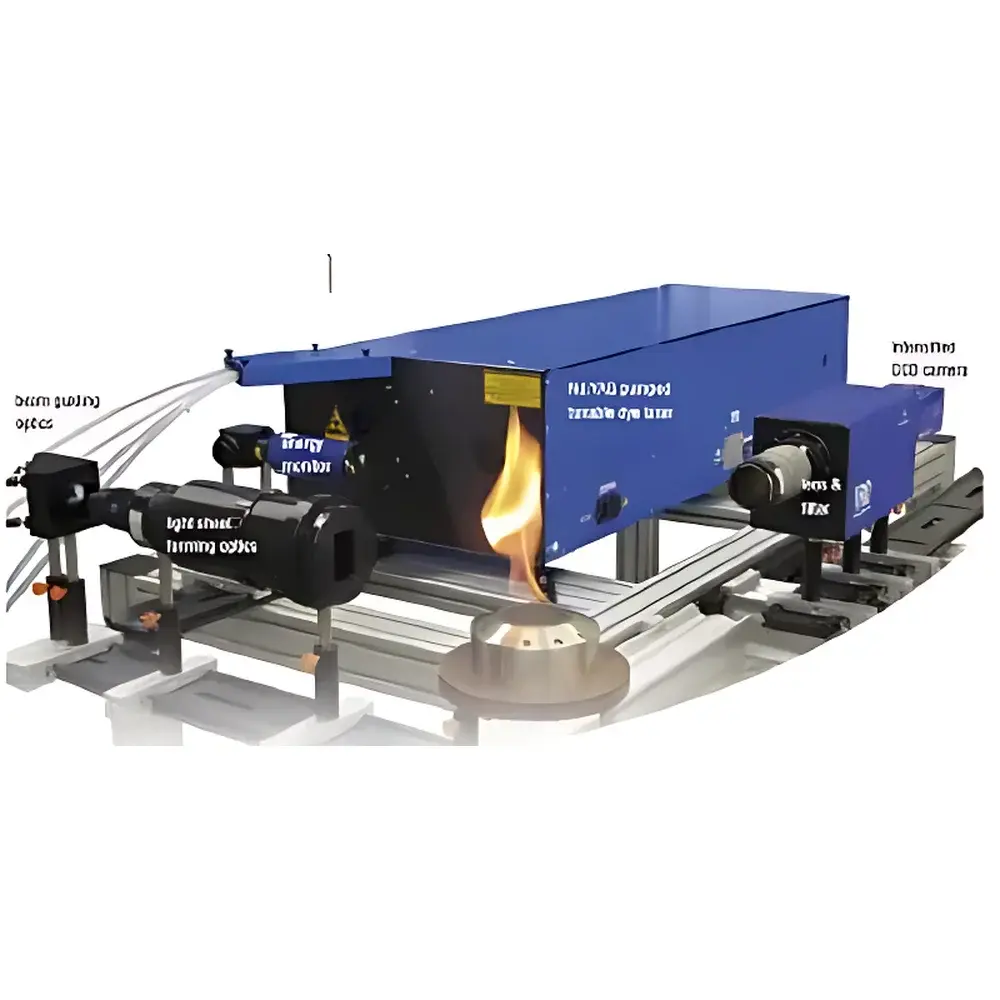
Time-Resolved Planar Laser-Induced Fluorescence Measurement System TR-PLIF by LaVision GmbH
| Brand | LaVision GmbH |
|---|---|
| Origin | Germany |
| Model | TR-PLIF |
| Laser Repetition Rate | ≥1 kHz |
| Excitation Source | Frequency-Doubled Nd:YAG (532 nm), Pumped by High-Repetition-Rate YAG Laser |
| Detection | Intensified CCD or sCMOS Camera with Sub-Microsecond Gating |
| Temporal Resolution | <100 ns (adjustable via optical delay and camera gating) |
| Spatial Resolution | ≤50 µm (system-limited, dependent on optics and pixel binning) |
| Spectral Bandwidth | Tunable via narrowband interference filters (FWHM ≈ 1–5 nm) |
| Compliance | CE Marked, RoHS Compliant |
Overview
The Time-Resolved Planar Laser-Induced Fluorescence (TR-PLIF) Measurement System TR-PLIF is a high-speed, quantitative optical diagnostic platform engineered for non-intrusive, two-dimensional imaging of reactive species dynamics in transient combustion and plasma environments. Developed by LaVision GmbH—a leader in laser-based measurement technology—the system employs a frequency-doubled, high-repetition-rate Nd:YAG laser (532 nm) pumped by a master oscillator power amplifier (MOPA)-configured YAG laser to generate precisely timed, high-energy planar light sheets. When this sheet illuminates target species—such as OH, CH, NO, or formaldehyde—in the measurement plane, resonant excitation induces fluorescence emission. An intensified camera (ICCD or gated sCMOS), synchronized with sub-nanosecond precision to the laser pulse, captures spatially resolved fluorescence signals with temporal resolution down to <100 ns. This enables direct visualization of radical formation, transport, and quenching kinetics across flame fronts, ignition kernels, and turbulent reaction zones—critical for validating high-fidelity CFD simulations and advancing fundamental combustion chemistry models.
Key Features
- High-repetition-rate excitation architecture: ≥1 kHz laser repetition rate supports statistically robust ensemble averaging or single-shot acquisition in unsteady flows.
- Optically synchronized gating: Precise electronic and optical delay control ensures accurate temporal registration between laser pulse, molecular excitation, and detector exposure window.
- Modular optical design: Interchangeable wavelength-selective filters (1–5 nm FWHM), high-transmission plano-convex optics, and adjustable beam shaping enable rapid reconfiguration for multiple target species.
- Quantitative calibration support: Integrated neutral density filter wheels, reference cell modules, and line-of-sight absorbance diagnostics facilitate absolute species concentration mapping under varying pressure and temperature conditions.
- Ruggedized alignment frame: Kinematic mounting and vibration-damped optical table integration ensure long-term stability in industrial test cells and university-scale combustion rigs.
- Real-time signal monitoring: Onboard photodiode feedback and TTL-triggered status indicators allow continuous verification of laser energy stability and timing integrity during extended acquisitions.
Sample Compatibility & Compliance
The TR-PLIF system is compatible with gaseous and partially premixed reacting flows—including laminar flames, turbulent jet flames, spark-ignited and compression-ignited engine configurations, detonation tubes, and low-temperature plasma reactors. It operates effectively across pressures from 0.1 atm to 30 atm and temperatures up to 2500 K, provided optical access (quartz or sapphire windows) and spectral transparency at the excitation/emission wavelengths are maintained. The system conforms to EU Directive 2014/30/EU (EMC Directive) and 2014/35/EU (Low Voltage Directive), carries the CE marking, and complies with RoHS 2011/65/EU restrictions on hazardous substances. All laser components meet IEC 60825-1:2014 Class IV safety requirements; interlocked enclosures and beam path containment are mandatory per local laser safety protocols (ANSI Z136.1 or DIN EN 60825-1).
Software & Data Management
LaVision’s DaVis 10 software suite provides full system control, synchronization, and post-processing. It supports hardware-triggered acquisition sequences, multi-channel time-resolved image stacking, and automated background subtraction using pre- and post-pulse frames. Quantitative analysis includes Abel inversion for axisymmetric flames, line-integrated calibration correction, and species-specific LIF signal modeling incorporating collisional quenching rates from NIST databases. Raw data is stored in HDF5 format with embedded metadata (laser energy, delay time, filter ID, camera gain), ensuring traceability for GLP-compliant reporting. Audit trails, user access levels, and electronic signatures align with FDA 21 CFR Part 11 requirements for regulated R&D environments.
Applications
- Temporal evolution of OH radicals during flame kernel development in SI engines
- CH* and C₂* PLIF for soot precursor tracking in diesel spray combustion
- NO distribution mapping in reburn zones of gas turbine combustors
- Formaldehyde (HCHO) PLIF for low-temperature heat release detection in HCCI regimes
- Two-color PLIF for simultaneous temperature and species concentration fields
- Time-resolved imaging of plasma-assisted ignition in scramjet isolators
FAQ
What laser wavelengths are supported for excitation?
The standard configuration uses 532 nm (frequency-doubled Nd:YAG); optional OPO extensions provide tunable output from 210 nm to 2000 nm for broader species coverage.
Can TR-PLIF be integrated with particle image velocimetry (PIV)?
Yes—LaVision’s stereo-PIV and TR-PLIF share common timing architecture and optical paths; dual-modal acquisition is routinely implemented using sequential or simultaneous dual-laser illumination schemes.
Is absolute concentration quantification possible?
Yes—when combined with calibrated reference cells, collisional quenching corrections, and known thermodynamic conditions, the system delivers mole-fraction accuracy within ±15% (95% confidence) for OH in atmospheric-pressure flames.
What camera options are available?
Standard configurations include high-gain ICCD cameras with 200 ps gate width; optional ultra-low-noise sCMOS cameras with programmable electronic gating are available for higher quantum efficiency in weak-signal regimes.
Does the system support automated calibration routines?
DaVis 10 includes scripted calibration workflows for laser sheet uniformity mapping, camera pixel response correction, and spectral filter transmission profiling—all exportable as PDF reports with timestamped metadata.
Related Products




