
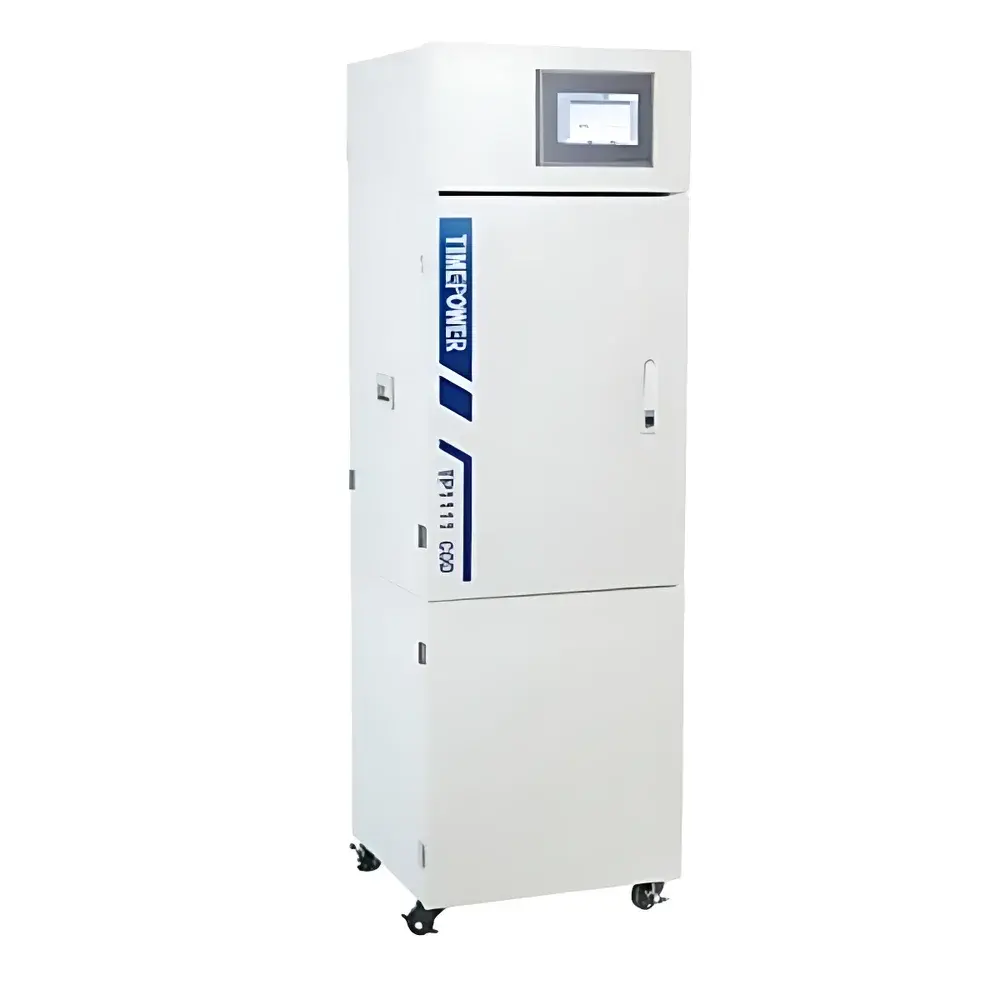
Timepower TP-1111 Online COD Analyzer
| Brand | Timepower |
|---|---|
| Origin | Beijing, China |
| Manufacturer Type | Direct Manufacturer |
| Product Category | Domestic |
| Model | TP-1111 |
| Instrument Type | Online Analyzer |
| Measurement Principle | Electrochemical Method (Online Configuration) |
| Wavelength | 610 nm |
| Measurement Range | 0–1500 mg/L or 0–5000 mg/L (selectable) |
| Accuracy | ≤ ±10% of reading |
| Repeatability | ≤ 5% FS |
| Detection Limit | 0.1 mg/L |
| Minimum Sampling Interval | 40 min (user-configurable) |
| Batch Processing Capacity | 15 or 30 samples per cycle |
Overview
The Timepower TP-1111 Online COD Analyzer is an industrial-grade, continuous-monitoring instrument engineered for reliable, real-time quantification of Chemical Oxygen Demand (COD) in aqueous matrices. Unlike laboratory-based spectrophotometric methods relying on post-sampling digestion and manual analysis, the TP-1111 implements an integrated electrochemical measurement architecture—combined with high-temperature, high-pressure catalytic digestion—to deliver stable, interference-resistant output under unattended operation. Its design adheres to HJ/T 399–2007 (“Water Quality – Determination of Chemical Oxygen Demand – Rapid Digestion Spectrophotometric Method”), ensuring regulatory alignment for environmental monitoring stations, municipal wastewater treatment plants, and industrial effluent discharge points across China. The system operates autonomously within fixed or variable sampling intervals (minimum 40 minutes), enabling dynamic tracking of organic load fluctuations in influent, effluent, and process streams without operator intervention.
Key Features
- Integrated high-pressure, high-temperature digestion module (≥165 °C, ≥0.6 MPa) ensures complete oxidation of refractory organics while minimizing volatile loss and cross-contamination.
- Optical detection at 610 nm using a stable LED light source and precision photodiode array, calibrated against NIST-traceable potassium hydrogen phthalate standards.
- Valve-driven reagent delivery system with air-buffered, negative-pressure aspiration—eliminates direct contact between aggressive digest reagents (e.g., K₂Cr₂O₇/H₂SO₄) and peristaltic tubing, extending component service life beyond 12 months under continuous operation.
- Micro-dosing capability: precise 1.0 mL reagent aliquots per measurement cycle, reducing annual reagent consumption by >40% compared to conventional flow-injection systems.
- Large-bore (≥1.5 mm ID) modified PTFE transparent tubing minimizes clogging from suspended solids, supporting long-term deployment in raw sewage or turbid surface water applications.
- Modular architecture with hot-swappable components—including digestion cell, optical module, and fluidic manifold—facilitates field maintenance without full system shutdown.
Sample Compatibility & Compliance
The TP-1111 accommodates a broad spectrum of water types: raw municipal wastewater, secondary-treated effluent, industrial process water (e.g., food processing, textile dyeing, pharmaceutical manufacturing), lake and river surface water, and potable water distribution systems. It meets functional requirements outlined in HJ/T 399–2007 and supports data integrity protocols consistent with ISO/IEC 17025:2017 for testing laboratories. While not certified to US EPA Method 410.4 or ASTM D1252, its performance envelope (0.1–5000 mg/L COD, ≤±10% accuracy) aligns with Tier 2 operational validation criteria for continuous emission monitoring systems (CEMS) under China’s “Technical Guidelines for Automatic Monitoring of Pollutant Sources” (HJ 353–2019). All wetted materials comply with GB/T 17219–2001 (Sanitary Safety of Drinking Water Equipment).
Software & Data Management
Embedded firmware provides local data logging (≥30 days at 15-min intervals) with timestamped audit trails, including calibration events, error codes, and maintenance alerts. Optional RS-485 Modbus RTU or Ethernet TCP/IP interfaces enable integration into SCADA, DCS, or cloud-based environmental data platforms (e.g., Siemens Desigo, Honeywell Experion, or custom MQTT brokers). Data export supports CSV and XML formats compliant with China’s National Environmental Monitoring Center (NEMC) data submission schema. Firmware updates are performed via secure HTTPS OTA (Over-the-Air) with SHA-256 signature verification—no physical access required. System logs retain full traceability for GLP-aligned internal quality assurance reviews.
Applications
- Real-time COD trending at wastewater treatment plant influent channels to optimize aeration basin loading and chemical dosing.
- Compliance monitoring at industrial discharge outfalls subject to local ecological environment bureau (EEB) permit limits.
- Early-warning detection of accidental organic spills in receiving waters upstream of drinking water intakes.
- Performance evaluation of advanced oxidation processes (AOPs) and membrane bioreactors (MBRs) during pilot-scale trials.
- Long-term water quality assessment in eutrophic lakes and reservoirs where seasonal organic flux drives hypoxia risk.
FAQ
Does the TP-1111 require daily manual calibration?
No. The system performs automatic zero and span checks at user-defined intervals (e.g., every 6 or 12 hours) using factory-prepared standard solutions. Full calibration verification is recommended monthly per HJ/T 399–2007 Annex B.
Can it operate in high-salinity seawater-influenced estuaries?
Yes—chloride interference is mitigated via Ag₂SO₄ precipitation in the digestion step; however, chloride concentrations >2000 mg/L require optional chloride compensation protocol activation.
Is remote diagnostics supported?
Yes. Integrated web server enables secure remote login (HTTPS + two-factor authentication) for live status viewing, log download, and parameter adjustment without on-site technician dispatch.
What maintenance tasks are required quarterly?
Replacement of digestion cell gaskets, optical window cleaning with ethanol-moistened lint-free cloth, and verification of peristaltic pump tubing tension and valve actuation timing.
Does the system meet cybersecurity requirements for industrial control networks?
It complies with IEC 62443-3-3 SL1: default credentials are disabled at first boot, TLS 1.2+ encryption is enforced for all network services, and firmware signing prevents unauthorized code injection.







