
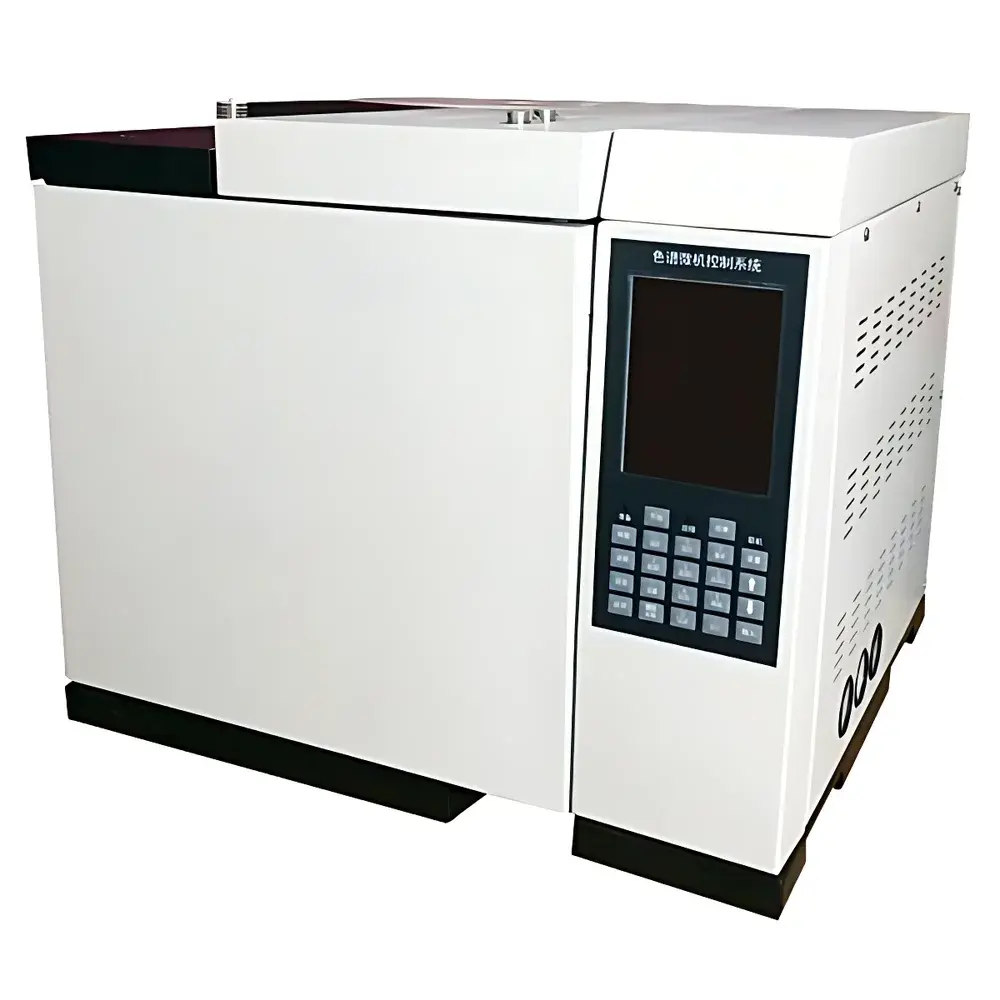
TimePower TP101 Gas Chromatograph for Oil & Gas Analysis
| Brand | TimePower |
|---|---|
| Origin | Beijing, China |
| Manufacturer Type | Direct Manufacturer |
| Product Origin | Domestic (China) |
| Model | TP101 |
| Pricing | Available Upon Request |
Overview
The TimePower TP101 Gas Chromatograph is a dedicated analytical instrument engineered for precise separation, identification, and quantification of dissolved gases in insulating oils—primarily applied in power transformer condition monitoring, but also widely deployed across petroleum refining, pharmaceutical manufacturing, environmental air quality assessment, forensic toxicology, food & beverage safety testing (e.g., residual solvent analysis in wines and tobacco), and industrial hygiene laboratories. It operates on the fundamental principle of gas chromatography: sample volatilization followed by partitioning between a mobile gas phase (carrier gas—typically high-purity nitrogen or helium) and a stationary liquid phase coated inside a fused-silica capillary or packed column. Separated analytes elute at characteristic retention times and are detected via dual parallel detectors—Thermal Conductivity Detector (TCD) and Flame Ionization Detector (FID)—with optional integrated methanizer for enhanced hydrocarbon sensitivity. The system supports ASTM D3612, IEC 60567, and GB/T 17623-compliant workflows for transformer oil gas analysis (DGA), ensuring trace-level detection of key fault gases including H₂, CH₄, C₂H₂, C₂H₄, C₂H₆, CO, and CO₂.
Key Features
- Multi-dimensional gas chromatographic architecture enabling simultaneous dual-column, dual-detector analysis with integrated methanizer—eliminating need for multiple injections and improving inter-method reproducibility.
- Optimized thermal management: oven temperature programmability from ambient to 200 °C with ≤±0.3 °C isothermal stability and <1.5-hour warm-up time to operational readiness.
- Dual-detector configuration: TCD (minimum detectable concentration: 0.1 ppm for CH₄ and C₂H₂; sensitivity ≥1000 mV·mL/mg for benzene) and FID (detection limit ≤5×10⁻¹² g/s; baseline noise ≤1×10⁻¹² A/30 min), providing complementary selectivity for permanent gases and hydrocarbons.
- Intelligent system diagnostics: real-time self-check, over-temperature protection on all independently controlled zones (oven, detector, methanizer—settable up to 380 °C), and audible/visual fault alerts for critical failures including gas leakage or pressure deviation.
- Low-sample-consumption design: single-injection capability with micro-volume injection port, reducing sample requirement while maintaining quantitative accuracy per USP and ISO 17025 validation expectations.
- Robust mechanical construction: 31.8 kg unit housed in EMI-shielded chassis (620 × 445 × 485 mm); designed for laboratory benchtop deployment with vibration-dampened optical and electronic subsystems.
Sample Compatibility & Compliance
The TP101 accommodates liquid-phase samples requiring headspace extraction (e.g., transformer oil per IEC 60567 Clause 8), gaseous standards (certified NIST-traceable calibration mixtures), and ambient air matrices. All gas pathways employ electropolished stainless-steel tubing and Swagelok® fittings to minimize adsorption and memory effects. System compliance includes adherence to GLP documentation requirements, audit-ready electronic records (when paired with validated chromatography data system software), and compatibility with 21 CFR Part 11–compliant data integrity configurations. Routine operation meets ASTM D3612 Type B methodology specifications for dissolved gas analysis, supporting predictive maintenance protocols in electric utility asset management.
Software & Data Management
Controlled via TimePower Chromatographic Workstation (v3.2+), the TP101 supports automated method development, peak integration using tangent skim and valley-to-valley algorithms, calibration curve generation (linear, quadratic, or multi-point weighted), and report export in PDF, CSV, and XML formats. Raw data files retain full acquisition metadata—including inlet pressure, detector voltage, and temperature ramp profiles—for retrospective reprocessing. Audit trails log user actions, method changes, and result modifications with timestamped, non-erasable entries. Integration with LIMS platforms is supported through ASTM E1394-compliant ASCII export and ODBC connectivity.
Applications
- Transformer oil dissolved gas analysis (DGA) for early fault detection (partial discharge, thermal faults, arcing).
- Hydrocarbon speciation in refinery process streams and petrochemical feedstocks.
- Residual solvent quantification in pharmaceutical active ingredients (ICH Q3C guidelines).
- Volatile organic compound (VOC) profiling in indoor air and workplace exposure assessments.
- Alcohol and ester profiling in fermented beverages and tobacco smoke condensate.
- Forensic analysis of accelerants and ignitable liquids per ASTM E1618.
FAQ
What carrier gases are compatible with the TP101?
High-purity nitrogen (≥99.999%), helium (≥99.999%), or hydrogen (≥99.999%) may be used—selection depends on detector type, column chemistry, and required analysis speed.
Is the methanizer integrated or external?
The methanizer is fully integrated into the detector compartment and thermally stabilized at 380 °C, enabling catalytic conversion of CO and CO₂ to methane prior to FID detection.
Does the system support unattended overnight operation?
Yes—equipped with hardware-based watchdog timers, automatic shutdown on critical fault, and scheduled run sequences via workstation software.
What preventive maintenance intervals are recommended?
Column trimming every 200 injections, detector cleaning quarterly, and leak checks prior to each calibration cycle are advised per manufacturer service bulletin TB-TP101-REV4.
Can the TP101 be configured for EPA Method 8260 compliance?
With appropriate column selection (e.g., DB-VRX), splitless injection, and FID/TCD optimization, it meets core performance criteria for volatile organic analysis—full validation per EPA requirements must be conducted onsite by the end user.





