
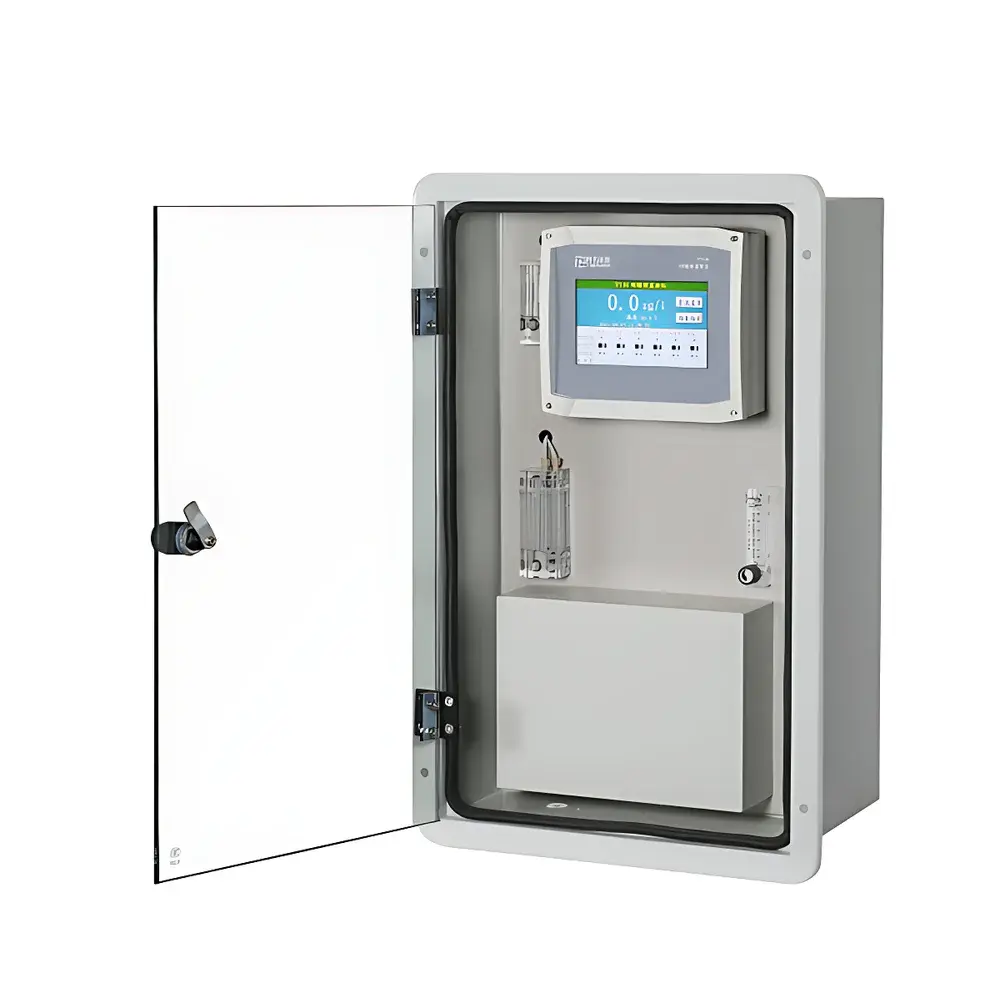
TimePower TP108 Online Hydrazine Analyzer
| [Brand | TimePower |
|---|---|
| Origin | Beijing, China |
| Manufacturer Type | Manufacturer |
| Product Category | Domestic |
| Model | TP108 |
| Instrument Type | Portable |
| Measurement Range | 0.0–100.0 μg/L |
| Display | 7.0-inch color LCD touchscreen (Chinese UI) |
| Accuracy | ±2% F.S. |
| Repeatability | ≤±1% F.S. |
| Drift | <±1% F.S./24 h |
| Response Time | <4 min |
| Cycle Time | ~3 min per channel |
| Sample Flow Rate | 10–40 L/h |
| Sample Temp. | 5–50 °C |
| Sample Particulates | <5 µm, non-colloidal |
| Ambient Temp. | 5–45 °C |
| Ambient Humidity | ≤90% RH (non-condensing) |
| Reagent Consumption | ~3 L/month |
| Output Signals | Isolated 0–20 mA / 4–20 mA / 0–10 mA (configurable) |
| Alarm Outputs | Independent per channel (flow loss, high/low limit) |
| Power Supply | AC 85–265 V, 45–65 Hz |
| Power Consumption | ≤100 W |
| Dimensions (W×H×D) | 460×720×280 mm |
| Panel Cutout | 670×410 mm |
| Weight | 22 kg |
| Channel Configurability | 1–6 channels selectable |
| Light Source | Monochromatic cold LED |
| Calibration | Automated dual-point standard calibration on user-defined schedule |
| Data Storage | 30 days of historical data |
| Compliance | Designed for continuous operation in industrial water monitoring environments] |
Overview
The TimePower TP108 Online Hydrazine Analyzer is a dedicated photometric analyzer engineered for continuous, real-time quantification of hydrazine (N2H4) in aqueous process streams. It operates on the principle of acid-catalyzed diazotization: in acidic medium, hydrazine reacts stoichiometrically with p-dimethylaminobenzaldehyde (PDAB) to form a stable yellow azo dye. Absorbance of this chromophore is measured at a fixed wavelength using a monochromatic cold LED light source, and concentration is calculated via the Lambert-Beer law—ensuring linearity and trace-level sensitivity across the 0.0–100.0 μg/L range. The instrument is purpose-built for feedwater, condensate, and boiler water monitoring in thermal power plants, where strict hydrazine control (<10–50 μg/L) is critical to oxygen scavenging efficacy and copper alloy corrosion mitigation. Its robust architecture supports unattended operation under fluctuating industrial water conditions, meeting long-term stability requirements for ISO 5667-3-compliant sampling protocols and ASTM D129-18-based method validation frameworks.
Key Features
- Modular multi-channel design: Supports 1–6 independent measurement channels in a single chassis—reducing footprint, cabling complexity, and total cost of ownership without compromising channel-specific calibration integrity.
- High-reliability fluidics: Utilizes imported solenoid valves rated for >500,000 actuation cycles; precision metering ensures reproducible reagent dosing and sample aspiration—critical for sub-μg/L accuracy and ≤±1% F.S. repeatability.
- Automated maintenance protocol: Programmable dual-point standard calibration (zero and span) executed at user-defined intervals (e.g., every 6 or 12 hours), minimizing manual intervention while maintaining traceability per GLP-aligned operational logs.
- Stable optical system: Cold LED light source eliminates thermal drift and offers >50,000-hour service life—superior to tungsten-halogen lamps in spectral stability and power efficiency.
- Industrial-grade I/O: Six isolated analog current outputs (0–20 mA / 4–20 mA / 0–10 mA configurable per channel) enable direct integration with DCS, PLC, or automatic chemical dosing controllers—supporting closed-loop hydrazine feed optimization.
- Intuitive human-machine interface: 7.0-inch color TFT touchscreen displays real-time concentration curves, trend overlays, alarm status, and maintenance prompts—all in context-aware Chinese language. Historical data (30-day buffer) is timestamped and exportable via USB for root-cause analysis.
Sample Compatibility & Compliance
The TP108 accepts raw or filtered water samples meeting defined physicochemical constraints: flow rate 10–40 L/h, temperature 5–50 °C, suspended solids <5 µm (non-agglomerating), and absence of colloidal organics or oxidants that interfere with PDAB chemistry. It complies with mechanical installation standards for panel-mounted analyzers (IEC 60529 IP20 enclosure rating) and meets electromagnetic compatibility requirements per EN 61326-1. While not certified to USP or EP 2.2.45 for pharmaceutical water, its measurement methodology aligns with EPA Method 379.1 principles for hydrazine determination and supports internal QA/QC documentation required under ISO/IEC 17025-accredited laboratories.
Software & Data Management
Firmware implements audit-trail-capable event logging—including calibration events, alarm triggers (flow loss, out-of-range, reagent low), and power cycle timestamps—with local storage in non-volatile memory. No proprietary cloud platform is required; all configuration, diagnostics, and data review occur locally via touchscreen. Exported CSV files include channel ID, timestamp (YYYY-MM-DD HH:MM:SS), measured value (μg/L), status flags, and calibration coefficients—facilitating import into LIMS or statistical process control (SPC) software. The system supports 21 CFR Part 11–compatible user access levels (Operator, Supervisor, Administrator) when deployed in regulated environments requiring electronic record integrity.
Applications
- Thermal power generation: Continuous monitoring of hydrazine residual in deaerator outlet, feedwater heaters, and drum boiler blowdown to ensure effective oxygen scavenging and prevent flow-accelerated corrosion (FAC) of carbon steel piping.
- Chemical & petrochemical plants: Control of hydrazine injection in high-purity steam systems serving catalyst reactors or heat exchangers sensitive to oxidative degradation.
- Pharmaceutical purified water (PW) and water-for-injection (WFI) loops: Optional use during commissioning or troubleshooting where residual hydrazine from sterilization agents must be verified below action limits.
- Municipal and industrial wastewater treatment: Monitoring of hydrazine-containing effluents from aerospace or electronics manufacturing before discharge—supporting compliance with local environmental permits referencing EU Directive 2008/105/EC priority substances.
FAQ
What sample filtration is required prior to analysis?
A 5-µm inline filter is mandatory to prevent particulate clogging of the microfluidic manifold and optical flow cell. Cartridge-type depth filters with polypropylene housing are recommended; avoid cellulose-based media that may leach interfering organics.
Can the TP108 operate without daily manual intervention?
Yes—when configured with scheduled auto-calibration, reagent level monitoring, and alarm relay outputs, it supports ≥7-day unattended operation typical of remote power plant auxiliary systems.
Is the PDAB reagent supplied by TimePower compatible with ASTM D3799?
The reagent formulation conforms to the core reaction chemistry described in ASTM D3799-16 (Standard Test Method for Hydrazine in Water by Direct Photometric Method), though users must validate performance against their site-specific matrix interferences.
How is measurement traceability maintained over time?
Each calibration uses NIST-traceable hydrazine standards (e.g., 10 μg/mL certified reference material); calibration coefficients and verification results are stored with digital signatures in the onboard log, supporting internal audit and regulatory inspection.
What maintenance tasks require trained personnel?
Only optical window cleaning, pump tube replacement (every 6 months), and full system verification using certified check standards—no field adjustment of optical gain or zero offset is permitted to preserve metrological integrity.







