
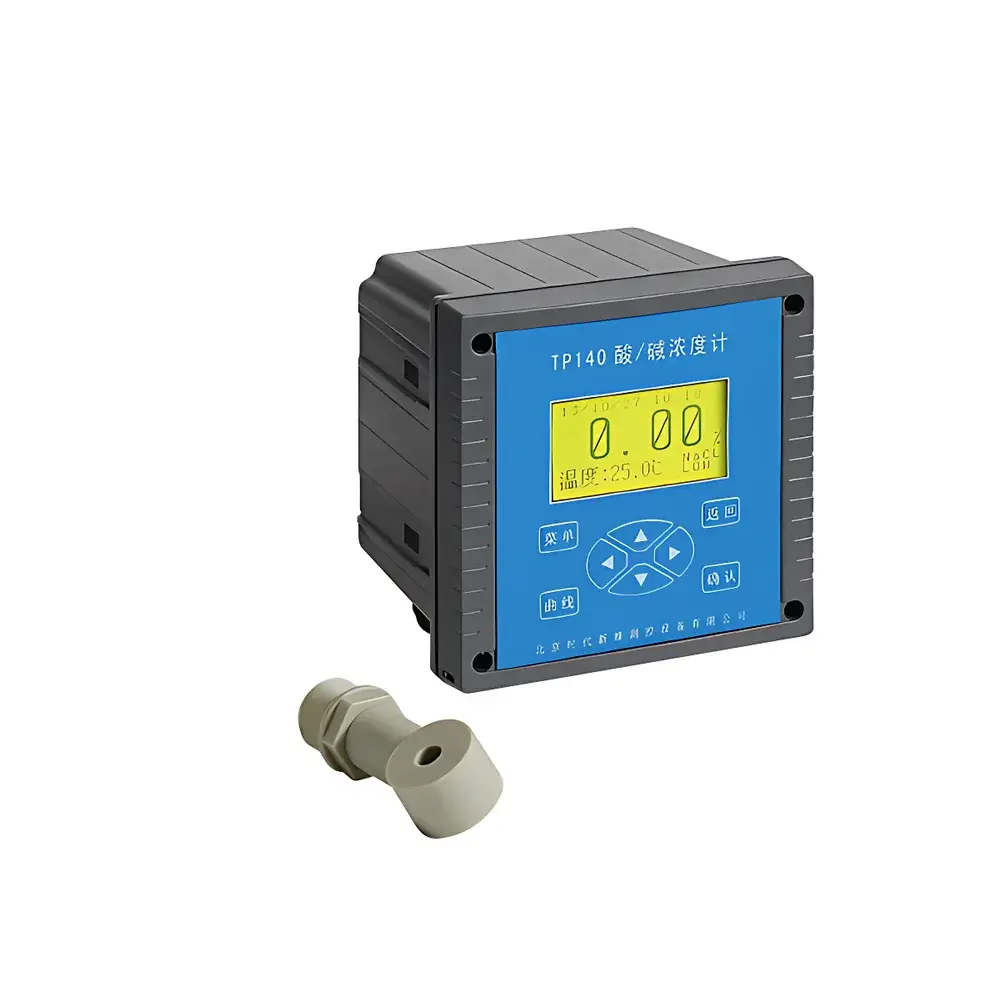
TimePower TP140 Online Acid/Alkali Concentration Analyzer
| Brand | TimePower |
|---|---|
| Origin | Beijing, China |
| Manufacturer Type | Direct Manufacturer |
| Product Origin | Domestic (China) |
| Model | TP140 |
| Pricing | Upon Request |
| Display | 128×64 dot-matrix LCD, Chinese interface |
| Measurement Ranges | HCl (0–10.00%), NaOH (0–10.00%), H₂SO₄ (0–20.00%), NaCl (0–20.00%), HNO₃ (0–15.00%), Na₂CO₃ (0–10.00%) |
| Accuracy | ±2% F.S. |
| Resolution | 0.01% |
| Repeatability | ≤1% |
| Temperature Sensor | Pt1000 |
| Temp. Measurement Range | 0.0–99.9 °C |
| Automatic Temp. Compensation Range | 0.1–60.0 °C |
| Sample Temp. Range | 5–60 °C |
| Ambient Temp. Range | 5–45 °C |
| Humidity Limit | ≤90% RH (non-condensing) |
| Storage/Transport Temp. | −25–55 °C (electrode excluded |
| Power Supply | AC 220 V ±10%, 50 Hz ±1 Hz |
| Power Consumption | <5 W |
| Dimensions (L×W×H) | 142×125×155 mm |
| Panel Cutout | 138×138 mm |
| Weight | 1.6 kg |
Overview
The TimePower TP140 Online Acid/Alkali Concentration Analyzer is an industrial-grade, microprocessor-controlled conductometric analyzer engineered for continuous, real-time monitoring of electrolyte concentration in aqueous process streams. Unlike pH-only instruments, the TP140 employs temperature-compensated electrical conductivity measurement—calibrated against known standard solutions—to derive mass percentage concentration (% w/w) for six common industrial reagents: hydrochloric acid (HCl), sodium hydroxide (NaOH), sulfuric acid (H₂SO₄), sodium chloride (NaCl), nitric acid (HNO₃), and sodium carbonate (Na₂CO₃). Its measurement principle relies on the linear correlation between solution conductivity and ionic strength within defined concentration ranges, with automatic Pt1000-based temperature compensation ensuring stability across dynamic thermal conditions (5–60 °C sample range). Designed specifically for regeneration monitoring in ion exchange demineralization systems and acid/alkali dosing control in boiler cleaning or pipeline passivation protocols, the TP140 delivers traceable, repeatable data without requiring frequent recalibration under steady-state operation.
Key Features
- Corrosion-resistant flow-through or immersion-type conductivity electrodes optimized for aggressive acidic and alkaline media
- High-resolution 24-bit analog-to-digital conversion ensures stable signal acquisition and minimizes quantization error
- Integrated Pt1000 temperature sensor with ±0.2 °C accuracy over 0.0–99.9 °C range, enabling precise automatic temperature compensation (ATC) per IEC 60746-3
- Embedded single-chip architecture with low-power consumption (<5 W), supporting unattended operation in utility-grade control cabinets
- Full Chinese-language graphical user interface (128×64 pixel LCD) with hierarchical menu navigation—no external PC required for configuration or diagnostics
- Configurable 4–20 mA analog output (isolated) and two programmable relay outputs for alarm or interlock signaling (e.g., feed pump shutdown upon out-of-spec concentration)
- Non-volatile memory retains calibration coefficients, historical min/max values, and up to 30 days of cyclic timestamped readings—even after power loss (data retention >10 years)
Sample Compatibility & Compliance
The TP140 is validated for use with clean, low-suspended-solids aqueous solutions containing no oils, particulates >50 µm, or strong oxidizers beyond specified ranges (e.g., >20% H₂SO₄ or >15% HNO₃ may require custom electrode materials). It complies with electromagnetic compatibility standards EN 61326-1 (industrial environment) and safety requirements per GB 4793.1–2007 (equivalent to IEC 61010-1). While not certified for hazardous area installation (e.g., ATEX/IECEx), its IP65-rated enclosure supports wall- or panel-mount deployment in ISO Class 8 cleanrooms, chemical metering skids, and utility water treatment control rooms. The instrument supports audit-ready operation when paired with optional RS485 Modbus RTU communication for integration into DCS/SCADA platforms compliant with ISA-88/ISA-95 frameworks.
Software & Data Management
No proprietary software is required for basic operation; all setup—including span calibration, relay hysteresis, and ATC offset—is performed locally via front-panel keys. For centralized data logging, the optional Modbus RTU interface enables readout of live concentration values, temperature, status flags, and event logs into historian systems (e.g., Siemens Desigo CC, Honeywell Experion PKS). Timestamped records adhere to GLP-aligned principles: each stored value includes system clock stamp, operator ID (if enabled via external authentication), and checksum-verified integrity. Firmware updates are delivered via USB flash drive with SHA-256 signature verification—supporting secure, version-controlled maintenance per FDA 21 CFR Part 11 Annex 11 expectations for electronic records in regulated water systems.
Applications
- Continuous monitoring of HCl or NaOH regenerant concentration in mixed-bed and dual-bed ion exchange systems for ultrapure water production (ASTM D1193 Type I/II)
- Real-time control of acid concentration during boiler tube descaling or stainless-steel pickling bath management (per ASTM A380 and ASME B31.1 guidelines)
- Concentration verification of neutralizing agents in wastewater equalization tanks prior to biological treatment stages
- Batch consistency validation in pharmaceutical excipient preparation where NaCl or Na₂CO₃ solutions serve as buffer components (USP water quality)
- Preventive maintenance trigger for electrode fouling detection via trending of conductivity drift relative to reference temperature
FAQ
Does the TP140 measure pH?
No. The TP140 is a dedicated conductometric concentration analyzer—not a pH meter. It infers % w/w from conductivity and temperature; pH measurement requires a separate glass electrode-based system.
Can it be used for hydrofluoric acid (HF) or phosphoric acid (H₃PO₄)?
Not without electrode material modification. Standard electrodes are rated for HCl, H₂SO₄, HNO₃, NaOH, NaCl, and Na₂CO₃ only. HF requires tantalum or Hastelloy C-276 wetted parts; contact TimePower engineering for custom configurations.
Is NIST-traceable calibration supported?
Yes. The instrument accepts user-loaded calibration tables derived from NIST-traceable standard solutions (e.g., NIST SRM 3129a for KCl conductivity standards). Factory calibration certificates include uncertainty budgets per ISO/IEC 17025.
What maintenance intervals are recommended?
Electrode cleaning every 2–4 weeks in high-fouling applications; full system verification (span check + temp. probe validation) every 3 months; annual firmware review for security patches and compliance alignment.
Related Products





