
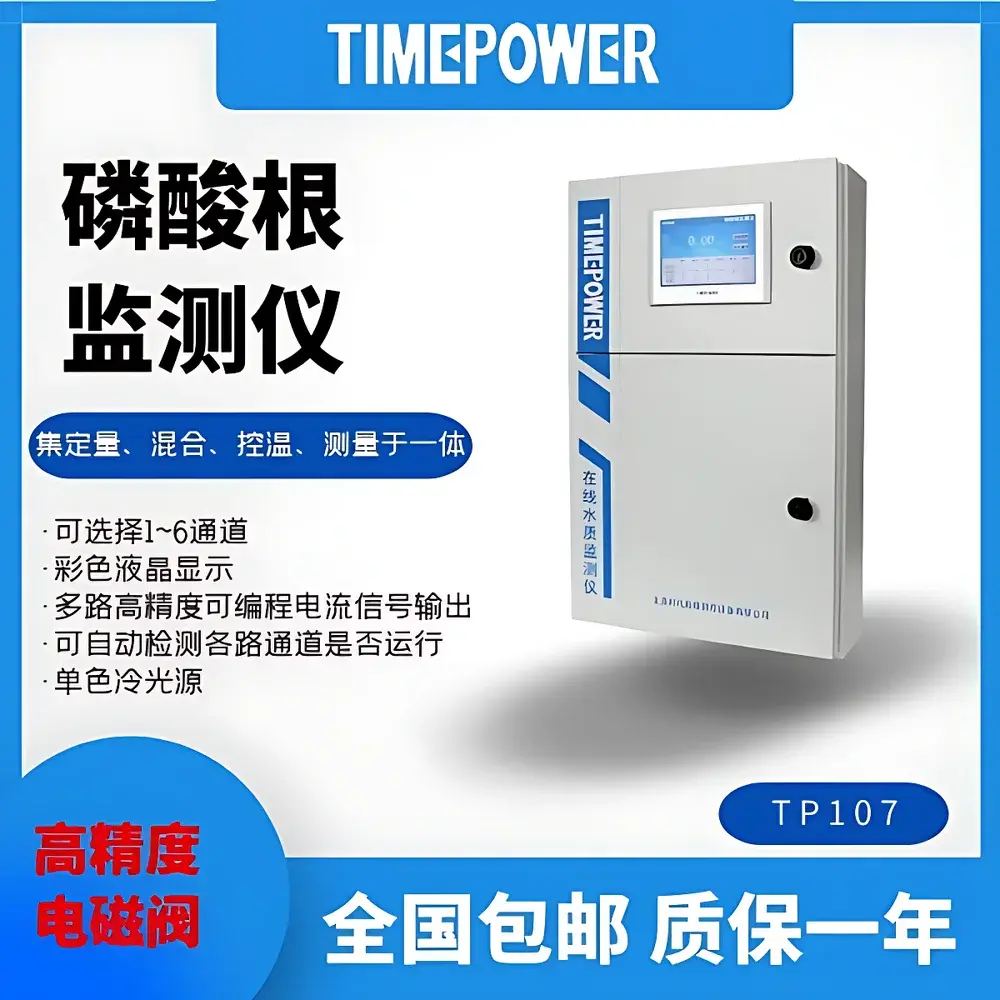
TimePower TP107 Online Phosphate Analyzer
| Brand | TimePower |
|---|---|
| Origin | Beijing, China |
| Manufacturer Type | Original Equipment Manufacturer (OEM) |
| Product Category | Domestic |
| Model | TP107 |
| Instrument Type | Laboratory-Grade Online Analyzer |
| Channel Configuration | 1–6 selectable channels |
| Display | Color LCD with simultaneous real-time display of phosphate concentration (mg/L as PO₄³⁻), temperature (°C), system time, and operational status |
| Output | Multiple programmable 4–20 mA current loops |
| Data Storage | 6,000 entries (concentration, timestamp, calibration logs, system diagnostics) |
| Light Source | Monochromatic cold LED (long-life, high photometric stability) |
| Compliance | GB/T 6913–2008 “Methods for analysis of boiler water and cooling water — Determination of phosphate” |
| Sample Handling | Automated peristaltic pumping, precision solenoid valve-controlled reagent dosing, thermostatically regulated reaction chamber |
| Power Supply | 220 VAC ±10%, 50 Hz |
| Environmental Rating | IP65 enclosure (indoor/outdoor wall-mount compatible) |
Overview
The TimePower TP107 Online Phosphate Analyzer is a laboratory-grade, multi-channel photometric analyzer engineered for continuous, unattended measurement of orthophosphate (PO₄³⁻) in aqueous process streams. It operates on the principle of molybdenum blue colorimetry—where orthophosphate reacts with ammonium molybdate and antimony potassium tartrate under acidic conditions to form a phosphomolybdenum heteropoly acid, subsequently reduced to an intensely colored molybdenum blue complex measurable at 880 nm. This method delivers high specificity for soluble reactive phosphorus (SRP), minimizing interferences from organic phosphates or particulate-bound forms. Designed for integration into closed-loop water chemistry control systems, the TP107 meets the metrological and procedural requirements of GB/T 6913–2008, making it suitable for critical applications in thermal power plant boiler feedwater, circulating cooling water, industrial effluent treatment, and municipal drinking water distribution networks.
Key Features
- Modular 1–6 channel architecture enables scalable deployment across multiple sampling points without redundant hardware—reducing CAPEX and simplifying maintenance scheduling.
- High-reliability solenoid valves with >500,000-cycle actuation life ensure precise, repeatable reagent and sample metering; volumetric accuracy maintained within ±1.5% of full scale across operating temperature range (5–40 °C).
- Integrated Peltier-based temperature control stabilizes the colorimetric reaction zone at 37 °C ±0.3 °C, eliminating ambient drift and enhancing reproducibility (RSD < 2.0% at 0.1 mg/L PO₄³⁻).
- Color LCD interface displays real-time phosphate concentration (mg/L as PO₄³⁻), measured temperature, system uptime, and diagnostic flags—all on a single screen without navigation layers.
- Four independently configurable 4–20 mA analog outputs support seamless integration with DCS, PLC, or automated phosphate dosing controllers; each output assignable to concentration, temperature, alarm status, or system health.
- Embedded non-volatile memory retains 6,000 timestamped data records—including measurement values, calibration events, zero/span verification logs, and fault codes—with automatic overwrite policy and USB export capability.
Sample Compatibility & Compliance
The TP107 accepts clarified liquid samples with turbidity < 5 NTU and suspended solids < 10 mg/L. It accommodates inlet pressures from 0.1 to 0.6 MPa and flow rates of 50–200 mL/min via standard 6 mm OD tubing. Sample matrices include deionized boiler feedwater (conductivity < 1 µS/cm), recirculating cooling tower water (pH 6.5–9.0, hardness up to 500 mg/L as CaCO₃), and tertiary-treated wastewater effluent. All wetted components—PFA-lined sample lines, quartz flow cells, and chemically resistant solenoid valve manifolds—are compliant with ISO 8502-1 for low-metal leaching. The analyzer satisfies functional requirements for GLP-compliant water chemistry monitoring and supports audit-ready documentation per FDA 21 CFR Part 11 when paired with TimePower’s optional secure logging module.
Software & Data Management
Firmware v3.2 includes embedded event-driven logging, automatic self-diagnostics (e.g., lamp intensity decay tracking, valve response time validation), and configurable alarm thresholds with latching behavior. Data export is supported via USB 2.0 (CSV format) or RS-485 Modbus RTU protocol (slave ID configurable). Optional PC-based TimePower ChemView software provides trend visualization, calibration curve management, report generation (PDF/Excel), and electronic signature-enabled calibration approval workflows. All stored data include ISO 8601 timestamps, instrument serial number, and operator ID fields—enabling traceability in regulated environments.
Applications
- Real-time phosphate control in drum-type utility boilers to prevent scale formation and maintain < 0.05 mg/L residual PO₄³⁻ in high-pressure feedwater.
- Monitoring phosphate dosing efficacy in corrosion-inhibited cooling water systems across petrochemical refineries and fertilizer production plants.
- Regulatory compliance tracking for phosphorus discharge limits in EPA NPDES-permitted industrial outfalls.
- Process validation in pharmaceutical water-for-injection (WFI) loop monitoring where orthophosphate serves as an indicator of membrane integrity failure.
- Quality assurance in beverage manufacturing, where phosphate levels correlate with cleaning-in-place (CIP) rinse efficiency.
FAQ
What is the detection range and limit of quantitation (LOQ) for the TP107?
The standard configuration measures 0.01–10.00 mg/L PO₄³⁻ with an LOQ of 0.01 mg/L (signal-to-noise ratio ≥ 10:1). Extended range kits (0.1–50 mg/L) are available upon request.
Does the analyzer require daily manual intervention?
No—once commissioned, the TP107 operates autonomously for up to 30 days between reagent refills and 90 days between calibration verifications, assuming stable sample conditions and ambient temperatures between 15–35 °C.
Can it be integrated into a Siemens PCS7 or Honeywell Experion DCS?
Yes—native Modbus RTU support enables direct register mapping; DCS-specific function block libraries are provided for Siemens S7-1200/1500 and Honeywell C300 systems.
Is third-party certification (e.g., UKAS, TÜV) available for this model?
While the TP107 itself is not UKAS-accredited, TimePower provides test reports traceable to NIM (National Institute of Metrology, China) standards and supports customer-led field validation per ISO/IEC 17025 requirements.
How is reagent consumption managed across multiple channels?
Each channel operates independently with dedicated reagent reservoirs and peristaltic pump heads; average consumption is 12 mL/hour per active channel using standard molybdate/ascorbic acid reagents.
Related Products







