
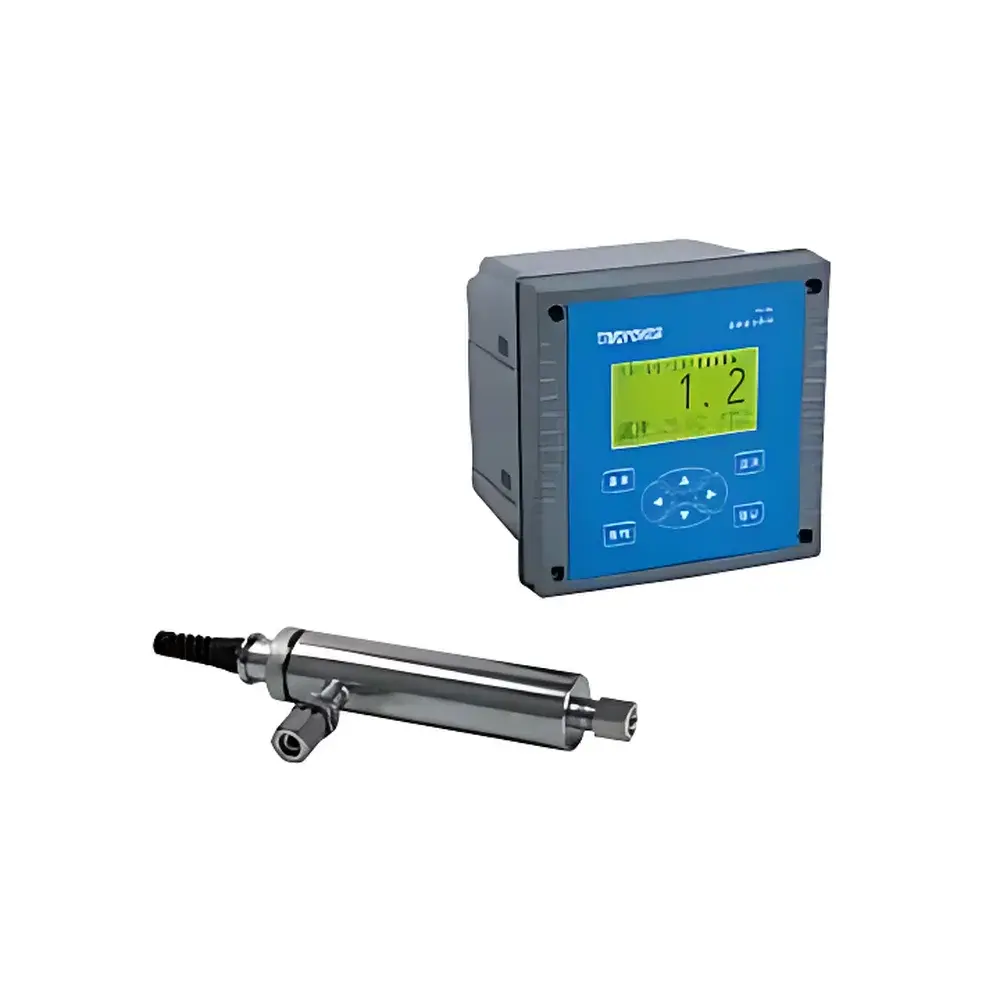
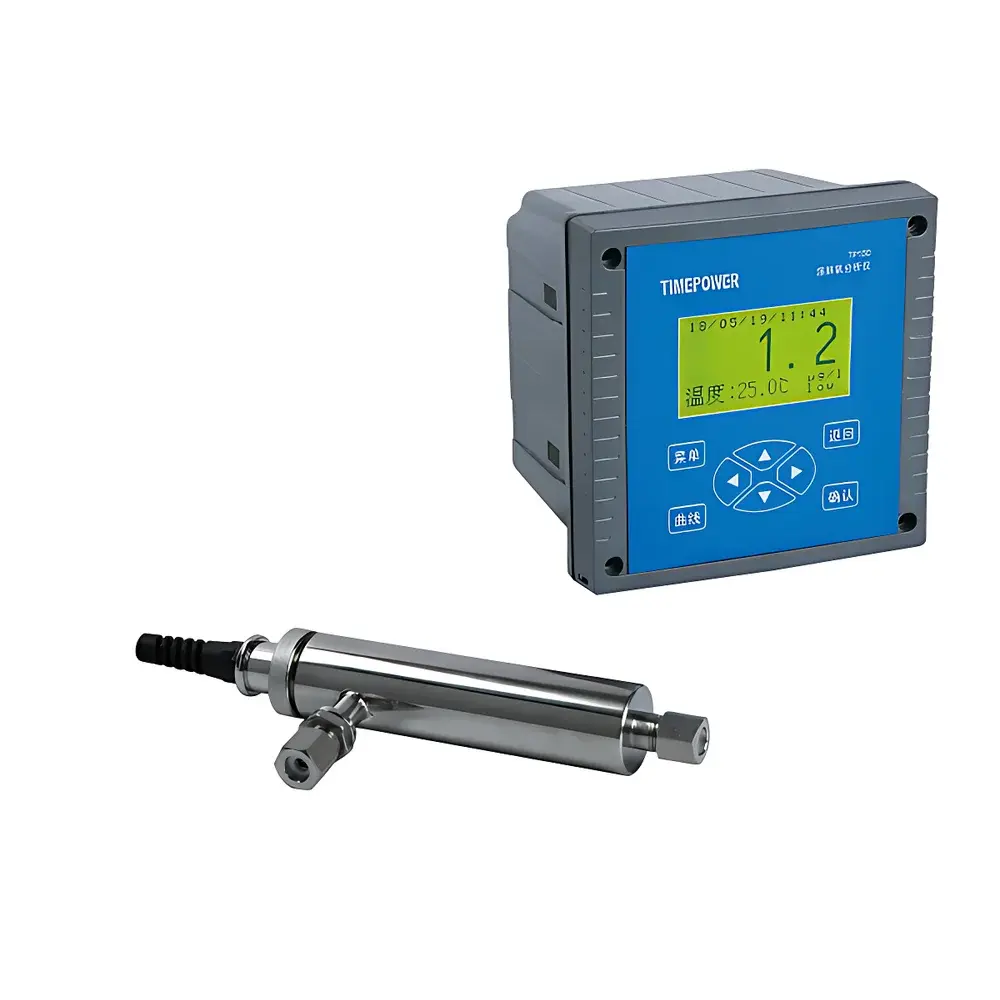
Timepower TP150 Online Dissolved Oxygen Analyzer
| Brand | Timepower |
|---|---|
| Origin | Beijing, China |
| Manufacturer Type | Direct Manufacturer |
| Product Origin | Domestic (China) |
| Model | TP150 |
| Instrument Type | Online Analyzer |
| Measurement Principle | Fluorescence Quenching (Note: Correction — original Chinese text erroneously states “polarographic” and “membrane electrode method”, but parameter field explicitly specifies *fluorescence method* |
| Measurement Ranges | 0.0–100 µg/L |
| Accuracy | ±1.5% FS |
| Repeatability | 0.05% |
| Detection Limit | ±2 ppb |
| Resolution | 0.1 µg/L (0–100 µg/L), 1.0 µg/L (100–1000 µg/L), 0.01 mg/L (1.00–20.00 mg/L) |
| Response Time (T90) | <5 min at 25 °C |
| Temperature Compensation Range | 0–60.0 °C |
| Sample Temperature Range | 5–45 °C |
| Ambient Operating Temperature | 0–60 °C |
| Humidity Limit | ≤90% RH (non-condensing) |
| Enclosure Rating | IP65 |
| Analog Output Options | 0–10 mA, 0–20 mA, 4–20 mA (load <300 Ω) |
| Relay Outputs | 220 VAC / 3 A (configurable alarm thresholds) |
| Power Supply | AC 85–265 V, 45–65 Hz |
| Power Consumption | ≤15 W |
| Dimensions (H×W×D) | 145 × 120 × 150 mm |
| Panel Cutout | 138 × 138 mm |
| Weight | 0.64 kg |
Overview
The Timepower TP150 Online Dissolved Oxygen Analyzer is an industrial-grade, continuous-monitoring instrument engineered for ultra-trace dissolved oxygen (DO) quantification in water and wastewater treatment systems, pharmaceutical process streams, boiler feedwater, and high-purity utility loops. Unlike conventional amperometric or galvanic sensors, the TP150 employs solid-state fluorescence quenching technology—where molecular oxygen modulates the lifetime and intensity of a luminophore embedded in an oxygen-permeable optical membrane. This non-consumptive, zero-current measurement principle eliminates cathode polarization, electrolyte depletion, and flow-dependent artifacts, enabling stable, maintenance-light operation across sub-ppb to 20 mg/L ranges. Its triple-range auto-switching architecture (0.0–100 µg/L, 100–1000 µg/L, 1.00–20.00 mg/L) ensures optimal signal-to-noise ratio across diverse applications—from deaerator outlet validation to ultrapure water (UPW) monitoring per ASTM D8079 and USP <643>.
Key Features
- Fluorescence-based sensing core with factory-calibrated, replaceable optical membrane module—no electrolyte refills or cathode polishing required.
- 24-bit high-resolution A/D conversion and precision temperature-compensated signal processing, delivering ≤1.5% full-scale accuracy and 0.05% repeatability.
- IP65-rated NEMA 4X enclosure with integrated 128×64 dot-matrix LCD and intuitive Chinese-language menu navigation (hardware-localized UI; firmware supports multi-language localization upon request).
- Configurable analog outputs (0–10 mA, 0–20 mA, or 4–20 mA) with galvanic isolation and user-defined scaling; dual programmable relay outputs rated for 220 VAC / 3 A.
- Onboard cyclic data logging for up to 3,000 timestamped measurements; retained for ≥10 years during power loss via non-volatile FRAM memory.
- Robust mechanical design: compact footprint (145 × 120 × 150 mm), lightweight (0.64 kg), and compatible with panel-mount, wall-mount, or rack-mount installation.
Sample Compatibility & Compliance
The TP150 is validated for continuous immersion or flow-through operation in clean to moderately fouling aqueous matrices—including reverse osmosis permeate, condensate, cooling tower make-up, activated sludge effluent, and purified water per ISO 8573-1 (Class 2 for particulates) and EP/USP general chapter <1231>. It meets electromagnetic compatibility requirements per IEC 61326-1 (industrial environment) and safety standards per IEC 61010-1. While not pre-certified to FDA 21 CFR Part 11, its audit-ready data log structure (with immutable timestamps and no post-hoc editing capability) supports GLP/GMP-aligned validation protocols when deployed with controlled change management and electronic signature workflows.
Software & Data Management
No proprietary PC software is bundled; however, the TP150’s analog and relay outputs integrate natively with DCS, SCADA, and PLC systems (e.g., Siemens S7, Rockwell ControlLogix, Yokogawa CENTUM VP). Modbus RTU option is available upon request (requires optional communication module). All logged data are accessible via front-panel navigation or exported manually using standard USB-to-serial adapters. Configuration parameters—including calibration constants, alarm setpoints, and output scaling—are protected by dual-level password access (operator vs. engineer) to ensure configuration integrity.
Applications
- Boiler feedwater and steam cycle chemistry control (ASME PTC 19.11 compliance support)
- Pharmaceutical purified water (PW) and water-for-injection (WFI) system validation and routine monitoring
- Microelectronics UPW loop surveillance (meeting SEMI F63 oxygen specification limits)
- Bioreactor dissolved oxygen feedback control in upstream bioprocessing
- Environmental discharge monitoring per EPA Method 360.1 (modified for online fluorescence platforms)
- Drinking water ozonation and chlorination process optimization
FAQ
Does the TP150 require zero-oxygen calibration gas or chemical reagents?
No. The fluorescence sensor is calibrated using air-saturated water (100% air saturation at known temperature/pressure) and a zero point established via sodium sulfite solution or nitrogen sparging—no certified gas cylinders or hazardous chemicals are needed for routine verification.
Can the TP150 be used in seawater or high-TDS applications?
Yes—with optional marine-grade membrane and anti-fouling cap. Salt interference is corrected via built-in salinity compensation (0–45 g/kg); long-term drift in >35 ppt matrices requires quarterly membrane replacement and two-point calibration.
Is the analog output intrinsically safe for hazardous area installation?
The base unit is not IS-certified. For Zone 1/Div 1 deployment, it must be installed in a certified barrier-protected cabinet or paired with a HART or Foundation Fieldbus interface with appropriate intrinsic safety approval (e.g., FM/ATEX).
What is the expected service life of the optical membrane?
Under typical municipal or industrial use (25 °C, pH 6–9, no oil/hydrocarbon exposure), the membrane module maintains specification performance for ≥12 months; replacement is tool-free and takes <90 seconds.
How is temperature compensation implemented?
A Pt1000 RTD is integrated into the sensor tip. Compensation follows the modified Stern-Volmer equation with polynomial coefficients stored in sensor EEPROM, traceable to NIST SRM 1692 calibration standards.
Related Products







