
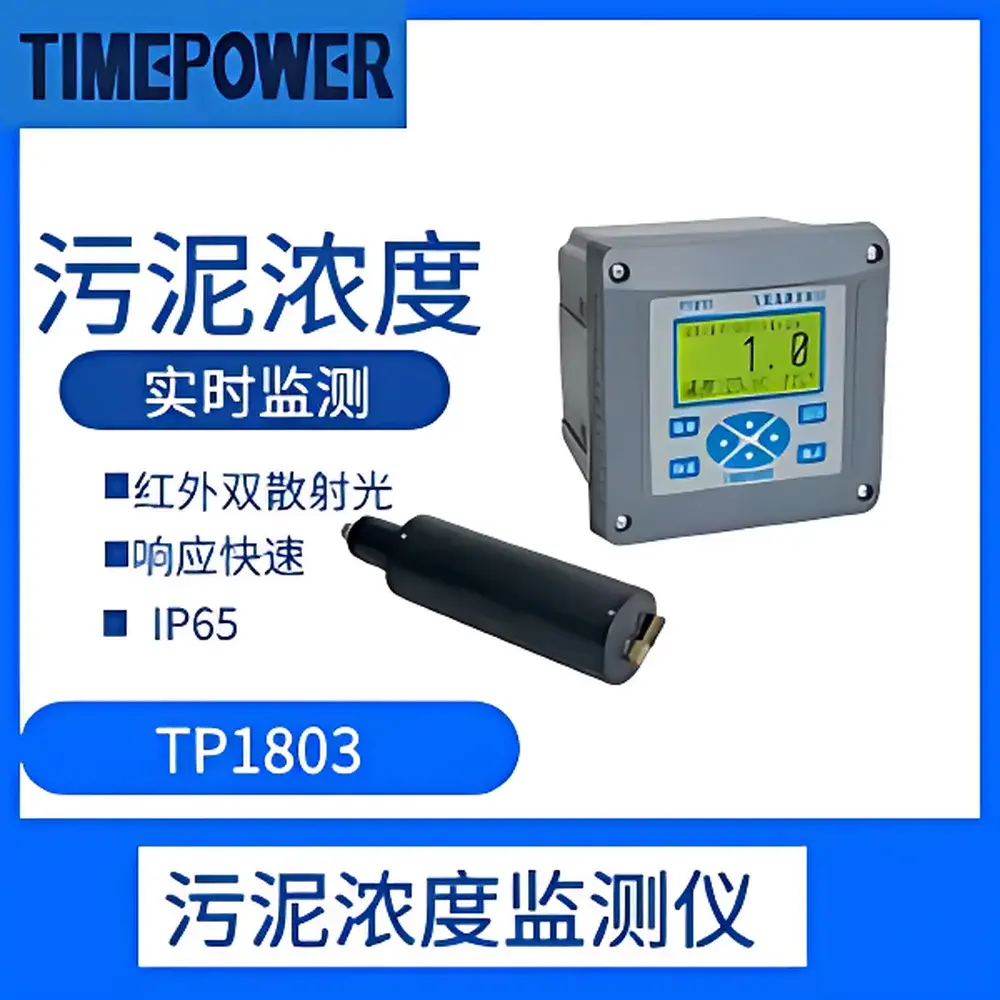
TimePower TP1803 Sludge Concentration Monitor & Interface Level Gauge
| Brand | TimePower |
|---|---|
| Origin | Beijing, China |
| Manufacturer Type | Direct Manufacturer |
| Product Category | Domestic |
| Model | TP1803 |
| Pricing | Available Upon Request |
Overview
The TimePower TP1803 Sludge Concentration Monitor and Interface Level Gauge is an industrial-grade, in-line optical sensor engineered for continuous, real-time measurement of suspended solids (SS) and sludge concentration in aqueous environments. It operates on the ISO 7027-compliant dual-beam infrared light scattering principle — employing two distinct infrared wavelengths (typically 850 nm and 940 nm) to simultaneously detect forward and side-scattered light. This dual-channel architecture effectively decouples turbidity-related interference from chromatic absorption effects, ensuring stable output independent of water coloration, dye presence, or organic humic substances commonly encountered in municipal and industrial wastewater streams. Unlike single-wavelength nephelometers, the TP1803 compensates for signal drift caused by fouling or aging of optical components through internal reference channel normalization. Its robust stainless-steel probe housing (IP68 rated) and sapphire optical window provide long-term stability under high-solids loading conditions typical in activated sludge basins, secondary clarifiers, thickening zones, and anaerobic digesters.
Key Features
- ISO 7027-compliant dual-infrared scattering detection for color-independent SS quantification
- Wide dynamic range: 0–120,000 mg/L TSS (customizable span available upon specification)
- High-resolution analog-to-digital conversion with selectable resolution: 0.01–1 mg/L, scaled per configured range
- Measurement accuracy: ±5% of full scale (FS), dependent on sludge homogeneity and particle size distribution
- Repeatability: ≤±2% FS under constant hydraulic and thermal conditions
- Process compatibility: Max operating pressure ≤0.4 MPa; flow velocity ≤2.5 m/s (8.2 ft/s)
- Integrated temperature compensation across 0–60 °C with ±0.5 °C sensor accuracy
- Standard 10 m shielded coaxial cable (extendable up to 100 m with signal integrity verification)
- 128×64 dot-matrix LCD display with native Chinese interface (English firmware optional)
- Power supply: AC 85–265 V, 45–65 Hz; compatible with industrial power grids without external transformers
- Mounting flexibility: Panel-cut, wall-mount, or rack-mount secondary transmitter enclosure
Sample Compatibility & Compliance
The TP1803 is validated for use in municipal wastewater treatment plants (WWTPs), industrial effluent lines (e.g., pulp & paper, food processing, pharmaceutical manufacturing), and sludge handling systems including gravity thickeners, dissolved air flotation (DAF) units, and centrifuge feed streams. It complies with ISO 7027:2016 for optical turbidity measurement methodology and meets CE electromagnetic compatibility (EMC) Directive 2014/30/EU requirements. While not certified to IEC 61508 SIL levels, its hardware architecture supports integration into safety-rated control loops when deployed with appropriate system-level validation per IEC 61511. The instrument adheres to GLP data integrity expectations when paired with compliant data loggers, supporting audit-ready timestamped records required under EPA Method 160.1 and ISO 5667-17 for wastewater sampling and analysis.
Software & Data Management
The TP1803 transmits analog 4–20 mA output (HART-enabled optional) and RS485 Modbus RTU protocol for seamless integration into SCADA, DCS, or PLC-based process control systems. Local configuration and diagnostics are performed via the built-in keypad and LCD interface. For centralized monitoring, TimePower provides optional PC-based configuration software (TP-Config Suite v3.x) supporting calibration history logging, zero/span adjustment, temperature coefficient tuning, and alarm threshold setting. All operational parameters—including calibration date, sensor status flags, and raw scatter intensity values—are stored with time stamps and accessible via serial query. The system supports basic data logging (up to 30 days at 1-min intervals) onboard; extended archival requires external historian systems compliant with ISA-95 or OPC UA standards.
Applications
- Real-time monitoring of mixed liquor suspended solids (MLSS) in aeration tanks
- Interface level tracking between clarified supernatant and settled sludge blanket in secondary clarifiers
- Feed concentration control for belt filter presses and centrifuges
- Performance verification of membrane bioreactors (MBRs) and submerged ultrafiltration systems
- Early detection of sludge bulking or filamentous overgrowth via trend analysis of scatter ratio shifts
- Compliance reporting for discharge consent limits under national wastewater regulations (e.g., China’s GB 18918-2002, EU Urban Wastewater Treatment Directive 91/271/EEC)
FAQ
What is the recommended maintenance interval for the optical window?
Routine visual inspection every 2 weeks is advised; mechanical cleaning with soft lint-free cloth and deionized water is sufficient under normal operation. Ultrasonic cleaning may be used quarterly in high-fouling applications.
Can the TP1803 distinguish between organic and inorganic suspended solids?
No — it reports total suspended solids (TSS) as mass concentration (mg/L) based on light scatter cross-section. Particle composition must be determined separately via gravimetric filtration (EPA 160.2) or elemental analysis.
Is the device suitable for seawater or brine applications?
Yes, provided the probe material (316L stainless steel + sapphire) remains compatible with chloride concentrations up to 35,000 ppm; however, salinity-induced refractive index shifts may require empirical recalibration.
Does the unit support FDA 21 CFR Part 11 compliance?
The standalone TP1803 does not include electronic signature or audit trail functionality; such features require integration with validated third-party data acquisition systems meeting Part 11 requirements.
How is zero calibration performed in-situ?
Zero calibration is executed using certified low-turbidity standard (Formazin or AMCO AEPA-1 equivalent) introduced into a bypass cell; field zeroing without standards is not recommended due to inherent baseline drift in high-solid matrices.
Related Products







