
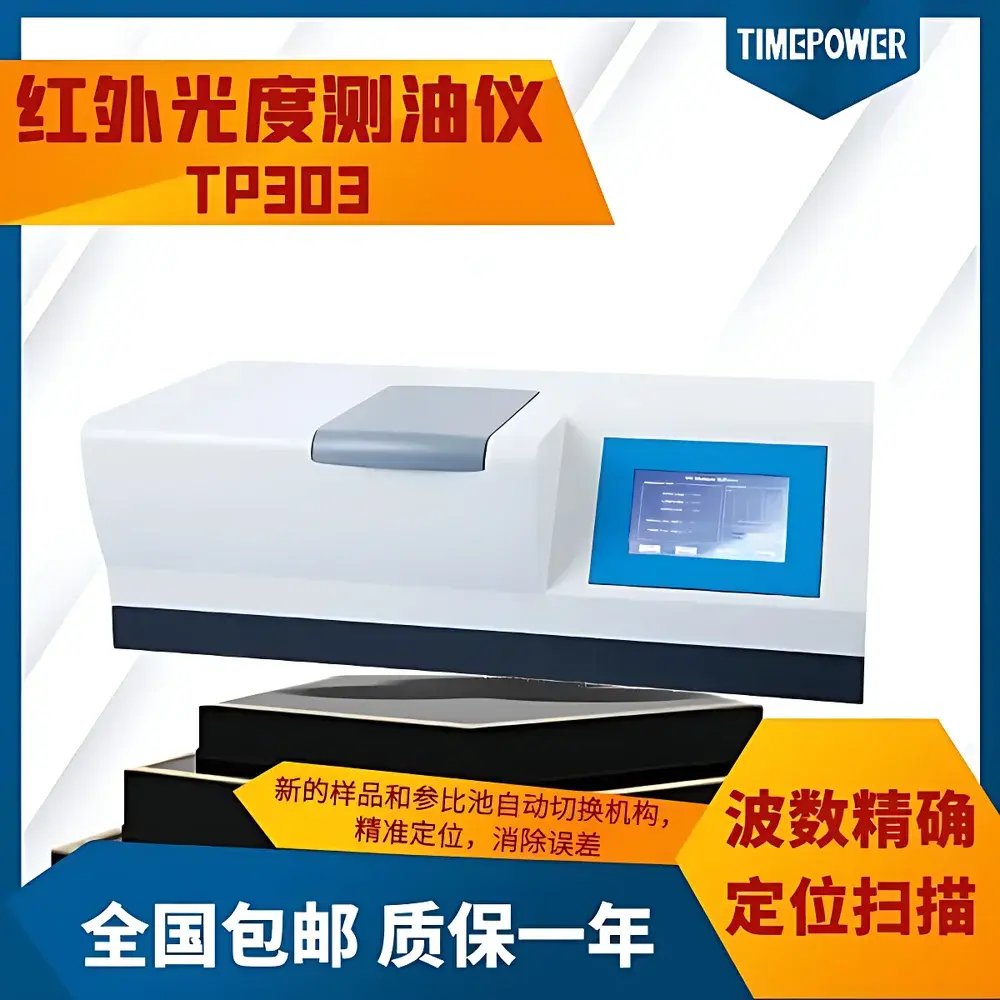
Timepower TP303 Benchtop Infrared Oil-in-Water Analyzer
| Brand | Timepower |
|---|---|
| Origin | Beijing, China |
| Manufacturer Type | Direct Manufacturer |
| Country of Origin | China |
| Model | TP303 |
| Pricing | Upon Request |
Overview
The Timepower TP303 Benchtop Infrared Oil-in-Water Analyzer is a dedicated laboratory instrument engineered for precise quantification of total petroleum hydrocarbons (TPH) and mineral oil content in aqueous matrices using standardized infrared absorption spectroscopy. It operates on the principle of dual-beam, single-wavelength (three-point) absorbance measurement at key mid-infrared spectral bands—specifically at 2960 cm⁻¹ (C–H asymmetric stretch), 2930 cm⁻¹ (C–H symmetric stretch), and 2870 cm⁻¹ (C–H deformation)—as mandated by China’s environmental monitoring standard HJ 637–2012. Unlike conventional calibration-dependent spectrophotometers, the TP303 implements a fixed-coefficient calculation algorithm derived from representative reference oils, eliminating the need for daily standard curve generation while maintaining traceability to certified reference materials. Its optical architecture employs a cosine-corrected, high-stability tungsten-halogen source coupled with a precision grating monochromator and thermoelectrically stabilized PbSe detector, ensuring long-term photometric stability and minimal drift under routine lab conditions.
Key Features
- Compliance with HJ 637–2012 methodology for oil-in-water analysis in environmental and industrial wastewater samples
- Dual-beam optical path with automated sample/reference cell switching to minimize mechanical alignment drift and baseline instability
- Cosine-based wavenumber scanning mechanism achieving spectral positioning accuracy better than ±1 cm⁻¹ across the 2800–3000 cm⁻¹ operational range
- True three-wavenumber measurement mode (2960, 2930, 2870 cm⁻¹) enabling direct calculation of total oil concentration without empirical calibration curves
- Dedicated software module for cooking fume oil analysis aligned with GB 18483–2001 emission limits, including integrated dilution factor compensation and reporting templates
- Integrated thermal-stabilized optical bench and wide-input switching power supply (100–240 VAC, 50/60 Hz) for operation in variable laboratory power environments
- High-contrast 5.7-inch backlit LCD display with full Chinese-language menu navigation; standalone operation without PC dependency
Sample Compatibility & Compliance
The TP303 is validated for use with liquid-phase extracts prepared via CCl₄ or tetrachloroethylene (per HJ 637–2012), including emulsified, dissolved, and suspended oil fractions in surface water, groundwater, municipal effluent, and industrial process streams. It supports both unfiltered and pre-filtered (0.45 µm membrane) sample preparations. Instrument compliance extends to GLP-aligned workflows: audit trails are maintained for all measurement events, including operator ID, date/time stamp, extraction solvent batch, and raw absorbance values. While not FDA 21 CFR Part 11–certified out-of-the-box, its data export format (CSV, TXT) enables integration into validated LIMS environments supporting electronic record retention per ISO/IEC 17025 requirements.
Software & Data Management
The embedded firmware provides real-time spectral visualization, coefficient validation checks, and automatic interference flagging based on spectral shape deviation thresholds. Measurement results—including calculated oil concentration (mg/L), residual absorbance ratios, and spectral quality indices—are stored internally (up to 1,000 records) and exportable via RS-232 or USB interface. Optional PC software (TP-DataLink v3.x) supports advanced spectral overlay, batch report generation (PDF/Excel), and calibration coefficient management with digital signature logging. All exported datasets retain native wavenumber resolution and raw detector voltage outputs for secondary reprocessing.
Applications
- Regulatory compliance testing for wastewater discharge permits (e.g., municipal treatment plants, petrochemical facilities)
- Environmental field lab screening of oil spills, sediment pore water, and stormwater runoff
- Quality control of cooling tower water, boiler feedwater, and metalworking fluid sumps
- Monitoring of oil-water separator efficiency in refinery and offshore platform operations
- Research-grade characterization of biodegradation kinetics in oil-contaminated aquifer systems
- Routine surveillance of food service exhaust ducts per GB 18483–2001 cooking fume regulations
FAQ
Does the TP303 require daily calibration with standard oil solutions?
No. The instrument uses pre-determined correction coefficients derived from NIST-traceable mineral oil standards; only periodic verification with a single reference standard (e.g., 5 mg/L mineral oil in CCl₄) is recommended every 30 days.
Can it distinguish between diesel, lubricating oil, and crude oil in mixed samples?
It quantifies total extractable petroleum hydrocarbons but does not speciate individual hydrocarbon classes; spectral interference assessment is supported via real-time residual plot analysis.
Is the instrument compatible with non-CCl₄ extraction solvents?
Yes—tetrachloroethylene (PERC) and alternative IR-transparent solvents may be used, provided their blank absorbance profiles are validated against the instrument’s built-in solvent library.
What maintenance is required beyond routine cleaning of cuvettes and optical windows?
Annual verification of wavelength accuracy using polystyrene film standard and detector responsivity check using certified neutral density filters are advised.
Does the system support remote diagnostics or firmware updates?
Firmware updates are performed locally via USB drive; remote diagnostic capability is not included but can be enabled through optional Ethernet module (TP-NET-01).




