
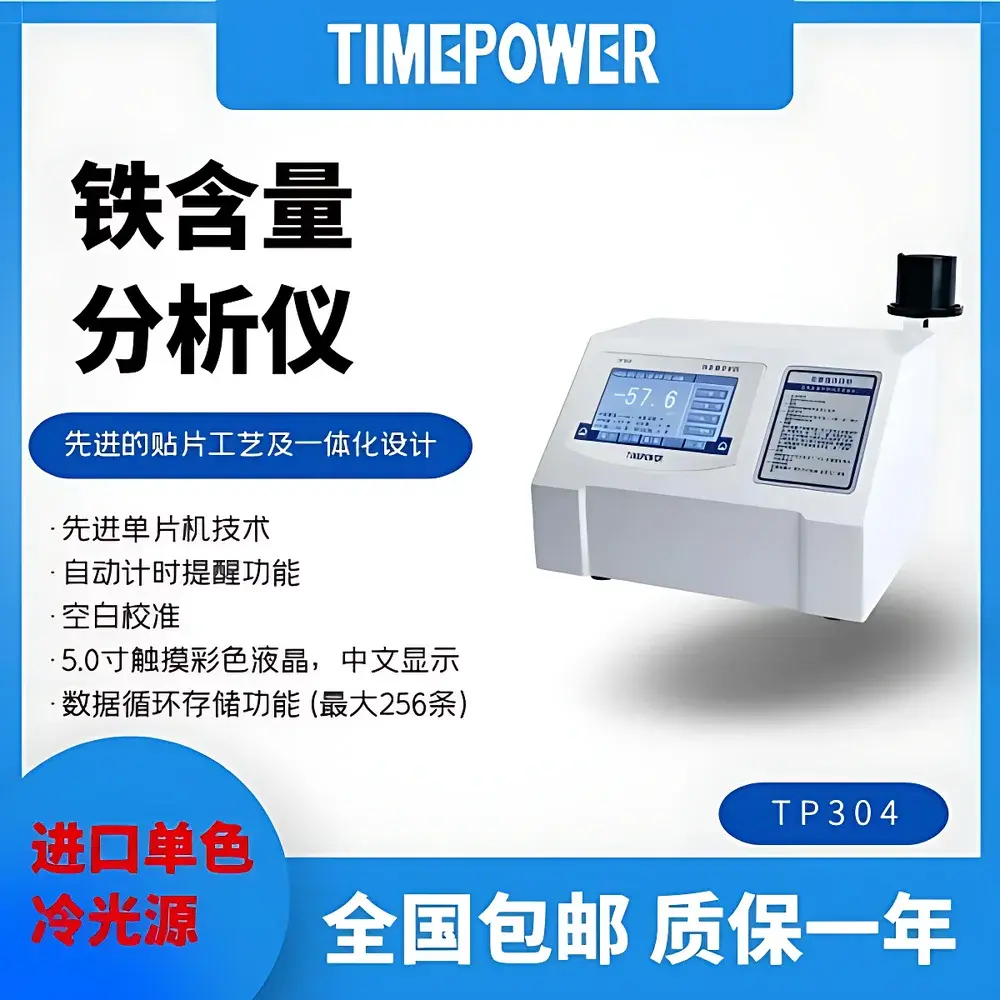
TimePower TP304 Iron Content Analyzer
| Brand | TimePower |
|---|---|
| Model | TP304 |
| Origin | Beijing, China |
| Manufacturer | TimePower Measurement & Control Co., Ltd. |
| Instrument Type | Visible Spectrophotometric Iron Analyzer (1,10-Phenanthroline Method) |
| Display | 5.0-inch TFT color touch LCD |
| Light Source | Imported monochromatic cold LED (λ = 510 nm ± 2 nm) |
| Detection Principle | Colorimetric spectrophotometry |
| Calibration | Automatic zero-point correction via blank calibration |
| Data Storage | Cyclic memory for ≤256 measurement records |
| Power Supply | AC 220 V ± 10%, 50 Hz |
| Compliance | Designed per GB/T 12149–2019 (Industrial Boiler Water and Steam Quality Testing), ASTM D1066 (Standard Practice for Sampling Steam) referenced methodology |
Overview
The TimePower TP304 Iron Content Analyzer is a dedicated benchtop photometric analyzer engineered for the quantitative determination of total dissolved iron (Fe²⁺/Fe³⁺) in low-conductivity aqueous matrices common in thermal power plant water-steam cycles. It operates on the internationally standardized 1,10-phenanthroline colorimetric method (ISO 6685:1982, GB/T 12149–2019), wherein ferrous ions form a stable orange-red chelate complex with 1,10-phenanthroline under controlled pH and reducing conditions. Absorbance is measured at 510 nm using a precision monochromatic cold LED light source, ensuring minimal thermal drift and long-term photometric stability. The instrument is purpose-built for routine monitoring of boiler feedwater, condensate, steam condensate, generator internal cooling water, drum boiler water, and natural surface waters—where sub-ppb to low-ppm iron concentrations directly impact corrosion kinetics, deposit formation, and turbine efficiency.
Key Features
- 5.0-inch high-resolution TFT color touchscreen interface with intuitive Chinese-language navigation and real-time status prompts
- Advanced surface-mount technology (SMT) PCB architecture with integrated shielding, delivering enhanced electromagnetic compatibility (EMC) and long-term signal integrity
- Dedicated 8-bit microcontroller unit optimized for low-power operation (<3 W standby) and deterministic timing control during colorimetric reaction incubation
- Imported narrow-band cold LED light source (center wavelength 510 nm ± 2 nm, FWHM <15 nm) providing superior photometric repeatability (RSD <0.8% over 8 h)
- Automated timing sequence with audible and visual alerts for critical reaction intervals (e.g., 10-min complexation period), minimizing operator dependency
- Onboard blank calibration routine that compensates for cuvette optical path variance, reagent background, and electronic zero drift—essential for maintaining accuracy across extended operational shifts
- Cyclic non-volatile memory storing up to 256 measurement entries (date/time stamp, sample ID, absorbance, calculated Fe concentration); overflow management ensures continuous logging without manual intervention
Sample Compatibility & Compliance
The TP304 accepts standard 10-mm rectangular quartz or high-transmittance optical glass cuvettes (path length 10 mm). It supports direct analysis of clarified samples with turbidity <1 NTU and suspended solids <1 mg/L. For high-iron or complex matrix samples (e.g., raw river water), optional acid digestion (HCl/HNO₃) and ascorbic acid reduction pretreatment are recommended per ISO 6685 protocols. The analyzer conforms to key regulatory frameworks governing power plant chemistry: it supports data acquisition aligned with GB/T 12149–2019 for boiler water quality verification, and its analytical methodology is traceable to ASTM D1066 (steam sampling practice) and ASTM D858 (standard test method for iron in water). While not a GLP/GMP-certified system, its calibration traceability, audit-ready data logs, and procedural consistency make it suitable for ISO 9001-certified QA/QC laboratories performing routine compliance testing.
Software & Data Management
The TP304 operates autonomously without external PC connectivity; all configuration, calibration, and reporting occur locally via the embedded UI. Measurement data—including timestamp, user-defined sample ID, raw absorbance, and final Fe concentration (reported in µg/L or mg/L)—are stored in chronological order with automatic overwrite logic. Data export is performed manually via USB flash drive (FAT32 formatted), generating CSV files compatible with Excel, LIMS, or statistical process control (SPC) platforms. No proprietary software installation is required. The firmware implements basic audit trail functionality: each calibration event and parameter change is time-stamped and logged alongside operator ID (entered manually), satisfying minimum documentation requirements for internal quality audits.
Applications
- Continuous iron monitoring in ultra-pure boiler feedwater systems (target: <5 µg/L Fe to prevent magnetite scaling)
- Corrosion product tracking in condensate return lines and deaerator outlets
- Steam purity assessment per IAPWS RP-7 guidelines, where iron serves as an indicator of superheater tube degradation
- Generator stator cooling water surveillance to detect early copper-iron galvanic coupling effects
- Baseline iron profiling in makeup water sources (reservoirs, wells) prior to demineralization treatment
- Educational use in university chemistry labs for teaching spectrophotometric quantification principles and redox-based complexometric analysis
FAQ
What is the detection range and typical LOD for the TP304?
The instrument is calibrated for a linear dynamic range of 0–500 µg/L Fe, with a limit of detection (LOD) of approximately 3 µg/L based on 3σ of blank measurements (n=10), consistent with the 1,10-phenanthroline method’s inherent sensitivity.
Does the TP304 support automatic dilution or multi-range measurement?
No—sample dilution must be performed manually prior to analysis. Users select the appropriate calibration curve (low-range: 0–100 µg/L; high-range: 0–500 µg/L) via the menu interface.
Is the reagent kit included, and what is its shelf life?
Reagents (1,10-phenanthroline solution, ammonium acetate buffer, hydroxylamine hydrochloride reducer) are supplied separately. Unopened kits retain stability for ≥12 months when stored at 4–25 °C; post-opening, buffer and reducer solutions remain valid for 30 days under refrigeration.
Can the TP304 be integrated into a central SCADA or DCS system?
It does not feature analog outputs (4–20 mA) or industrial communication protocols (Modbus RTU/TCP). Integration requires external data loggers or USB-to-serial gateways configured for periodic CSV polling.






