
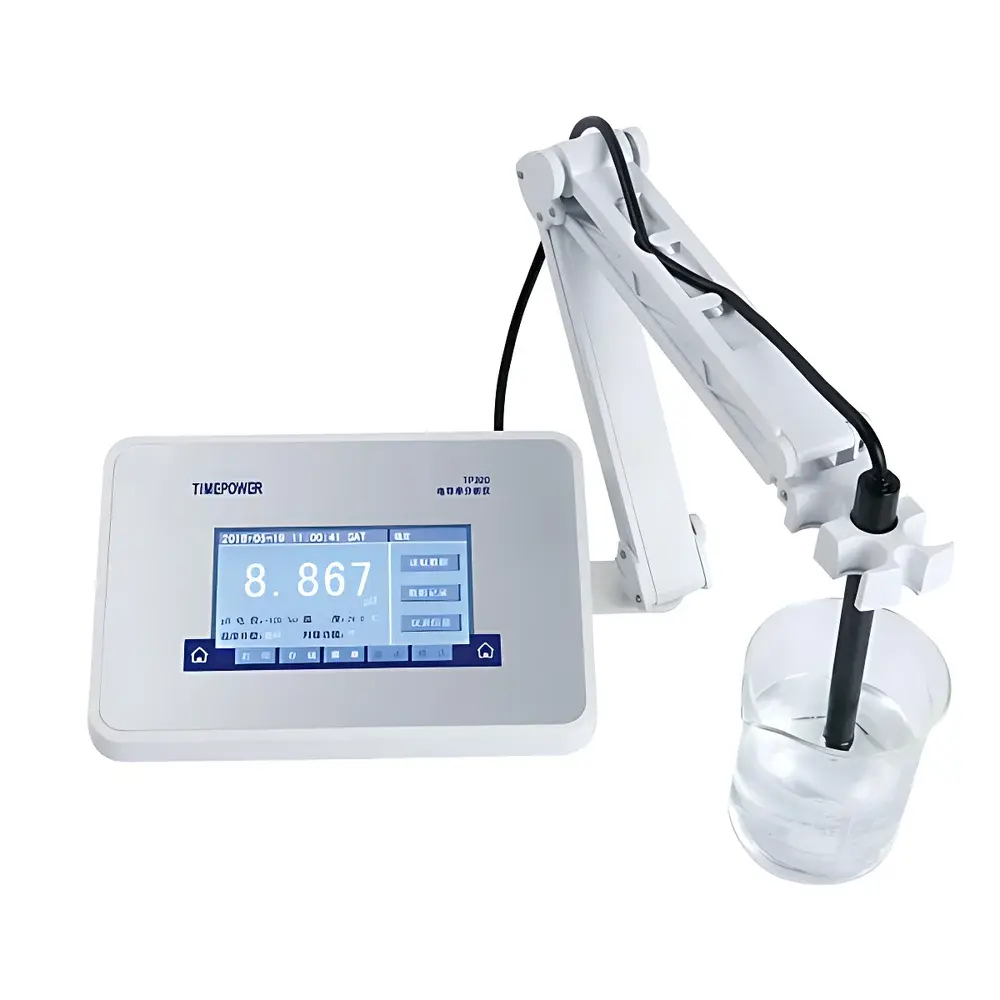
TimePower TP320 Benchtop Conductivity Analyzer
| Brand | TimePower |
|---|---|
| Origin | Beijing, China |
| Manufacturer Type | OEM/ODM Manufacturer |
| Product Category | Domestic (China-Made) |
| Model | TP320 |
| Detection Parameter | Single-Parameter (Conductivity) |
| Form Factor | Benchtop |
| Conductivity Range | 0–30,000 mS/cm |
| TDS Range | 0–100 g/L |
| Resistivity Range | Up to 1 × 10¹² Ω·cm |
| Salinity Range | 0–100 ppt |
| Temperature Range | 0.0–99.9 °C |
| Accuracy | ±1% F.S. |
| Minimum Resolution | 0.01 µS/cm |
| Display | 5.0-inch Color Touch LCD (Chinese UI) |
| Temperature Sensor | Pt1000 |
| Auto-Temperature Compensation | 0–60 °C |
| Repeatability | ≤1% |
| Power Supply | AC 85–265 V, 45–65 Hz |
| Power Consumption | ≤5 W |
| Dimensions | 200 × 200 × 85 mm |
| Weight | 2.1 kg |
| Data Retention | >10 years (non-volatile memory) |
| Electrode Options | K=0.01, 0.1, 1.0, and 10.0 cm⁻¹ conductivity cells (platinum black or stainless steel) |
Overview
The TimePower TP320 Benchtop Conductivity Analyzer is a precision electrochemical instrument engineered for stable, traceable, and repeatable measurement of electrical conductivity in aqueous solutions. It operates on the principle of two-electrode or four-electrode conductometric sensing—applying a low-frequency sinusoidal AC voltage (1–3 kHz) across a pair of parallel or cylindrical electrodes immersed in the sample. This method eliminates polarization effects and minimizes electrolytic decomposition, ensuring long-term electrode stability and measurement fidelity. The analyzer supports full-range conductivity quantification from ultrapure water (<1 µS/cm) to highly conductive brines (up to 30,000 mS/cm), making it suitable for laboratories requiring compliance with ASTM D1125, ISO 7888, USP , and EPA Method 120.1. Its benchtop architecture integrates thermal compensation via Pt1000 sensor, enabling automatic correction per ISO 7888 Annex B and IEC 60746-3 standards.
Key Features
- Multi-range conductivity measurement with selectable cell constants (K = 0.01, 0.1, 1.0, and 10.0 cm⁻¹) to optimize resolution and accuracy across diverse sample matrices—from deionized water to industrial effluents.
- High-resolution analog-to-digital conversion and embedded microcontroller architecture ensure ±1% full-scale accuracy and ≤1% repeatability under controlled environmental conditions (5–45 °C, ≤90% RH).
- Integrated temperature compensation (0–60 °C range) using Pt1000 thermistor, compliant with linear and non-linear (Steinhart-Hart) correction algorithms per IEC 60746-3.
- 5.0-inch color touch LCD with Chinese-language interface provides simultaneous real-time display of conductivity, TDS, resistivity, salinity, temperature, timestamp, and system status—no external PC required for operation.
- Non-volatile memory retains >10 years of calibration history, measurement logs, and configuration settings without battery backup—fully traceable for GLP/GMP audits.
- Rugged, surface-mount PCB design with sealed enclosure (IP20-rated) ensures operational stability in QC labs, power plant chemistry departments, and pharmaceutical water systems.
Sample Compatibility & Compliance
The TP320 accommodates a broad spectrum of aqueous samples including boiler feedwater, reverse osmosis permeate, pharmaceutical purified water (PW) and water for injection (WFI), municipal wastewater, chemical process streams, and food-grade rinse solutions. Its modular electrode support enables seamless transition between low-conductivity (K = 0.01 cm⁻¹) and high-conductivity (K = 10.0 cm⁻¹) configurations—critical for minimizing cell constant error per ISO 7888:2012. All measurements adhere to traceability requirements defined in ISO/IEC 17025:2017, with documented uncertainty budgets available upon request. The instrument meets electromagnetic compatibility (EMC) per IEC 61326-1 and safety requirements per IEC 61010-1 for laboratory electrical equipment.
Software & Data Management
While the TP320 operates as a standalone analyzer with no mandatory software dependency, its internal data structure follows CSV-compatible logging conventions. Measurement records—including date/time stamps, raw conductivity values, compensated values, temperature readings, and electrode ID—are stored sequentially and retrievable via front-panel navigation. For regulated environments, optional RS232/USB output (available via firmware update) supports integration with LIMS or SCADA platforms compliant with FDA 21 CFR Part 11—enabling electronic signatures, audit trails, and user-access controls. Calibration events are time-stamped and archived with operator ID fields, satisfying ALCOA+ data integrity principles.
Applications
- Power generation: Continuous monitoring of condensate polisher effluent and turbine cycle chemistry per EPRI guidelines.
- Pharmaceutical manufacturing: Routine verification of PW/WFI conductivity against USP limits (e.g., ≤1.3 µS/cm at 25 °C).
- Environmental testing: Field-deployable lab validation of surface water, groundwater, and wastewater per EPA 120.1 and ISO 15839.
- Chemical process control: Real-time feedback for acid/base concentration adjustment in fertilizer and electroplating baths.
- Food & beverage QA: Verification of cleaning-in-place (CIP) rinse water purity and final product formulation consistency.
- Academic research: Teaching and method development in electrochemistry, membrane separation, and ion exchange kinetics.
FAQ
What cell constant should I select for measuring ultrapure water?
For samples below 1 µS/cm, use the K = 0.01 cm⁻¹ electrode with a sealed flow-through cell to minimize CO₂ absorption and airborne contamination.
Does the TP320 support GLP-compliant calibration documentation?
Yes—each calibration event stores date, standard value, measured value, deviation, and operator ID; exportable via optional serial interface.
Is temperature compensation configurable manually or only automatic?
Both modes are supported: automatic Pt1000-based compensation (default) or manual offset entry for specialized protocols.
Can the instrument be integrated into a SCADA system?
RS232 communication is hardware-ready; Modbus RTU or ASCII protocol implementation requires optional firmware activation and configuration.
What is the recommended recalibration frequency for routine QC use?
Per ISO/IEC 17025, recalibrate before each analytical batch or at least daily when used in GMP environments; verify with NIST-traceable KCl standards.





