
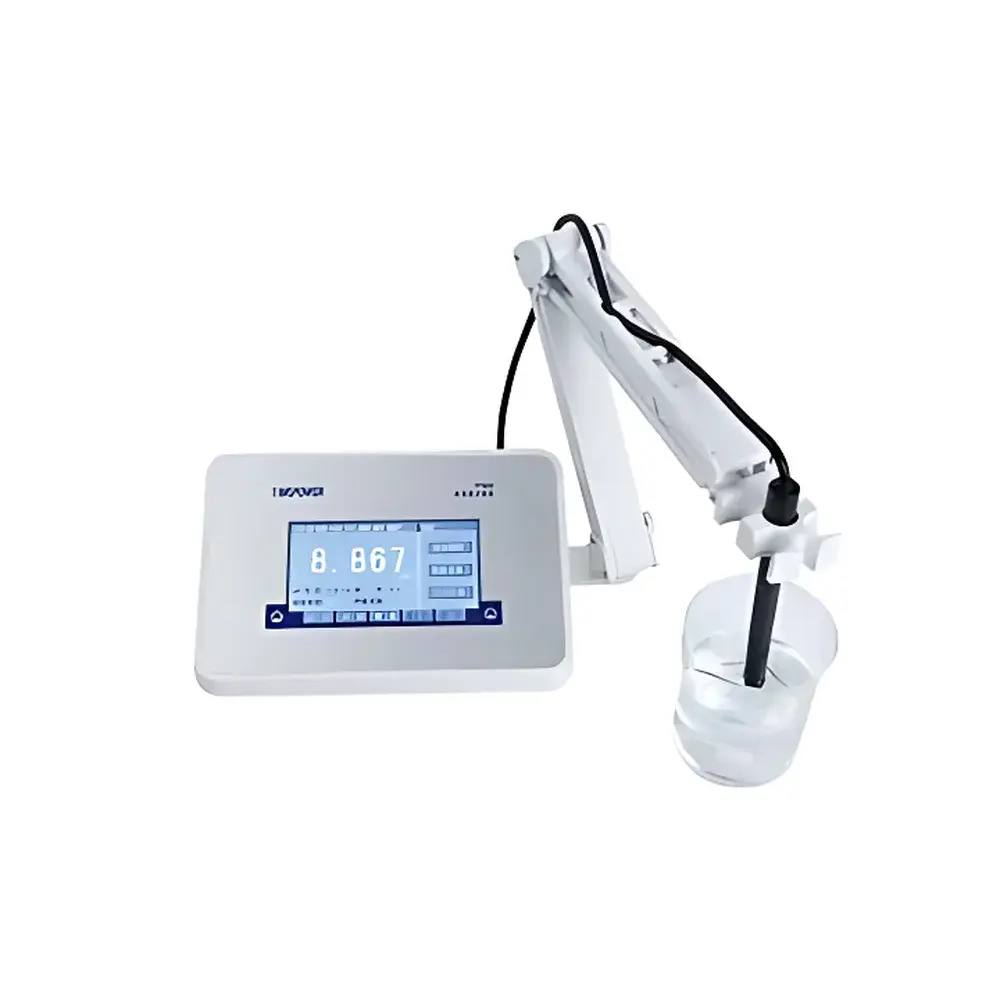
Timepower TP320 Precision Benchtop Conductivity Analyzer
| Brand | Timepower |
|---|---|
| Model | TP320 |
| Origin | Beijing, China |
| Manufacturer Type | Direct Manufacturer |
| Country of Origin | China |
| Measurement Principle | Two-electrode AC conductance (1–3 kHz sine wave) |
| Cell Constants Supported | 0.01, 0.1, 1.0, 10.0 cm⁻¹ |
| Conductivity Range | 0.000–30,000 µS/cm (auto-ranging across four cell constants) |
| Accuracy | ±2.5% FS |
| Resolution | 0.001 µS/cm |
| Repeatability | ≤1% |
| Temperature Compensation | Automatic, PT1000 sensor, 0–60 °C |
| Sample Temp. Range | 5–60 °C |
| Ambient Temp. Range | 5–45 °C |
| Humidity Limit | ≤90% RH (non-condensing) |
| Storage Temp. | −25 to +55 °C |
| Power Supply | AC 85–265 V, 45–65 Hz |
| Power Consumption | ≤5 W |
| Dimensions | 200 × 200 × 85 mm |
| Weight | 2.1 kg |
| Display | 5.0-inch color TFT touchscreen, Chinese UI |
| Data Storage | Cyclic non-volatile memory, >10 years retention after power loss |
| Key Functions | Auto-range switching, real-time temperature compensation, multi-parameter on-screen display (conductivity, temp, time, status), menu-driven operation |
Overview
The Timepower TP320 Precision Benchtop Conductivity Analyzer is an industrial-grade, microprocessor-controlled laboratory instrument engineered for high-reproducibility electrical conductivity measurement in aqueous solutions. It operates on the fundamental principle of two-electrode AC conductance: a low-distortion sinusoidal excitation voltage (1–3 kHz) is applied across a pair of parallel or cylindrical electrodes immersed in the sample, minimizing polarization and electrolytic decomposition while enabling stable current measurement. The resulting conductance—converted to conductivity using the calibrated cell constant (K)—is corrected in real time via an integrated PT1000 temperature sensor and programmable linear or non-linear temperature compensation algorithms compliant with ASTM D1125 and ISO 7888 standards. Designed for continuous monitoring and quality control environments, the TP320 delivers traceable, repeatable measurements across four decades of conductivity—from ultrapure water (sub-1 µS/cm) to concentrated brines (up to 30 mS/cm)—without manual range intervention.
Key Features
- Four selectable electrode cell constants (0.01, 0.1, 1.0, and 10.0 cm⁻¹) optimized for specific conductivity regimes—enabling accurate measurement of ultrapure water (K = 0.01 cm⁻¹), potable water (K = 0.1 cm⁻¹), process streams (K = 1.0 cm⁻¹), and high-conductivity industrial effluents (K = 10.0 cm⁻¹).
- High-stability analog front-end with 24-bit ADC and embedded single-chip microcontroller architecture ensures <1% repeatability and ±2.5% full-scale accuracy per IEC 60746-3 verification protocols.
- 5.0-inch capacitive touchscreen interface with intuitive Chinese-language menu navigation—designed for rapid operator training and minimal error rate in regulated lab environments.
- Integrated non-volatile memory retains calibration data, measurement logs, and system configuration for >10 years without battery backup—fully compliant with GLP audit requirements for data integrity.
- Robust mechanical design (IP20-rated enclosure), surface-mount PCB assembly, and thermally stabilized circuitry ensure long-term operational stability under variable ambient conditions (5–45 °C, ≤90% RH).
- Real-time concurrent display of conductivity value, compensated temperature, timestamp, and instrument status—eliminating need for secondary logging devices during routine QC checks.
Sample Compatibility & Compliance
The TP320 supports a broad spectrum of aqueous matrices encountered in regulated industries: boiler feedwater and condensate (power generation), nutrient solutions and rinse waters (pharmaceutical manufacturing), fermentation broths and buffer preparations (biotechnology), wastewater influent/effluent (municipal and industrial treatment), and process cooling loops (chemical and metallurgical plants). Its electrode compatibility aligns with USP , EP 2.2.38, and ASTM D5391 for purified water testing—particularly when paired with K = 0.01 cm⁻¹ electrodes and sealed flow cells to suppress CO₂ absorption artifacts in sub-3 µS/cm measurements. All firmware and calibration routines are structured to support 21 CFR Part 11-compliant electronic records when deployed with validated IT infrastructure.
Software & Data Management
While the TP320 operates as a standalone benchtop analyzer, its internal memory implements circular buffer logic with automatic overwrite upon capacity saturation—preserving the most recent 10,000+ measurement records with timestamp, conductivity, temperature, and electrode ID metadata. Data export is supported via USB host port (FAT32-formatted flash drive), generating CSV files compatible with LIMS integration, statistical process control (SPC) software, and Excel-based trending analysis. Calibration history—including date, standard used (e.g., KCl 0.01 mol/L at 25 °C), slope, offset, and operator ID—is permanently archived and retrievable for internal audits or regulatory inspections. No proprietary software installation is required for basic data retrieval.
Applications
- Power plant chemistry control: continuous monitoring of condensate polisher effluent and makeup water conductivity to detect condenser tube leakage or resin exhaustion.
- Pharmaceutical water systems: routine verification of Purified Water (PW) and Water for Injection (WFI) conductivity against pharmacopoeial limits per USP .
- Environmental compliance labs: field-deployable verification of surface water, groundwater, and treated effluent per EPA Method 120.1 and ISO 10523.
- Chemical process QA/QC: inline verification of acid/base concentration, salt solution strength, and cleaning-in-place (CIP) rinse endpoint detection.
- Food & beverage R&D: monitoring of osmotic pressure proxies in syrup dilutions, brine formulations, and dairy processing streams.
FAQ
What electrode constant should I select for ultrapure water measurement?
For samples below 3 µS/cm—especially those approaching 0.055 µS/cm (theoretical conductivity of Type I water at 25 °C)—a K = 0.01 cm⁻¹ electrode is mandatory. Use with a sealed, temperature-controlled flow cell to prevent atmospheric CO₂ dissolution and surface contamination.
Does the TP320 support linear and non-linear temperature compensation?
Yes. It offers both fixed α = 2.0 %/°C linear compensation (standard for general-purpose use) and configurable polynomial compensation tables aligned with NIST-traceable KCl reference data for high-accuracy applications.
Is the instrument suitable for GMP-regulated environments?
Yes. With documented calibration procedures, audit-trail-enabled data storage, and secure user-access controls (via optional password-protected setup mode), the TP320 meets core elements of EU GMP Annex 11 and FDA guidance on laboratory instrument qualification.
Can I connect the TP320 to a SCADA or DCS system?
No native 4–20 mA or Modbus RTU output is included; however, the USB data dump functionality enables scheduled automated extraction for integration into centralized data historians via middleware scripting.
How often does the instrument require recalibration?
Per ISO/IEC 17025 recommendations, initial calibration verification is advised before first use and after any physical impact or environmental shock. Routine verification using certified KCl standards is recommended daily for critical applications or weekly for general lab use.



