
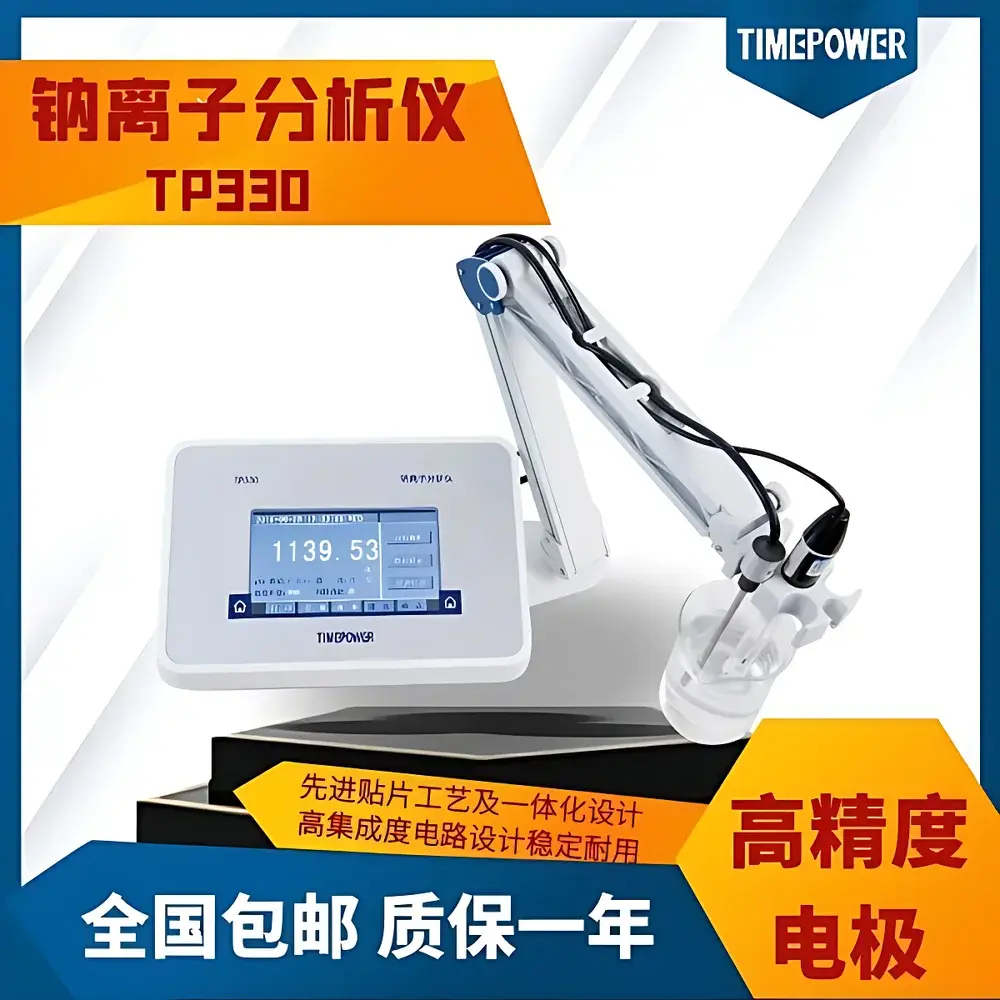
TimePower TP330 Benchtop Sodium Ion Analyzer
| Brand | TimePower |
|---|---|
| Model | TP330 |
| Origin | Beijing, China |
| Manufacturer | TimePower Measurement & Control Co., Ltd. |
| Type | Benchtop Sodium-Specific Ion Analyzer |
| Measurement Principle | Potentiometric Detection with Solid-State Sodium-Selective Electrode (SSE) |
| Display | 5.0-inch Color TFT Touchscreen |
| Data Storage | Cyclic non-volatile memory with >10-year data retention after power loss |
| A/D Resolution | 24-bit |
| Microcontroller Architecture | Low-power embedded single-chip system |
| Compliance | Designed for laboratory use in accordance with ISO 7888, ASTM D1587, and USP <643> guidelines for sodium measurement in purified water and steam condensate |
Overview
The TimePower TP330 Benchtop Sodium Ion Analyzer is a precision potentiometric instrument engineered for reliable, trace-level sodium ion quantification in ultra-pure water matrices—particularly critical in high-pressure boiler feedwater, nuclear steam generator chemistry, pharmaceutical water-for-injection (WFI), and semiconductor rinse water applications. It employs a solid-state sodium-selective electrode (SSE) based on lanthanum aluminate (LaAlO₃) membrane technology, offering stable Nernstian response (59.2 mV/decade at 25 °C) with minimal interference from hydrogen ion (pH > 10 required) and potassium ion (< 0.1% cross-sensitivity). Unlike optical or ISE-based systems requiring frequent calibration drift correction, the TP330 integrates real-time temperature compensation (Pt1000 sensor) and automatic junction potential correction, enabling consistent sub-ppb (≤0.01 µg/L) detection capability under controlled lab conditions. Its benchtop form factor eliminates the need for external peristaltic pumps or pressurized sample loops, making it suitable for discrete batch analysis rather than continuous online monitoring.
Key Features
- High-stability solid-state sodium-selective electrode with LaAlO₃ sensing membrane and Ag/AgCl reference system
- 24-bit high-resolution analog-to-digital conversion ensuring signal integrity and low-noise baseline stability
- Embedded low-power microcontroller architecture optimized for extended unattended operation and thermal drift mitigation
- 5.0-inch capacitive touchscreen interface with intuitive Chinese-language menu navigation and context-sensitive soft keys
- Cyclic non-volatile flash memory supporting ≥10,000 measurement records with automatic overwrite management and timestamping
- Integrated temperature compensation via Pt1000 RTD sensor; supports manual offset adjustment for electrode-specific slope calibration
- Modular electrode holder design compatible with standard 12-mm diameter sodium ISEs and refillable double-junction reference electrodes
Sample Compatibility & Compliance
The TP330 is validated for aqueous samples with conductivity < 1 µS/cm and pH ≥ 10.5 (adjusted with diisopropylamine or cyclohexylamine), meeting ASTM D1587–22 requirements for sodium determination in high-purity water. It complies with ISO 7888:2019 (electrochemical methods for ion concentration) and supports GLP documentation workflows through exportable CSV logs containing date/time, measured mV, calculated [Na⁺], temperature, electrode slope (%), and asymmetry potential. While not certified for FDA 21 CFR Part 11 compliance out-of-the-box, its audit trail functionality—including user ID tagging (via optional password-protected login), calibration history, and change logs—enables qualification under GMP Annex 11 and EU GMP Chapter 4 for regulated laboratory environments.
Software & Data Management
Data acquisition and reporting are managed entirely onboard via firmware-resident algorithms—no PC dependency required. Measurement results are stored with full metrological metadata: raw mV output, Nernst slope (mV/decade), temperature-corrected activity coefficient, and uncertainty estimation derived from electrode reproducibility (±0.02 pNa at 0.1 ppb, n=6). Export is supported via USB 2.0 to FAT32-formatted drives; files include UTF-8 encoded headers and ISO 8601 timestamps. Firmware updates are delivered via signed binary packages verified using SHA-256 checksums. Optional RS-485 Modbus RTU interface enables integration into SCADA or LIMS platforms for centralized data aggregation.
Applications
- Steam cycle chemistry control in fossil and nuclear power plants (ASTM D1587-compliant condensate and feedwater testing)
- Validation of purification efficiency in pharmaceutical WFI and pure steam systems (USP , EP 2.2.38)
- Trace sodium monitoring in ultrapure water used in semiconductor wafer cleaning processes (SEMI F57)
- Research-grade ion transport studies in electrochemistry and membrane science laboratories
- Educational training in analytical chemistry curricula focusing on ion-selective electrode theory and calibration protocols
FAQ
What is the minimum detectable sodium concentration with the TP330?
The practical lower limit of quantitation (LLOQ) is 0.01 µg/L (0.001 ppb) when operated with a calibrated SSE, maintained at pH > 10.5, and using low-sodium rinse water (≤0.005 µg/L blank).
Does the TP330 support automatic calibration verification?
No—it requires manual two-point calibration (e.g., 0.1 ppb and 10 ppb Na⁺ standards) using certified reference materials traceable to NIST SRM 3194. Slope and intercept validation must be performed before each analytical session.
Can the instrument store calibration parameters across power cycles?
Yes—calibration coefficients, electrode serial numbers, and user-defined labels are retained in write-protected EEPROM memory independent of main power supply.
Is the sodium electrode included with the base unit?
The TP330 is supplied without electrodes; users must procure compatible solid-state sodium ISEs and double-junction reference electrodes separately, following manufacturer-recommended pairing specifications.
What maintenance intervals are recommended for routine operation?
Electrode membrane polishing is advised every 3 months under daily use; electrolyte refilling (for reference electrode) and junction cleaning should occur weekly. Full system verification against primary standards is required quarterly per ISO/IEC 17025 internal quality procedures.
Related Products







