
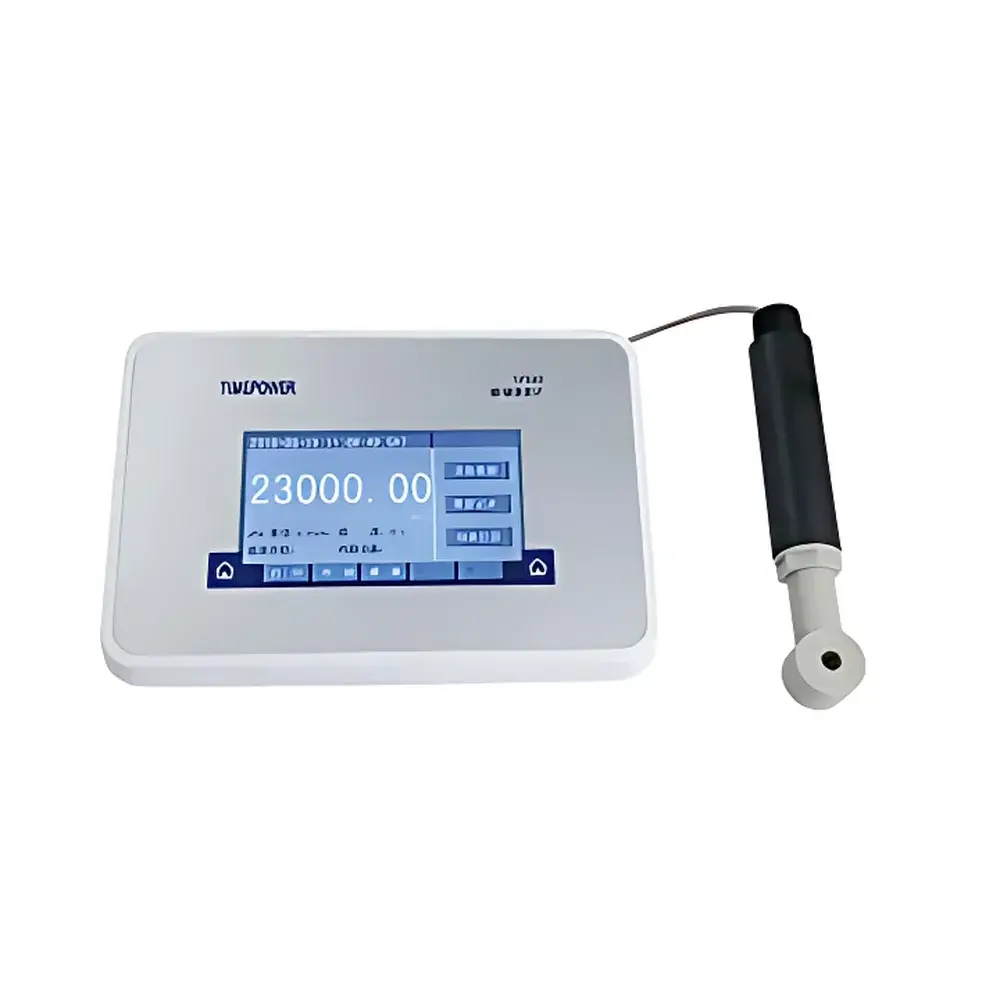
Timepower TP340 Acid-Base Concentration Meter
| Brand | Timepower |
|---|---|
| Model | TP340 |
| Origin | Beijing, China |
| Manufacturer Type | Direct Manufacturer |
| Country of Origin | China |
| Measurement Range (selectable) | HCl (0–10.00%), NaOH (0–10.00%), H₂SO₄ (0–20.00%), NaCl (0–20.00%), HNO₃ (0–15.00%), Na₂CO₃ (0–10.00%) |
| Accuracy | ±2% FS |
| Resolution | 0.01% |
| Repeatability | ≤1% |
| Stability | ±1% FS/4h |
| Temperature Compensation | Pt1000 sensor, 0–60 °C |
| Sample Temp. Range | 5–50 °C |
| Ambient Temp. Range | 5–45 °C |
| Humidity Limit | ≤90% RH (non-condensing) |
| Storage Temp. | −25–55 °C |
| Power Supply | AC 85–265 V, 45–65 Hz |
| Power Consumption | ≤5 W |
| Dimensions | 200 × 200 × 85 mm |
| Weight | 2.1 kg |
| Display | 5.0″ color touchscreen LCD with Chinese UI |
| A/D Conversion | 24-bit |
| Electrode | corrosion-resistant conductometric electrode |
Overview
The Timepower TP340 Acid-Base Concentration Meter is a precision conductometric analyzer engineered for real-time, non-titrative quantification of strong acid and base concentrations in industrial process streams and laboratory samples. It operates on the fundamental principle of solution conductivity measurement: electrical conductance between two parallel plate electrodes (1 cm² area, 1 cm spacing) immersed in an electrolyte is directly proportional to ion mobility and concentration. By applying temperature-compensated conductivity measurements and referencing pre-calibrated molar conductance values for common electrolytes—including HCl, NaOH, H₂SO₄, HNO₃, NaCl, and Na₂CO₃—the instrument computes mass percentage concentration via validated empirical algorithms. Unlike pH meters or titrators, the TP340 delivers rapid, operator-independent results without reagents, consumables, or endpoint detection—making it ideal for continuous monitoring in demanding environments where reliability, chemical resistance, and long-term stability are critical.
Key Features
- Corrosion-resistant conductometric electrode assembly optimized for aggressive acidic and alkaline media, including concentrated sulfuric and nitric acid solutions.
- High-resolution 24-bit analog-to-digital conversion ensures signal integrity and minimizes quantization error across the full measurement range.
- Integrated Pt1000 temperature sensor enables automatic temperature compensation (0–60 °C), correcting for thermal effects on conductivity per IEC 60788 and ASTM D1125 standards.
- Embedded microcontroller architecture with low-power consumption (≤5 W) supports unattended operation in control rooms or field-mounted enclosures.
- 5.0-inch capacitive touchscreen display with intuitive Chinese-language menu navigation—designed for operators with minimal instrumentation training.
- Circular data storage buffer retains up to 1,000 measurement records; overflow management automatically purges oldest entries to maintain continuity without manual intervention.
- Compact, fanless chassis (200 × 200 × 85 mm, 2.1 kg) meets IP20 ingress protection requirements for indoor industrial use.
Sample Compatibility & Compliance
The TP340 is validated for aqueous solutions containing fully dissociated strong electrolytes. It is routinely deployed in power generation (ion exchange resin regeneration monitoring), chemical manufacturing (in-line acid/base dosing verification), metallurgical leaching circuits, food-grade cleaning-in-place (CIP) validation, and pharmaceutical active pharmaceutical ingredient (API) synthesis steps requiring stoichiometric acid or base addition. While not certified to ISO/IEC 17025 for accredited testing, its design adheres to functional safety principles outlined in IEC 61508 for non-safety-critical process analyzers. The instrument’s measurement traceability aligns with national metrological verification regulations for conductivity-based concentration instruments (JJG 376–2007, China). Electrical safety complies with GB 4793.1–2019 (equivalent to IEC 61010-1).
Software & Data Management
The onboard firmware supports configuration, calibration, and diagnostics via the touchscreen interface. Calibration routines include single-point standard verification using certified reference solutions (e.g., 5.00% HCl or 3.00% NaOH). All calibration events, measurement timestamps, and user actions are logged locally with date/time stamps—supporting basic GLP documentation requirements. Data export is available via USB flash drive in CSV format for integration into LIMS or SCADA systems. Though the device does not implement FDA 21 CFR Part 11-compliant electronic signatures or audit trails, its deterministic firmware architecture and write-once calibration memory provide inherent resistance to unauthorized parameter modification.
Applications
- Monitoring HCl concentration during spent resin regeneration in high-purity water systems for power plant boiler feedwater treatment.
- Verifying NaOH strength in caustic scrubber recirculation loops within flue gas desulfurization (FGD) plants.
- Controlling H₂SO₄ dosage in zinc electrowinning electrolyte circulation systems.
- Validating NaOH concentration in dairy CIP tanks to ensure microbiological efficacy per 3-A Sanitary Standards.
- Tracking HNO₃ concentration in stainless steel passivation baths used in medical device manufacturing.
- Quantifying Na₂CO₃ content in detergent formulation QC laboratories.
FAQ
Does the TP340 require daily recalibration?
Calibration frequency depends on application severity and regulatory context. For stable process streams under routine conditions, weekly verification against a primary standard is sufficient. In high-variability or GMP-aligned environments, daily verification is recommended.
Can the instrument measure weak acids like acetic acid or organic bases?
No. The TP340 is calibrated exclusively for strong, fully dissociated electrolytes. Weak electrolytes exhibit non-linear conductivity-concentration relationships and are outside its validated scope.
What maintenance is required for the conductometric electrode?
Routine cleaning with deionized water after each use is essential. For scale-prone applications (e.g., hard water carryover), periodic soaking in dilute HCl (1% v/v) followed by thorough rinsing restores baseline response. Electrode lifespan exceeds 24 months under proper handling.
Is remote communication (e.g., Modbus RTU) supported?
The standard TP340 model features only local HMI operation. Optional RS-485 Modbus RTU output is available upon request for integration into distributed control systems.
How is temperature compensation applied?
The built-in Pt1000 sensor measures solution temperature at the electrode surface. Compensation uses a second-order polynomial algorithm derived from NIST-traceable conductivity-temperature datasets for each supported electrolyte.





