
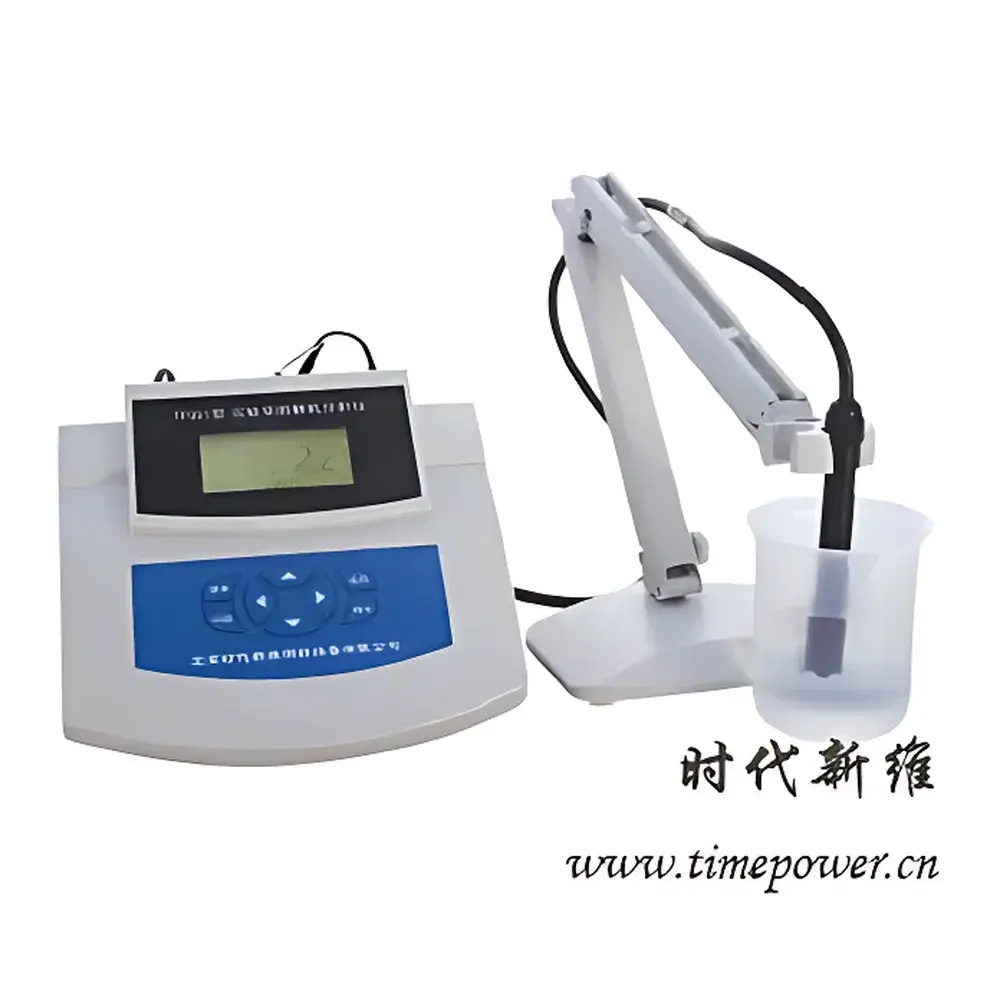
TimePower TP351 Benchtop Dissolved Oxygen Meter
| Brand | TimePower |
|---|---|
| Model | TP351 |
| Origin | Beijing, China |
| Manufacturer | TimePower Measurement & Control Co., Ltd. |
| Type | Polarographic Dissolved Oxygen Meter (Clark-type electrode) |
| Display | 128×64 dot-matrix LCD, Chinese interface |
| Measurement Range | 0.00–20.00 mg/L |
| Accuracy | ±1.5% F.S. |
| Resolution | 0.01 mg/L |
| Repeatability | ≤1% |
| Stability | ±1% F.S./4 h |
| Response Time (T90) | <5 min at 25 °C |
| Temperature Sensor | Pt100 |
| Temp. Measurement Range | 0.0–99.9 °C |
| Automatic Temperature Compensation Range | 0.1–60.0 °C |
| Sample Temperature Range | 5–60 °C |
| Operating Ambient | 5–45 °C, ≤90% RH (non-condensing) |
| Storage Temperature | −25–55 °C (electrode must be stored above 0 °C) |
| Power Supply | AC 220 V ±10%, 50 Hz ±1 Hz |
| Power Consumption | <5 W |
| Dimensions (L×W×H) | 225 mm × 210 mm × 260 mm |
| Weight | 1.5 kg |
| Standard Accessories | DO meter host, AC adapter, ppm-range polarographic DO electrode with YXI membrane cap, electrolyte refill solution (KCl-based), electrode stand |
Overview
The TimePower TP351 is a benchtop polarographic dissolved oxygen (DO) meter engineered for high-precision, routine measurement of dissolved molecular oxygen in aqueous solutions. Based on the Clark-type electrochemical principle, the instrument employs a galvanic or polarographic sensor—here configured as a polarographic cell with a platinum cathode and silver/silver chloride anode—to generate a current proportional to the partial pressure of oxygen diffusing through a selective gas-permeable membrane (YXI membrane). This current is converted to concentration units (mg/L or ppm) via calibrated signal processing, incorporating automatic temperature compensation using an integrated Pt100 thermistor. Designed for laboratory environments in municipal water treatment, environmental monitoring agencies, academic research labs, and industrial process control, the TP351 delivers stable, traceable measurements across a wide operational temperature range (5–60 °C), with full compliance to standard method frameworks referenced in ISO 5814, ASTM D888, and APHA Standard Methods 4500-OG.
Key Features
- Polarographic sensing architecture with YXI membrane cap—optimized for rapid response (<5 min T90 at 25 °C) and reliable performance in wastewater, surface water, and effluent samples with elevated DO levels.
- 24-bit analog-to-digital conversion ensures high-resolution data acquisition (0.01 mg/L) and minimizes quantization error in low-signal conditions.
- Embedded microcontroller platform with low-power design enables thermal stability and long-term operational consistency without drift-induced recalibration cycles.
- Integrated Pt100 temperature sensor provides real-time, high-fidelity thermal correction across 0.1–60.0 °C, eliminating manual input errors and supporting accurate Henry’s law-based solubility compensation.
- Chinese-language graphical user interface (128×64 LCD) with hierarchical menu navigation reduces operator training time while maintaining technical rigor in parameter selection and calibration verification.
- Onboard cyclic data storage retains up to 500 measurement records; overflow management ensures continuous logging without manual intervention or memory reset.
Sample Compatibility & Compliance
The TP351 is validated for use with freshwater, seawater (with salinity compensation applied manually), treated effluents, biological reactor samples, and potable water matrices. Its YXI membrane configuration resists fouling from suspended solids and organic films common in municipal and industrial wastewater streams. The system meets mechanical and electrical safety requirements per GB 4793.1 (equivalent to IEC 61010-1) and supports documentation practices aligned with GLP and ISO/IEC 17025 quality systems. While not inherently 21 CFR Part 11 compliant due to absence of electronic signature or audit trail functionality, raw data export via RS232 interface (optional cable) permits integration into validated LIMS environments where external data governance protocols apply.
Software & Data Management
The TP351 operates as a standalone analytical instrument with no proprietary PC software dependency. All calibration, measurement, and data review functions are executed locally via front-panel controls. Measured values—including timestamp, DO concentration, temperature, and electrode status—are stored in non-volatile memory and retrievable through sequential scrolling. For laboratories requiring traceable reporting, the RS232 serial port (available as optional accessory) enables ASCII-formatted output to terminal emulators or spreadsheet-compatible loggers. Calibration logs (zero and span points) are retained with date/time stamps, supporting internal QA audits and method validation documentation per ISO 17025 Clause 7.7.
Applications
- Regulatory compliance monitoring of DO in receiving waters and discharge permits (e.g., EPA NPDES, EU WFD).
- Biological oxygen demand (BOD) and chemical oxygen demand (COD) test preparation and endpoint verification.
- Activated sludge process optimization in wastewater treatment plants—tracking DO gradients in aeration basins and secondary clarifiers.
- Aquaculture system health assessment, including hatchery tank and recirculating aquaculture system (RAS) monitoring.
- Environmental field lab analysis following sample collection under APHA 4500-OG procedures.
- Academic teaching labs for fundamental electrochemistry and aquatic chemistry experiments.
FAQ
What type of electrode does the TP351 use, and is it replaceable?
The TP351 uses a polarographic dissolved oxygen electrode with a YXI gas-permeable membrane cap and refillable KCl electrolyte. The electrode is fully serviceable: membranes and cathodes can be replaced independently per manufacturer guidelines.
Does the instrument support automatic salinity compensation?
No—the TP351 performs automatic temperature compensation only. Salinity correction must be applied manually using published solubility tables or external calculation tools per ISO 5814 Annex A.
Can the TP351 be used for continuous immersion or online monitoring?
It is designed for batch-mode laboratory analysis. Continuous submersion is not recommended; the electrode must be stored upright with membrane moistened but not submerged when not in use.
Is calibration traceable to national standards?
Calibration follows standard two-point procedure (zero O2 via sodium sulfite solution and air saturation). Users may validate accuracy against NIST-traceable DO reference standards or certified water-air equilibrium gases.
What maintenance is required for long-term reliability?
Routine maintenance includes periodic membrane replacement (every 2–4 weeks under heavy use), electrolyte refilling, cathode cleaning with fine-grade emery paper, and verification of zero/slope response every 24 hours during extended operation.
Related Products







