
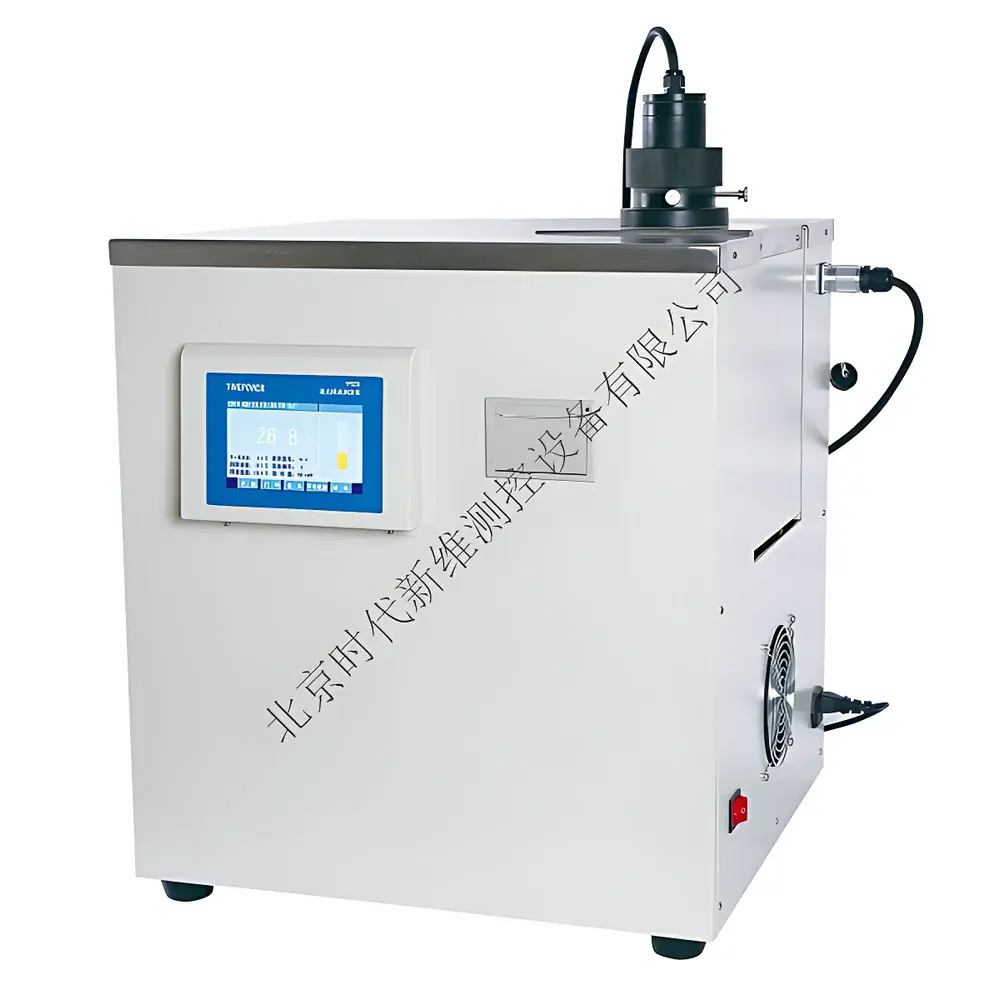
Timepower TP526 Automated Cloud Point and Pour Point Analyzer
| Brand | Timepower |
|---|---|
| Model | TP526 |
| Origin | Beijing, China |
| Manufacturer Type | Direct Manufacturer |
| Product Category | Domestic |
| Temperature Control Range | 35 °C to −70 °C |
| Pour Point Range | 5 °C to −70 °C |
| Display | Color LCD Touchscreen (Chinese UI) |
| Resolution | 0.1 °C |
| Temperature Accuracy | ±0.1 °C |
| Sample Position | Single-cell configuration |
| Cooling System | Dual-stage compression refrigeration |
| Power Supply | AC 220 V ±10 %, 50 Hz ±10 % |
| Power Consumption | ≤600 W |
| Dimensions (W×D×H) | 500 × 490 × 660 mm |
| Weight | 55 kg |
| Compliance Standards | GB/T 510, GB/T 3535, ASTM D2386, ASTM D97 |
Overview
The Timepower TP526 Automated Cloud Point and Pour Point Analyzer is a precision-engineered instrument designed for the standardized determination of cloud point (CP) and pour point (PP) in petroleum products—particularly lubricating oils, diesel fuels, residual fuels, and dark-colored hydrocarbon liquids. It operates on the principle of controlled thermal descent combined with optical detection of phase transition onset. During testing, the sample is cooled at a defined rate inside a standardized test tube per ASTM D2386 and GB/T 510 protocols. At predetermined temperature intervals, the instrument automatically tilts the sample assembly to 45° for 60 seconds; a high-sensitivity photodetector then monitors surface reflectivity changes to identify the first visible formation of wax crystals (cloud point) or cessation of flow (pour point). This opto-mechanical detection method eliminates subjective visual interpretation and ensures objective, operator-independent results aligned with international low-temperature performance specifications.
Key Features
- Single-position, fully automated test chamber with dual-stage compressor-based cooling system, enabling stable operation down to −70 °C with minimal thermal drift.
- PID-controlled temperature regulation with ±0.1 °C accuracy and 0.1 °C resolution across the full operational range (35 °C to −70 °C).
- Integrated tilt mechanism actuated by stepper motor, precisely timed and angled to 45° for exactly 60 seconds—fully compliant with ASTM D97 and GB/T 3535 mechanical requirements.
- Optical detection module utilizing near-infrared reflection sensing to detect microcrystallization onset without physical contact or sample disturbance.
- Color LCD touchscreen interface with intuitive Chinese-language navigation; supports both rapid screening mode (accelerated cooling) and standard-compliant stepwise cooling profiles.
- Onboard diagnostics with real-time error logging, fault code display, and guided troubleshooting prompts to minimize downtime.
- User-configurable cooling ramp rates and pass/fail criteria, enabling method customization for non-standard samples or internal QC protocols.
- Thermal insulation design and cold-well geometry optimized for reproducible heat transfer characteristics—critical for inter-laboratory comparability.
Sample Compatibility & Compliance
The TP526 accommodates a broad spectrum of petroleum-based fluids—including high-viscosity lubricants, asphaltene-rich residuals, and dyed or opaque distillates—without requiring dilution or pre-treatment. Its optical detection system is insensitive to sample color or turbidity, satisfying the technical scope of ASTM D97 (for pour point) and ASTM D2386 (for cloud point), as well as their Chinese national equivalents GB/T 3535 and GB/T 510. The instrument’s mechanical tilt sequence, temperature stability profile, and dwell timing are validated against these standards’ procedural clauses. While not certified to ISO/IEC 17025 out-of-the-box, its architecture supports GLP-compliant documentation when paired with external audit-ready data export (CSV/Excel) and timestamped result logs. No modifications are required to meet routine QC needs in power generation, refinery QA, third-party inspection labs, or petrochemical R&D environments.
Software & Data Management
The embedded firmware provides local storage of up to 500 test records with full metadata: sample ID, operator name, start/end time, ambient conditions, cooling curve snapshot, and final CP/PP determination. Results can be exported via USB interface in CSV format for integration into LIMS or statistical process control platforms. Although the native interface does not support FDA 21 CFR Part 11 electronic signature or audit trail functionality, raw data files retain immutable timestamps and instrument serial identifiers—facilitating retrospective validation under GMP-aligned workflows. Optional firmware upgrades may introduce network-enabled reporting (Ethernet/Wi-Fi) and remote calibration verification logs upon customer request.
Applications
- Quality assurance of base oils and finished lubricants for cold-weather operability compliance.
- Refinery fractionation monitoring—verifying cut-point integrity between diesel and heavy fuel streams.
- Condition monitoring of in-service turbine and hydraulic oils to detect wax precipitation risk.
- Research into additive efficacy (e.g., pour point depressants) through comparative low-temperature behavior analysis.
- Import/export clearance testing per national regulatory mandates (e.g., CNCA, AQSIQ, or EU EN 14214 Annex C).
- Supporting ASTM D6792 (Standard Guide for Low-Temperature Performance Testing) method development.
FAQ
What standards does the TP526 explicitly comply with?
It implements the procedural requirements of ASTM D2386 (cloud point), ASTM D97 (pour point), GB/T 510, and GB/T 3535—including specified cooling rates, tilt angles, dwell times, and observation intervals.
Can the instrument test highly viscous or opaque samples?
Yes—the optical detection system relies on surface reflectance rather than transmittance, making it suitable for dark, soot-laden, or undiluted residual fuels without compromise to detection sensitivity.
Is external calibration required before use?
The unit ships with NIST-traceable temperature verification certificates for key setpoints (−30 °C, 0 °C, 25 °C); field recalibration is performed using certified reference thermometers per manufacturer instructions.
What maintenance is recommended for long-term reliability?
Biannual inspection of refrigerant charge, condenser coil cleaning, and verification of tilt mechanism alignment are advised; compressor service life exceeds 15,000 operating hours under typical lab duty cycles.
Does the TP526 support multi-user access control or electronic signatures?
Not natively—but exported data files include operator ID, timestamp, and instrument ID, enabling manual traceability within externally managed QA systems.
Related Products







