
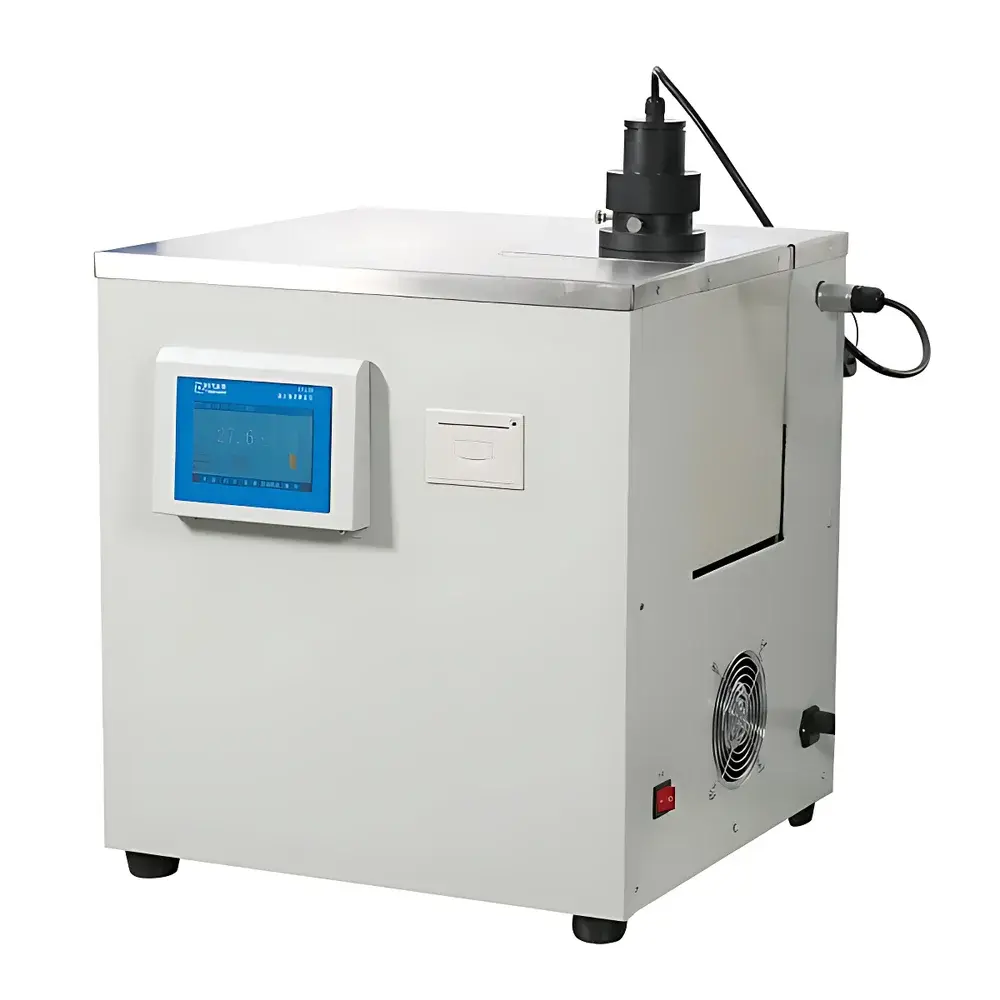
Timepower TP526 Automatic Pour Point Tester
| Brand | Timepower |
|---|---|
| Model | TP526 |
| Origin | Beijing, China |
| Manufacturer | Timepower Measurement & Control Co., Ltd. |
| Test Range | Ambient Temperature to –60 °C |
| Accuracy | ±1 °C |
| Resolution | 0.1 °C |
| Cooling Method | Semiconductor-based Thermoelectric Cooling |
| Display | LCD |
| Printer | Thermal, 36-character Chinese/English output |
| Power Supply | AC 220 V ±10 %, 50 Hz ±10 % |
| Power Consumption | <300 W |
| Dimensions (W×D×H) | 475 × 360 × 495 mm |
| Weight | 21.3 kg |
| Operating Environment | 10–40 °C, 30–80% RH |
| Compliance | Designed per GB/T 510–2010 (Petroleum Products—Determination of Pour Point) |
| CPU Architecture | Dual-MCU Control System |
| Self-Diagnostic Function | Yes |
Overview
The Timepower TP526 Automatic Pour Point Tester is a microprocessor-controlled analytical instrument engineered for precise, repeatable determination of the pour point of low-viscosity, light-colored petroleum products—including naphthas, kerosenes, diesel fuels, and lubricating oil distillates. It operates on the principle of controlled stepwise cooling combined with automated mechanical detection of flow cessation under standardized gravitational conditions, in strict accordance with GB/T 510–2010—the Chinese national standard equivalent to ASTM D97 and ISO 3016. Unlike manual methods requiring visual observation and subjective interpretation, the TP526 employs high-sensitivity pressure transduction to detect the onset of flow resistance during cooling, eliminating operator bias and significantly reducing inter-laboratory variability. Its semiconductor-based thermoelectric cooling system delivers stable, vibration-free temperature ramping without refrigerant gases or external chillers, making it suitable for routine QC laboratories, refinery process control environments, and regulatory testing facilities where footprint, reliability, and compliance traceability are critical.
Key Features
- Dual-CPU microcontroller architecture ensures robust real-time monitoring of cooling rate, temperature stability, and mechanical response detection—minimizing drift and enabling consistent cycle-to-cycle reproducibility.
- Semiconductor thermoelectric cooling module provides precise temperature control from ambient down to –60 °C with no moving parts, zero ozone-depleting refrigerants, and minimal maintenance requirements.
- Integrated pressure-sensing mechanism detects subtle changes in hydrostatic head resistance as the sample approaches solidification—delivering objective, non-visual endpoint determination.
- Thermal printer with 36-character Chinese/English support enables immediate hard-copy reporting of test parameters, result, date/time stamp, and instrument ID—fully compliant with GLP documentation practices.
- Onboard self-diagnostic routines continuously monitor sensor integrity, cooling performance, and power supply stability, flagging anomalies prior to test initiation to prevent invalid data generation.
- Ergonomic benchtop design (475 × 360 × 495 mm; 21.3 kg) features insulated chamber walls, quick-access sample port, and integrated fluid management (inlet/outlet tubing) for safe handling of hydrocarbon samples.
Sample Compatibility & Compliance
The TP526 is validated for use with transparent or translucent petroleum fractions having kinematic viscosity below 100 mm²/s at 40 °C, including jet fuel (Jet A-1), No. 1 and No. 2 diesel, base oils, and white mineral oils. It is not intended for heavy crudes, asphaltic residues, or highly paraffinic waxy oils where gelation mechanisms dominate over crystallization—such samples require complementary cloud point or cold filter plugging point (CFPP) analysis. The instrument conforms to the procedural and apparatus requirements of GB/T 510–2010, and its measurement methodology is technically aligned with ASTM D97 (Standard Test Method for Pour Point of Petroleum Products) and ISO 3016 (Petroleum Products—Determination of Pour Point). All thermal calibration points are traceable to NIM (National Institute of Metrology, China) standards. Data records meet basic audit-trail readiness for internal QA review; optional firmware upgrades support time-stamped event logging compatible with 21 CFR Part 11–aligned electronic record systems.
Software & Data Management
The TP526 operates via embedded firmware with no external PC dependency. All test protocols, calibration offsets, and user-defined setpoints are stored in non-volatile memory. Each test generates a timestamped report containing: initial sample temperature, cooling ramp rate, detected pour point, ambient conditions, and instrument serial number. Reports are printed locally and can be manually logged into LIMS or Excel-based tracking systems. While the unit does not feature USB or Ethernet connectivity in its base configuration, RS-232 serial output is available upon request for integration with centralized laboratory data acquisition platforms. Firmware updates are delivered via secure SD card interface, ensuring version control and validation documentation for regulated environments.
Applications
- Refinery quality assurance: Final product verification of diesel and heating oil pour point prior to dispatch.
- Power generation sector: Monitoring turbine oil and insulating oil low-temperature behavior in thermal and hydroelectric plants.
- Commercial inspection labs: Third-party certification of imported/exported distillate fuels per contract specifications.
- R&D laboratories: Screening additive packages (e.g., pour point depressants) and evaluating formulation stability across seasonal grades.
- Marine fuel testing: Verification of marine gas oil (MGO) compliance with ISO 8217 Table 1 specifications for arctic operation.
FAQ
What standards does the TP526 comply with?
It is designed and verified per GB/T 510–2010, with technical equivalence to ASTM D97 and ISO 3016.
Can the TP526 measure cloud point?
No—it is optimized exclusively for pour point determination using flow cessation detection; cloud point requires optical scattering or video-based detection not supported by this platform.
Is external coolant or compressed air required?
No—its thermoelectric cooling system operates independently with only AC mains power.
How often does the instrument require calibration verification?
Annual verification against certified reference materials (e.g., NIST SRM 2721) is recommended; daily zero-point checks using isopropanol at known sub-zero temperatures are advised for high-throughput labs.
Does the TP526 support multi-language UI?
The display and printer support both simplified Chinese and English; additional language localization is not available in current firmware.





