
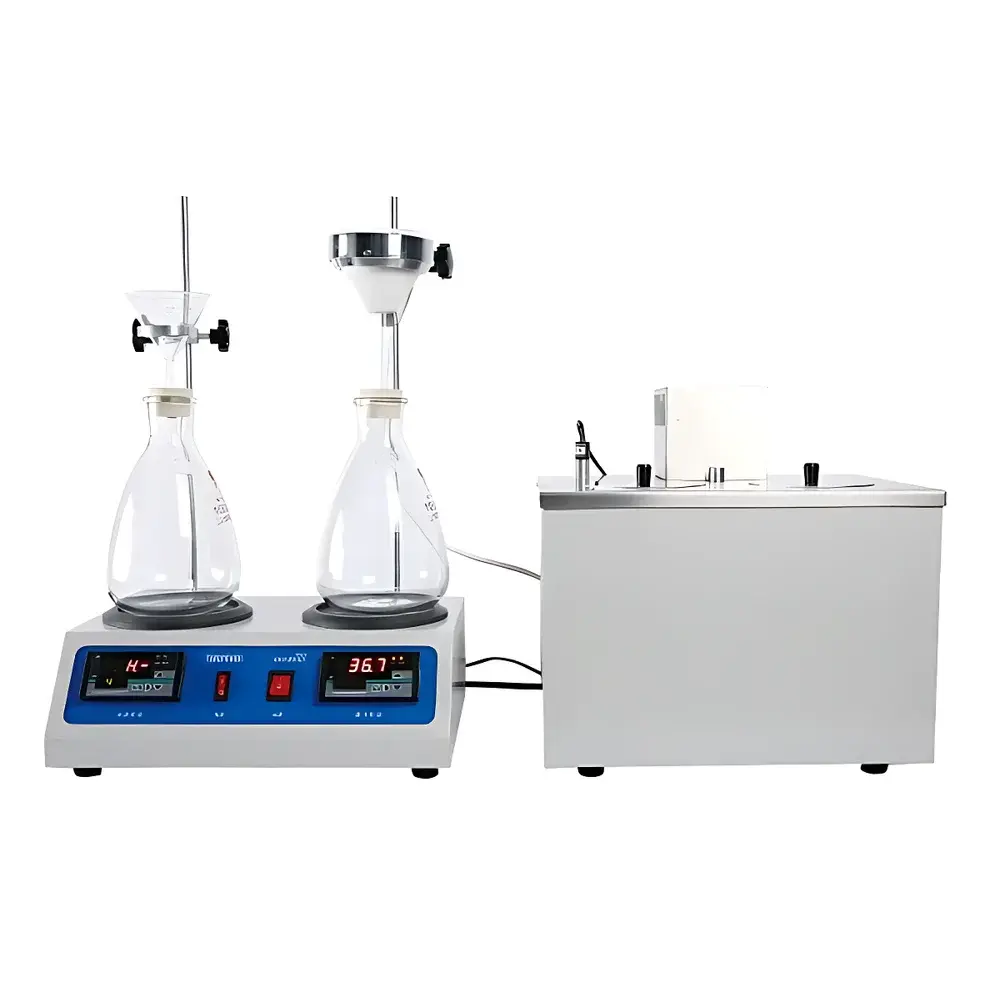
TimePower TP539 Mechanical Impurities Analyzer
| Brand | TimePower |
|---|---|
| Origin | Beijing, China |
| Manufacturer Type | Direct Manufacturer |
| Region of Origin | Domestic (China) |
| Model | TP539 |
| Instrument Type | Laboratory Benchtop Analyzer |
| Compliance Standard | GB/T 511–2010 Petroleum Products and Additives — Determination of Mechanical Impurities (Gravimetric Method) |
| Temperature Control Range (Water Bath & Funnel) | Room Temperature to 90 °C |
| Temperature Control Accuracy | ±1 °C |
| Funnel Temperature Display | LED Digital |
| Ambient Operating Conditions | 5–40 °C, ≤85% RH |
| Power Supply | AC 220 V ±10%, 50 Hz ±10% |
| Max. Power Consumption | ≤1200 W |
| Dimensions (Control Box) | 390 × 260 × 130 mm |
| Dimensions (Water Bath) | 90 × 290 × 370 mm |
| Net Weight | 4.8 kg |
Overview
The TimePower TP539 Mechanical Impurities Analyzer is a dedicated gravimetric laboratory instrument engineered for the precise quantification of insoluble particulate matter—commonly referred to as mechanical impurities—in petroleum products and lubricant additives. It operates strictly in accordance with the Chinese national standard GB/T 511–2010, which aligns methodologically with internationally recognized gravimetric protocols used in refinery QC, power generation asset management, and petrochemical R&D. The system implements a controlled, temperature-regulated filtration process wherein sample dissolution, hot solvent washing, vacuum-assisted filtration, and post-drying gravimetric weighing are executed under standardized thermal conditions. Its core architecture integrates a dual-zone temperature-controlled environment (water bath and heated funnel), vacuum filtration manifold, motor-driven magnetic stirring, and microprocessor-based electronic temperature regulation—ensuring reproducible thermal ramping and stable holding at user-defined setpoints between ambient and 90 °C.
Key Features
- Dual independent temperature control zones: water bath and heating funnel—both adjustable from ambient to 90 °C with ±1 °C accuracy and LED digital readout for traceable process monitoring.
- Enhanced opto-isolated silicon-controlled rectifier (SCR) power regulation: rotary potentiometer adjusts conduction angle to deliver continuously variable heating voltage (0–220 V AC), enabling compliance with GB/T 511’s specified heating rate profiles.
- Integrated magnetic stirrer with automatic timing function: ensures homogeneous suspension of insoluble particles during solvent extraction, minimizing settling bias prior to filtration.
- Modular glassware assembly: includes ASTM-compliant filtering crucibles (Gooch or sintered glass frits), calibrated funnels, and solvent-resistant tubing—designed for easy cleaning, validation, and GLP-aligned documentation.
- Benchtop compact footprint: control unit (390 × 260 × 130 mm) and water bath (90 × 290 × 370 mm) occupy minimal lab space while supporting full procedural compliance without external HVAC dependency.
- Robust electrical architecture: conforms to IEC 61010-1 safety requirements for laboratory electrical equipment; includes over-temperature cutoff, short-circuit protection, and EMI-suppressed power conditioning.
Sample Compatibility & Compliance
The TP539 is validated for use with light and heavy petroleum fractions—including gasoline, diesel, fuel oil, base oils, turbine oils, hydraulic fluids, and multifunctional additive packages. It accommodates both filter paper (Whatman Grade 40/42) and sintered glass crucibles (porosity grades G3/G4), supporting solvent systems specified in GB/T 511: low-boiling naphtha (for light oils), toluene (≤80 °C), and ethanol-toluene mixtures (heated to 60 °C) for stubborn residues. All thermal and vacuum parameters remain within the operational envelope defined by ISO/IEC 17025–2017 for testing laboratories. While GB/T 511 is the primary reference, the methodology is technically equivalent to ASTM D3270 (Standard Test Method for Mechanical Impurities in Used Lubricating Oils) and IP 390, facilitating cross-standard data correlation in multinational quality assurance workflows.
Software & Data Management
The TP539 is a hardware-only platform with no embedded firmware or proprietary software interface. Temperature setpoints, dwell times, and manual operation logs are recorded externally per GLP requirements. Users integrate the instrument into existing LIMS or ELN environments via standardized procedural documentation (SOPs), calibration records (traceable to NIM-certified thermistors), and audit-ready maintenance logs. Optional accessories include NIST-traceable digital thermometers (±0.1 °C) and certified Class M2 analytical balances (0.1 mg readability) to satisfy FDA 21 CFR Part 11 data integrity expectations when paired with compliant electronic record systems.
Applications
- Power industry: routine inspection of turbine and transformer oils for wear metal debris and oxidation sludge—critical for predictive maintenance and ISO 4406 particle count correlation.
- Petrochemical QA/QC labs: verification of mechanical impurity limits (<0.005 wt%) in finished lubricants prior to release.
- Research institutes: comparative evaluation of detergent-dispersant package efficacy under accelerated aging protocols.
- Third-party testing laboratories: accredited analysis for customs clearance (CIQ), SGS, BV, and CNAS-certified reports under GB/T 511–2010 scope.
- Refinery process monitoring: detection of catalyst fines, rust particles, or silica contamination in distillate streams.
FAQ
What solvents are compatible with the TP539 for mechanical impurities analysis?
Toluene (≤80 °C), naphtha, and 1:1 v/v ethanol–toluene mixtures (preheated to 60 °C) are validated per GB/T 511. Chlorinated solvents are not recommended due to glassware compatibility and environmental handling constraints.
Can the TP539 be used for water-based emulsions or coolant samples?
No. The instrument is designed exclusively for hydrocarbon-based matrices. Aqueous or glycol-containing samples require phase separation pretreatment and are outside the validated scope of GB/T 511.
Is third-party calibration support available for the temperature sensors?
Yes. TimePower provides factory calibration certificates traceable to the National Institute of Metrology (NIM) of China. End users may engage ISO/IEC 17025-accredited calibration providers for on-site verification using dry-block calibrators or PRT standards.
How often should the sintered glass crucibles be cleaned and inspected?
After each test cycle, crucibles must be rinsed with toluene, dried at 105 °C for 1 hour, and weighed. Visual inspection for microfractures or pore blockage is required before reuse; replacement is recommended after 50 cycles or upon deviation >0.2 mg in tare weight stability.
Does the TP539 meet any international regulatory requirements for pharmaceutical excipient testing?
No. While mechanically analogous to USP particulate matter procedures, the TP539 is not configured for sterile-grade filtration or membrane integrity testing and lacks validation documentation for ICH Q5A or FDA guidance on parenteral particulates.
Related Products







