
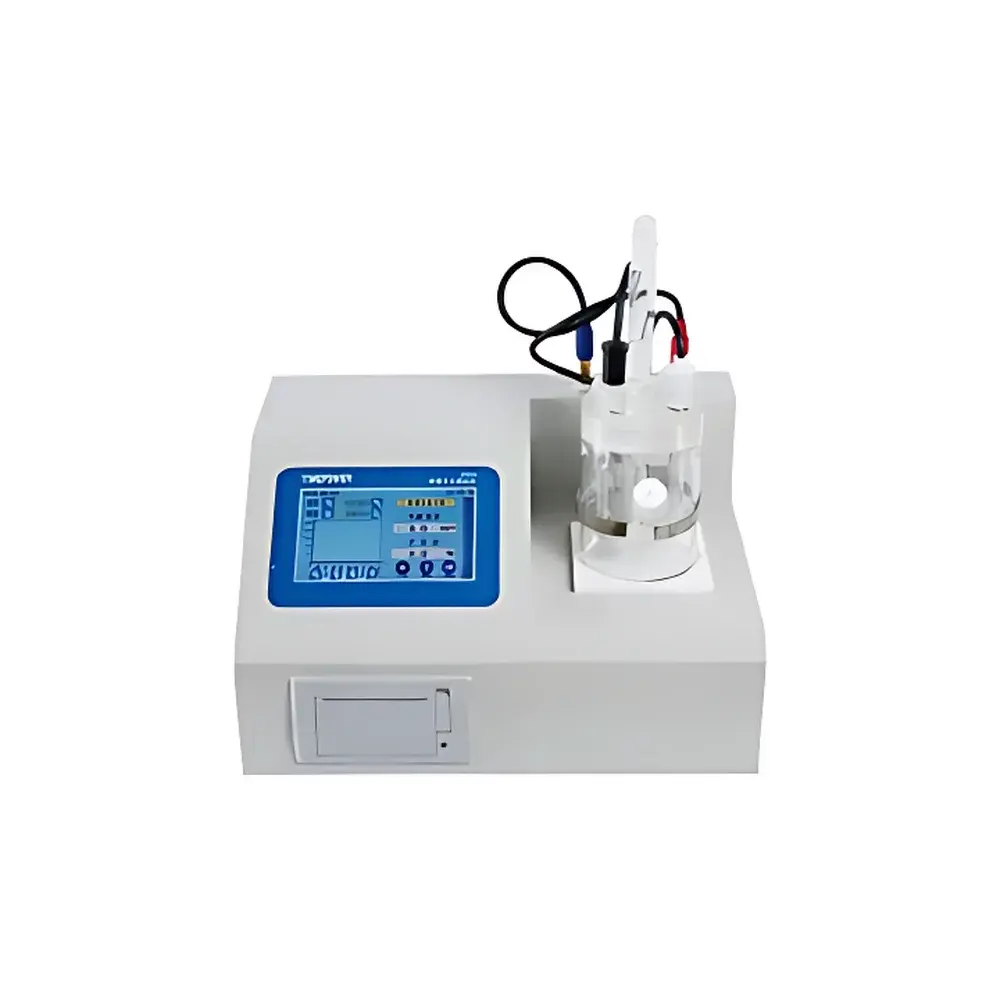
Timepower TP553 Coulometric Karl Fischer Moisture Titrator
| Brand | Timepower |
|---|---|
| Origin | Beijing, China |
| Manufacturer Type | Direct Manufacturer |
| Country of Origin | China |
| Model | TP553 |
| Application | Universal Coulometric Moisture Analyzer for Liquids, Solids, and Gases |
| Measurement Principle | Coulometric Karl Fischer Titration (ASTM D6304, ISO 12937, USP <921>, GB/T 7600, GB/T 6283, SH/T 0246, SH/T 0255) |
| Display | 128×64 Graphic LCD |
| Data Storage | 256 Records with Timestamp (10-Year Non-Volatile Retention) |
| Resolution | 0.1 µg H₂O |
| Measurement Range | 3 µg – 100 mg H₂O |
| Accuracy | ±20% at 3 µg, ±10% at 10 µg, ±5% at 100 µg, ±0.5% above 100 µg (excluding sampling error) |
| Electrolysis Current | 0–400 mA |
| Max. Electrolysis Rate | 2.4 mg H₂O/min |
| Stirring Speed | 10 Adjustable Levels |
| Electrolysis Gain | 10 Adjustable Levels |
| Environmental Operating Conditions | 20–30 °C, ≤85% RH |
| Power Supply | AC 220 V ±10%, 50 Hz ±10% |
| Max. Power Consumption | ≤30 W |
| Dimensions | 320 × 240 × 200 mm |
| Weight | 5 kg |
| Compliance | GLP-ready architecture with audit-trail-capable data logging, RS232 interface for external data export and LIMS integration |
Overview
The Timepower TP553 is a high-precision coulometric Karl Fischer moisture titrator engineered for trace-level water quantification in liquid, solid, and gaseous samples across regulated industrial laboratories. It operates on the fundamental electrochemical principle of coulometric Karl Fischer titration: iodine is generated *in situ* at the anode via controlled electrolysis of iodide-containing reagent (typically iodine, sulfur dioxide, pyridine or imidazole base, and methanol). According to Faraday’s law, the quantity of iodine produced is directly proportional to the charge passed. Since one mole of iodine reacts stoichiometrically with one mole of water (H₂O + I₂ + SO₂ + 3RN → 2RN·HI + RN·SO₃), the total charge consumed during titration is converted into an exact mass of water—calculated and displayed in real time with 0.1 µg resolution. This method delivers exceptional sensitivity and reproducibility for measurements down to 3 µg H₂O, eliminating the need for volumetric reagent standardization and minimizing reagent consumption compared to volumetric KF systems.
Key Features
- True coulometric architecture with dynamically compensated blank current and drift correction algorithms, ensuring baseline stability and measurement integrity over extended analysis cycles.
- Dual-compensation logic: real-time electrolyte blank current subtraction and equilibrium point drift compensation to correct for background electrolysis and environmental drift.
- High-fidelity electrode signal conditioning circuitry enables rapid, unambiguous endpoint detection—even in complex matrices—with robust electromagnetic interference (EMI) rejection.
- Hermetically sealed, waterproof electrolytic cell design reduces equilibration time by >40% and extends electrolyte service life up to 3× versus conventional cells.
- High-current electrolysis capability (0–400 mA) accelerates attainment of stable baseline and shortens assay cycle time—critical for high-throughput QC labs.
- 10-step adjustable stirring speed and 10-step electrolysis gain tuning allow method optimization for viscous, heterogeneous, or low-conductivity samples.
- Comprehensive self-diagnostic suite: automatic open-circuit and short-circuit detection for measuring electrodes, preventing erroneous results due to hardware faults.
- GLP-compliant data handling: timestamped records (256 entries, non-volatile flash memory, 10-year retention), password-protected parameter settings, and RS232 serial interface for secure data export to LIMS or ELN systems.
Sample Compatibility & Compliance
The TP553 accommodates diverse sample types—including polar solvents (e.g., alcohols, ketones), non-polar hydrocarbons (e.g., transformer oils, lubricants), polymers, pharmaceutical actives, agrochemicals, and compressed gases—via dedicated sampling accessories (0.5 µL and 50 µL micro-syringes, 1 mL gas-tight syringes). Its coulometric mode eliminates volumetric calibration dependencies, making it ideal for low-water-content materials (<100 ppm) where precision is paramount. The instrument conforms to international standard methods including ASTM D6304 (Standard Test Method for Determination of Water in Petroleum Distillates by Coulometric Karl Fischer Titration), ISO 12937 (Petroleum Products — Determination of Water — Coulometric Karl Fischer Titration Method), USP (Water Determination), and multiple Chinese national standards (GB/T 7600, GB/T 6283, SH/T 0246, SH/T 0255). Its firmware architecture supports audit-trail generation per FDA 21 CFR Part 11 requirements when paired with compliant data management software.
Software & Data Management
While the TP553 operates as a standalone benchtop analyzer with embedded firmware, its RS232 interface enables seamless integration into laboratory informatics ecosystems. Raw measurement data—including sample ID, timestamp, water mass (µg), calculated % moisture, electrolysis charge (C), endpoint duration, and system diagnostics—is transmitted in ASCII format for direct ingestion into LIMS, ELN, or custom QA databases. All stored records retain immutable timestamps and are retained without battery backup reliance. Screen-saver functionality prolongs LCD lifespan under continuous operation, and intuitive icon-free keypad navigation minimizes operator training burden. Firmware supports three standardized calculation modes (absolute mass, % w/w, % w/v) with user-definable unit preferences.
Applications
The TP553 serves as a primary moisture verification tool in quality control and R&D environments where regulatory compliance and analytical rigor are mandatory. In power generation, it verifies moisture content in insulating oils (IEC 60814, ASTM D1533) to prevent dielectric breakdown. In petroleum refining, it quantifies water in jet fuels (ASTM D6304), crude fractions, and additives to ensure specification compliance. In pharmaceutical manufacturing, it validates residual solvent levels in APIs and excipients per ICH Q5C and USP . In polymer synthesis and electronics-grade chemical production, it detects sub-ppm moisture in monomers and solvents that could catalyze hydrolysis or compromise thin-film deposition. Its versatility extends to food-grade ethanol, pesticide formulations, and battery electrolyte precursors—any application demanding trace water quantification with metrological traceability.
FAQ
What sample types can be analyzed directly without pretreatment?
Liquid samples miscible with KF reagent (e.g., alcohols, acetone, THF) may be injected directly. Solid samples require dissolution in suitable solvents (e.g., chloroform, formamide); gaseous samples require carrier gas sparging into the titration cell.
Is the instrument compatible with modern LIMS platforms?
Yes—via RS232 serial output using ASCII protocol; third-party middleware or custom scripts enable mapping to LIMS field structures.
How often must the electrolyte be replaced?
Replacement frequency depends on cumulative water load and ambient humidity; the instrument alerts users when accumulated charge approaches the reagent’s theoretical capacity (displayed as “Reagent Total” in setup menu).
Does the TP553 support 21 CFR Part 11 compliance?
The hardware provides essential foundations (audit-trail-capable storage, user-access controls, electronic signatures via external software); full compliance requires validated data management software deployed on connected PCs.
What safety precautions apply to the KF reagent?
All KF reagents contain toxic, volatile, and flammable components (e.g., pyridine, methanol, SO₂). Handling must occur in a certified fume hood with appropriate PPE (nitrile gloves, goggles, lab coat).




