
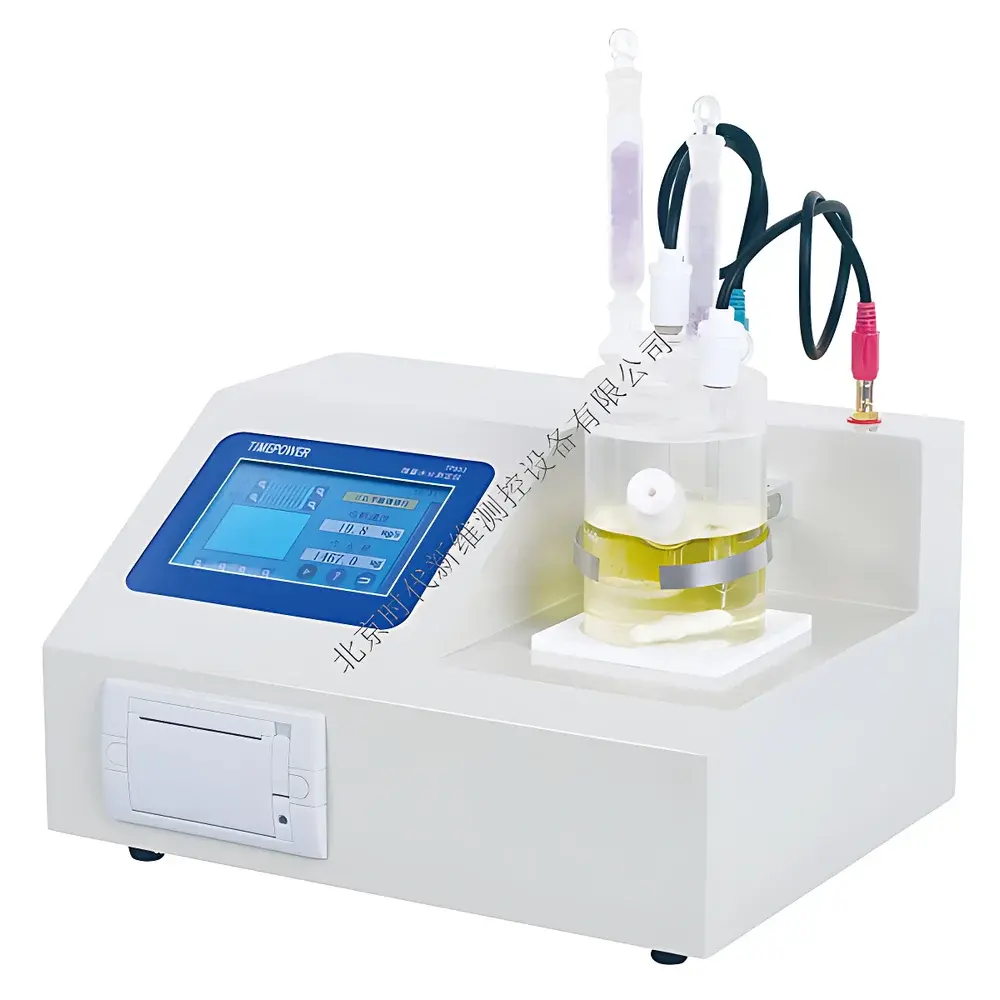
TimePower TP553 Coulometric Karl Fischer Moisture Titrator for Oil and Liquid Samples
| Brand | TimePower |
|---|---|
| Origin | Beijing, China |
| Manufacturer Type | Direct Manufacturer |
| Country of Origin | China |
| Model | TimePower TP553 |
| Pricing | Upon Request |
| Measurement Principle | Coulometric Karl Fischer Titration |
| Compliance | GB/T 7600, GB/T 6283, SH/T 0246, SH/T 0255 |
| Display | 128×64 Graphic LCD |
| Resolution | 0.1 µg |
| Measurement Range | 3 µg – 100 mg H₂O |
| Max. Electrolysis Rate | 2.4 mg/min |
| Electrolysis Current | 0–400 mA |
| Stirring Speed | 10 adjustable levels |
| Electrolysis Gain | 10 adjustable levels |
| Data Storage | 256 timestamped records (10-year power-loss retention) |
| Interface | RS232 |
| Power Supply | AC 220 V ±10%, 50 Hz ±10% |
| Max. Power Consumption | ≤30 W |
| Dimensions | 320 × 240 × 200 mm |
| Weight | 5 kg |
| Operating Temperature | 20–30 °C |
| Operating Humidity | ≤85% RH |
| Electrode Fault Detection | Open-circuit & short-circuit auto-diagnosis |
| Sample Compatibility | Liquids (oils, alcohols, solvents), solids (dissolved or homogenized), gases (via carrier gas adapter) |
| Accessories Included | Dual-compartment coulometric cell, 0.5 µL & 50 µL microsyringes, 1 mL glass syringe, vacuum grease, KF electrolyte (pyridine-free formulation available) |
Overview
The TimePower TP553 is a precision coulometric Karl Fischer moisture titrator engineered for trace water quantification in low-moisture matrices—particularly insulating oils, transformer fluids, hydrocarbon solvents, and high-purity chemical intermediates. It operates on the fundamental electrochemical principle of coulometric KF titration: iodine is generated *in situ* at the anode via controlled electrolysis of iodide ions (I⁻) present in the reagent. According to Faraday’s law, the quantity of iodine produced is directly proportional to the charge passed (Q = n·F, where n = moles of electrons, F = Faraday constant). Since one mole of I₂ reacts stoichiometrically with one mole of H₂O, the total charge consumed during titration yields an absolute, gravimetrically traceable water mass—eliminating the need for volumetric standardization or reagent titer verification. This method delivers inherent accuracy, exceptional sensitivity (down to 0.1 µg H₂O), and long-term stability without drift-induced recalibration—critical for compliance-driven environments such as power generation asset maintenance (IEC 60814, ASTM D6304) and pharmaceutical excipient release testing (USP ).
Key Features
- High-fidelity coulometric detection circuitry with adaptive endpoint recognition—minimizes over-titration and ensures reproducible results across heterogeneous sample types.
- Dual-compartment, hermetically sealed electrolytic cell with optimized electrode geometry and hydrophobic septum design—reduces ambient moisture ingress, extends electrolyte service life (>150 tests per fill under controlled conditions), and shortens equilibration time to <2 minutes.
- Intelligent baseline compensation algorithms: real-time blank current correction and dynamic drift offset adjustment—essential for accurate measurement of samples with volatile solvents or low-conductivity matrices.
- 10-step independent control of stirring speed and electrolysis gain—enables method optimization for viscous oils (e.g., turbine oil, hydraulic fluid) and low-dielectric solvents (e.g., toluene, xylene).
- Comprehensive hardware diagnostics: automatic open-circuit/short-circuit detection of measuring and generator electrodes—prevents erroneous readings and supports GLP-compliant instrument qualification (IQ/OQ).
- Energy-efficient design: low thermal load (<30 W) and integrated LCD screen saver—enhances operational longevity in continuous-lab environments.
Sample Compatibility & Compliance
The TP553 accommodates liquids (direct injection), solids (via dissolution in KF-compatible solvents such as chloroform/methanol mixtures), and gases (using optional gas sampling kit with flow-controlled carrier gas). It meets the metrological requirements of multiple international standards: GB/T 7600 (for insulating oils), GB/T 6283 (general liquid/solid determination), SH/T 0246 (light petroleum products), and SH/T 0255 (additive-containing lubricants). Its coulometric architecture inherently satisfies ISO 760 and ASTM E203 for absolute water quantification—making it suitable for audit-ready workflows in GMP-regulated pharmaceutical manufacturing, ISO 17025-accredited testing labs, and utility-scale transformer oil condition monitoring programs aligned with IEEE C57.106.
Software & Data Management
Data integrity is maintained through timestamped storage of up to 256 test records—including sample ID, water mass (µg), calculated % H₂O or ppm, date/time stamp, operator ID (manual entry), and system status flags. All entries are retained for ≥10 years without power—fulfilling ALCOA+ data retention expectations. The RS232 serial interface supports bidirectional communication with LIMS or custom SCADA systems; ASCII-formatted output includes raw charge integration values and endpoint stability metrics. While the embedded firmware does not include 21 CFR Part 11 electronic signature functionality, the device supports audit-trail-ready operation when paired with validated third-party data capture software compliant with FDA and EU Annex 11 requirements.
Applications
- Power industry: moisture assessment in transformer, turbine, and switchgear insulating oils per IEC 60429 and ASTM D1533—critical for dielectric strength assurance and predictive maintenance scheduling.
- Petrochemical QA/QC: quantification of residual water in benzene, styrene, MTBE, and polymer-grade monomers where ppm-level hydration affects catalyst performance and product shelf life.
- Pharmaceutical development: water content verification of APIs, lyophilized powders, and excipients in accordance with USP and Ph. Eur. 2.5.12.
- Fine chemical synthesis: real-time reaction monitoring of moisture-sensitive Grignard or organolithium reagents; validation of solvent drying efficacy (e.g., THF, DMF, acetonitrile).
- Food-grade oil certification: compliance testing for edible vegetable oils per AOAC 985.24 and ISO 8534—ensuring regulatory adherence to maximum allowable moisture limits.
FAQ
What is the minimum detectable water mass?
The TP553 achieves a resolution of 0.1 µg H₂O, with reliable quantification starting at 3 µg—suitable for ultra-dry hydrocarbon matrices.
Can the instrument measure water in solid samples?
Yes—solids must be dissolved or suspended in a KF-compatible solvent (e.g., methanol-chloroform mixture) prior to injection; solubility and reaction kinetics must be verified per sample type.
Is pyridine-based electrolyte required?
No—the standard reagent uses a modern pyridine-free formulation (imidazole/methanol-based); full safety data sheets (SDS) and handling protocols are provided.
How often should the electrolyte be replaced?
Replacement is triggered when cumulative water consumption approaches the reagent’s certified capacity (typically indicated by rising background current or prolonged endpoint stabilization); average service life exceeds 150 injections under routine use.
Does the device support GLP documentation requirements?
It provides timestamped, non-erasable result storage and hardware fault logging—serving as foundational evidence for GLP audits when integrated into a documented laboratory quality management system.






