
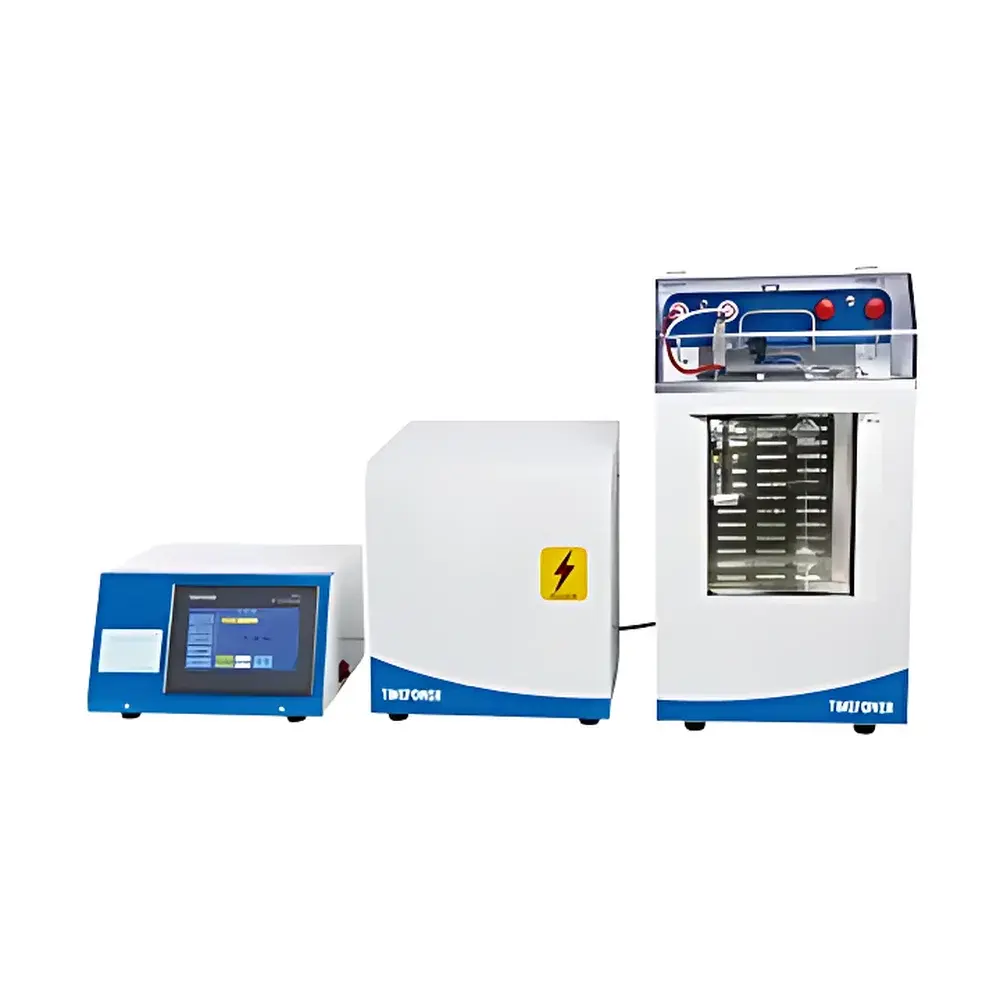
TimePower TP575 Gassing Tendency Tester
| Brand | TimePower |
|---|---|
| Origin | Beijing, China |
| Manufacturer Type | Direct Manufacturer |
| Model | TP575 |
| Compliance | GB/T 11142–1989, NB/SH/T 0810–2010 |
| Display | 7-inch capacitive touchscreen LCD |
| Temperature Control | 80 °C ±0.05 °C (adjustable range: ambient to 100 °C) |
| Voltage Application | 10 kV ±0.2 kV (50 Hz) |
| Test Duration | 5, 10, 50, or 120 min (automatically selected per standard) |
| Timing Accuracy | <±0.1 s |
| Hydrogen Inlet Pressure | 0.05–0.1 MPa |
| Stirring Speed | 1200 rpm |
| Temperature Resolution | 0.01 °C |
| Voltage Resolution | 0.01 kV |
| Data Storage | 1000 test records |
| Relative Humidity Limit | <85% RH |
| Heating Power | ≤1500 W |
| Total Power Consumption | ≤1700 W |
| Operating Ambient | 10–40 °C |
| Dimensions (Controller / HV Generator / Test Unit) | 320×305×195 mm / 320×305×380 mm / 320×305×590 mm |
| Safety | Integrated interlock switch, earth-grounding requirement, dry-bath protection logic |
| Output | Thermal printer (built-in) |
Overview
The TimePower TP575 Gassing Tendency Tester is a precision-engineered instrument designed to quantify the gassing behavior of insulating oils under controlled electrochemical stress. It operates on the principle of measuring net gas absorption or evolution at the oil–hydrogen interface when subjected to a radial electric field—simulating real-world transformer operating conditions where dielectric liquids interact with dissolved hydrogen and high-voltage gradients. The test method conforms strictly to two key international-standard-aligned specifications: GB/T 11142–1989 (equivalent in scope to ASTM D2300) and NB/SH/T 0810–2010, which defines the standardized procedure for evaluating insulating oil stability under combined electrical stress and ionization. During testing, pre-dried and hydrogen-saturated oil is held at 80 °C ±0.05 °C in a thermostatically regulated bath while exposed to a stable 10 kV AC (50 Hz) field for durations up to 120 minutes. Gas volume change is measured volumetrically via calibrated gas burette (gas collection tube), enabling direct quantification of net gassing tendency in mL/100mL oil.
Key Features
- Integrated dual-module architecture: independent high-voltage generator (380 mm height) and temperature-controlled test chamber ensure electromagnetic isolation and thermal stability.
- High-accuracy digital temperature control system using imported platinum RTD sensors and PID-driven solid-state heating modules—achieving ±0.05 °C uniformity across the bath volume.
- 7-inch industrial-grade capacitive touchscreen interface with embedded procedural flowcharts—guides users step-by-step through sample preparation, gas saturation, voltage application, and data validation.
- Automated timing logic synchronized to standard-defined durations (5, 10, 50, or 120 min), with sub-second chronometric resolution (<±0.1 s) traceable to internal quartz oscillator.
- Dedicated hydrogen pressure regulation circuit (0.05–0.1 MPa range) with stainless-steel fittings and leak-tested gas pathways compliant with ISO 8573-1 Class 4 purity requirements.
- Mechanical safety interlocks including door-actuated HV cutoff, earth-ground monitoring circuit, and dry-bath thermal lockout—preventing operation without heat-transfer medium.
- Onboard thermal printer with non-volatile memory buffer ensures immediate hardcopy output with timestamp, test parameters, and calculated gassing value (mL/100mL).
- Local data storage for 1000 complete test records—including voltage, temperature, time, gas volume, operator ID, and pass/fail flag per NB/SH/T 0810 criteria.
Sample Compatibility & Compliance
The TP575 accommodates standard IEC 60156-compliant oil samples (typically 300–400 mL) in its dedicated gassing cell assembly, which includes a borosilicate glass析气池 (degassing cell) and calibrated 100-mL graduated gas burette (量气管). All wetted components are chemically inert to hydrocarbon-based insulating oils, naphthenic and paraffinic formulations, and inhibited or uninhibited mineral oils. The instrument meets mechanical and electrical safety requirements per GB 4793.1–2007 (IEC 61010-1 equivalent) and supports laboratory quality systems requiring audit-ready documentation. Its operational protocol aligns with transformer oil maintenance practices defined in IEEE C57.106 and IEC 60296, and raw data output supports GLP-compliant record retention and FDA 21 CFR Part 11–aligned electronic signature readiness when integrated with validated LIMS environments.
Software & Data Management
No external PC software is required for basic operation; all control, acquisition, calculation, and reporting occur onboard. However, the RS232 serial port enables optional integration with laboratory information management systems (LIMS) or SCADA platforms via ASCII-based command protocol. Each stored record contains full metadata: test ID, date/time stamp, ambient RH/temperature, setpoint deviations, raw gas volume readings before/after test, calculated net gassing value, and operator confirmation code. Exported data files follow ASTM E1382-compliant formatting for cross-platform compatibility. Firmware updates are performed via USB flash drive with cryptographic signature verification to ensure integrity and traceability.
Applications
- Quality assurance of new insulating oils prior to transformer filling (per IEC 60296 Annex B).
- Condition monitoring of in-service transformer oils during routine maintenance intervals.
- Research evaluation of antioxidant additive efficacy under accelerated electrical aging.
- Comparative assessment of alternative base oils (e.g., natural esters vs. mineral oils) for gassing stability.
- Root-cause analysis of abnormal gas-in-oil readings (e.g., elevated H₂ in DGA reports) by isolating electrochemical gassing contribution.
- Supporting compliance with national grid technical specifications (e.g., State Grid Corporation of China Q/GDW 11289–2014).
FAQ
What standards does the TP575 comply with?
It fully implements GB/T 11142–1989 and NB/SH/T 0810–2010, with functional equivalence to ASTM D2300 and supplementary alignment with IEC 60156 test setup requirements.
Is calibration certification included?
The unit ships with factory calibration certificates for temperature (NIST-traceable RTD), voltage (high-voltage divider verified per IEC 61083-2), and timebase (quartz oscillator accuracy report); annual recalibration services are available.
Can the instrument operate outside the 80 °C setpoint?
Yes—the temperature controller supports adjustable setpoints from ambient to 100 °C in 0.01 °C increments, though standardized gassing tests require strict adherence to 80 °C per NB/SH/T 0810.
How is gas volume measured?
Via direct volumetric displacement in a Class A borosilicate glass gas burette (量气管), calibrated to ISO 4787, with meniscus correction algorithm applied automatically during final reading.
What maintenance is required?
Routine cleaning of the gassing cell and burette with solvent-rinsed lint-free wipes; biannual verification of hydrogen pressure regulator linearity and annual thermal mapping of the bath.





