
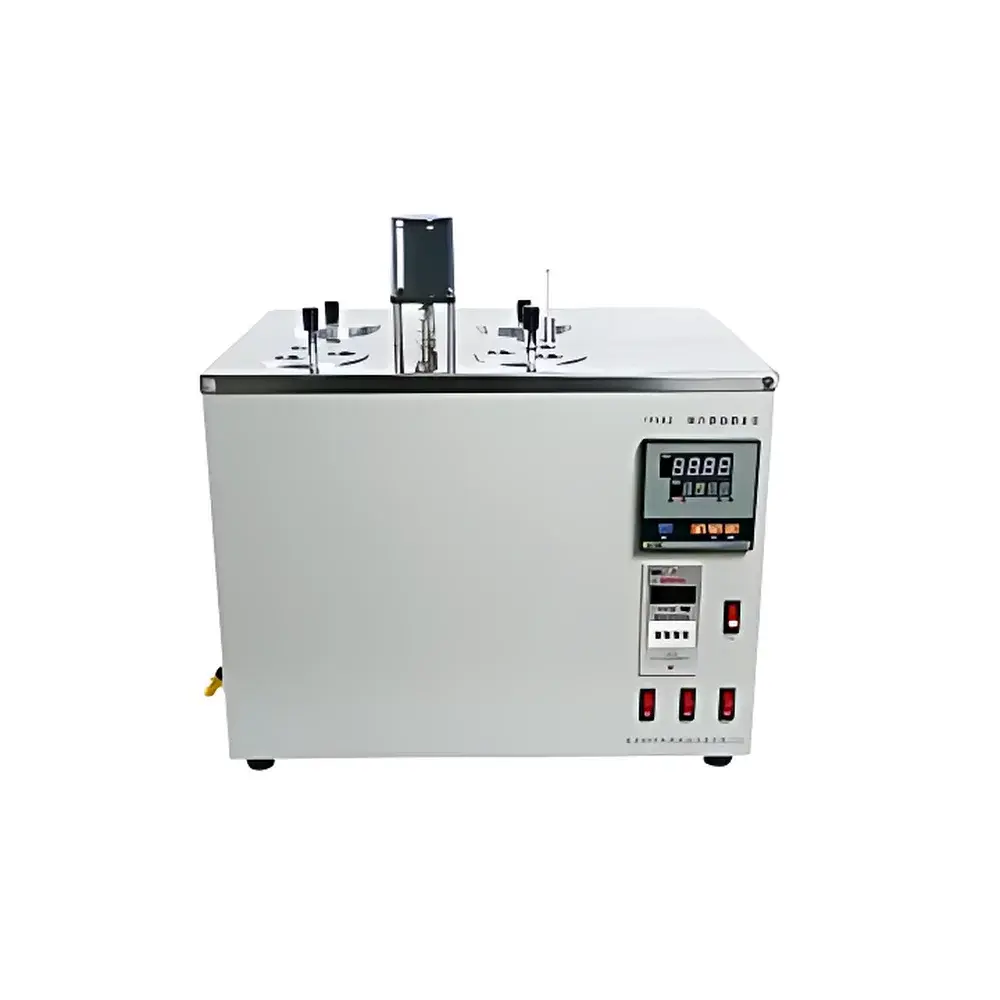
Timepower TP582 Copper Strip Corrosion Tester
| Brand | Timepower |
|---|---|
| Origin | Beijing, China |
| Manufacturer Type | Manufacturer |
| Country of Origin | Domestic (China) |
| Model | TP582 |
| Quotation | Upon Request |
| Temperature Control Range | Ambient to 150 °C |
| Temperature Accuracy | ±1 °C |
| Heating Power | 600 W (main) + 1000 W (auxiliary) |
| Temperature Sensor | Industrial Pt100 Platinum Resistance Thermometer |
| Timing Range | 1 min to 24 h |
| Time Display | LED digital |
| Temperature Display | 7-segment LED |
| Sample Capacity | 4 test cells (up to 12 samples per run) |
| Ambient Operating Conditions | 5–40 °C, ≤85% RH |
| Power Supply | AC 220 V ±10%, 50 Hz ±10% |
| Power Consumption | ≤1800 W |
| Dimensions (W×D×H) | 480 mm × 360 mm × 520 mm |
| Net Weight | 18 kg |
| Compliance Standards | GB/T 5096, GB/T 7326, ASTM D130, ASTM D4048, SH/T 0232, SH/T 0023, ISO 6251 |
Overview
The Timepower TP582 Copper Strip Corrosion Tester is a precision-engineered benchtop instrument designed for standardized evaluation of copper corrosion behavior in petroleum products under controlled thermal and temporal conditions. It operates on the principle of accelerated immersion testing: polished copper strips are immersed in test specimens—such as gasoline, jet fuel, diesel, lubricating oils, or solvent naphthas—and exposed to elevated temperatures for defined durations within a thermally stabilized metal bath. Corrosion severity is subsequently assessed visually against standardized color charts (e.g., ASTM D130 Rating Scale), providing a qualitative yet highly reproducible metric of sulfur-containing compound activity and oxidative instability. The system implements PID-based closed-loop temperature regulation with dual-stage heating architecture (600 W primary + 1000 W auxiliary), ensuring rapid thermal equilibration and minimal spatial gradient across the 4-cell test chamber. Its design conforms strictly to internationally harmonized test methodologies, enabling direct comparability of results across global laboratories engaged in refinery QC, fuels specification compliance, and additive performance validation.
Key Features
- Four independent test cell positions with uniform thermal distribution via forced-convection stirring motor and precision-machined aluminum bath block
- PID-controlled temperature regulation (ambient to 150 °C) with ±1 °C accuracy and Pt100 sensor feedback loop
- Programmable digital timer (1 minute to 24 hours) with audible end-of-test alarm and LED time display
- Integrated self-diagnostic firmware that monitors heater status, sensor integrity, and thermal overshoot history
- Robust mechanical architecture featuring corrosion-resistant stainless steel housing and sealed electrical compartments
- Dual-power heating system optimized for both rapid ramp-up and stable dwell-phase maintenance
Sample Compatibility & Compliance
The TP582 accommodates a broad spectrum of hydrocarbon-based fluids meeting volatility constraints specified in relevant standards—including aviation gasoline (AVGAS), turbine fuels (Jet A/A-1), automotive gasoline (including ethanol-blended variants up to E10), natural gasoline, kerosene, diesel fuel (EN 590, ASTM D975), distillate heating oils, lubricating base stocks, greases, and specialty solvents. Test applicability is explicitly limited to samples with Reid Vapor Pressure (RVP) ≤124 kPa (930 mmHg), consistent with ASTM D130 scope requirements. The instrument satisfies full technical alignment with GB/T 5096 (Chinese national standard for copper strip corrosion of petroleum products), ASTM D130 (Standard Test Method for Corrosiveness to Copper from Petroleum Products by Copper Strip Test), ASTM D4048 (for gaseous fuels), ISO 6251 (petroleum products — determination of copper strip corrosion), and Chinese industry standards SH/T 0232 and SH/T 0023. All operational parameters—including temperature setpoint tolerance, timing resolution, and bath homogeneity—are validated against metrological traceability protocols compliant with ISO/IEC 17025 laboratory accreditation frameworks.
Software & Data Management
The TP582 operates as a standalone hardware platform without embedded PC-based software; however, its control logic supports GLP-compliant documentation practices. All critical process parameters—including actual bath temperature (logged every 30 seconds), elapsed time, setpoint deviation history, and alarm events—are retained in non-volatile memory for post-test retrieval via front-panel navigation. While no proprietary data export interface is integrated, users may manually record timestamps and observed corrosion ratings into LIMS-compatible spreadsheets or electronic lab notebooks. For regulated environments operating under FDA 21 CFR Part 11 or EU Annex 11 requirements, the instrument’s deterministic behavior, auditable parameter logs, and absence of user-modifiable firmware ensure compatibility with computerized system validation (CSV) workflows when deployed within documented SOPs.
Applications
- Refinery quality assurance: verification of desulfurization efficiency and post-treatment stability of middle distillates
- Fuels certification testing for ASTM D975 (diesel), D1655 (jet fuel), and D439 (gasoline) specifications
- Evaluation of antioxidant and metal deactivator additive efficacy in lubricant formulations
- Research into sulfur speciation effects on copper catalysis in fuel systems and storage tanks
- Third-party contract testing labs performing accredited corrosion assessments per ISO/IEC 17025 scope
- Technical service support for OEM engine manufacturers assessing fuel compatibility with copper-bearing components
FAQ
What safety precautions must be observed before powering on the TP582?
The bath vessel must be filled with an appropriate heat-transfer medium (water, silicone oil, or specified oil–water mixture) prior to energizing the unit. Dry operation will permanently damage the heating elements and pose fire risk.
Is recalibration of the Pt100 sensor required during routine use?
No. The Pt100 sensor is factory-calibrated and sealed; field recalibration is not supported. Periodic verification against NIST-traceable reference thermometers is recommended annually per ISO/IEC 17025 internal audit requirements.
Can the TP582 perform simultaneous tests at different temperatures?
No. All four test cells share a single thermally coupled bath; therefore, only one uniform temperature can be maintained per test cycle.
What is the maximum allowable sample volume per test cell?
Each cell accepts standard ASTM D130 glass tubes (25 mm diameter × 150 mm length), holding approximately 30 mL of test fluid.
Does the instrument include copper strip preparation tools?
Yes—the standard configuration includes a dedicated abrasive strip polishing kit (grit-graded emery papers), calibrated micrometer for thickness verification, and cleaning solvents compliant with ASTM D130 Section 6.1.




