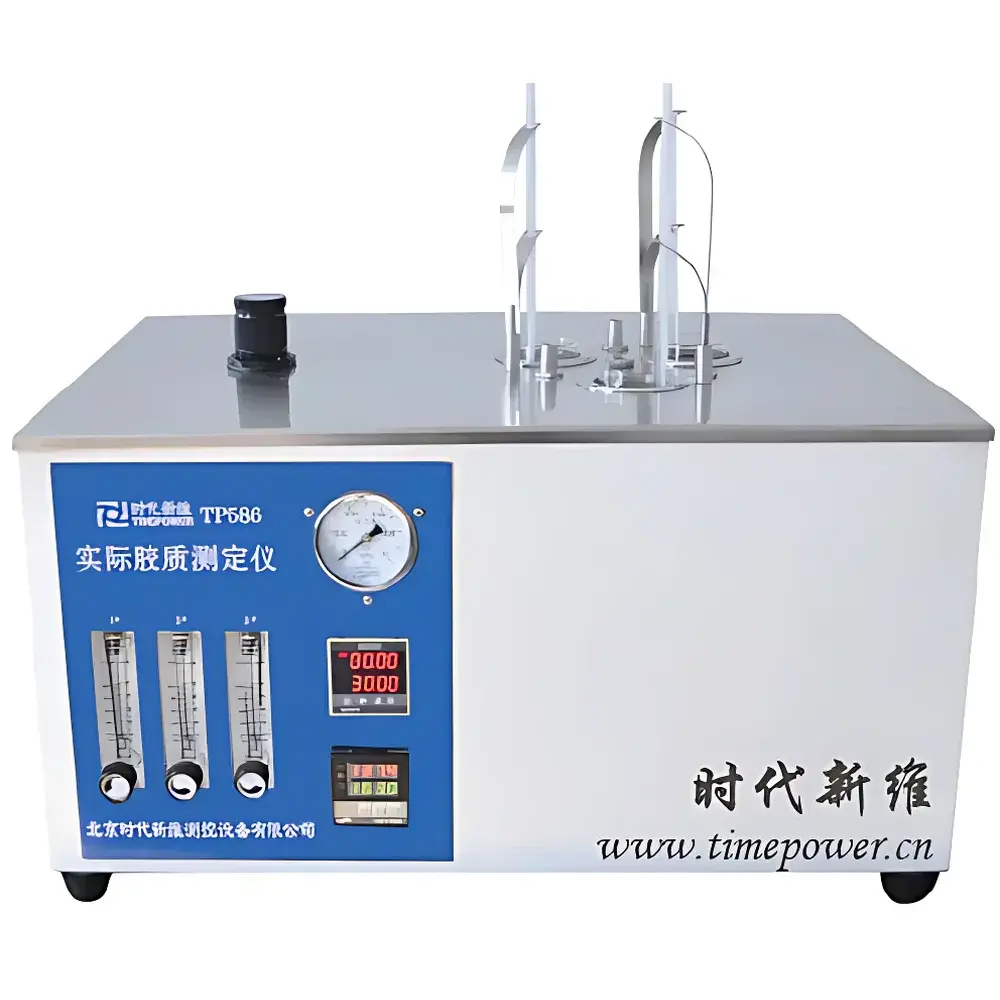
TimePower TP586 Actual Gum Content Analyzer
| Brand | TimePower |
|---|---|
| Origin | Beijing, China |
| Manufacturer Type | Direct Manufacturer |
| Country of Origin | China |
| Model | TP586 |
| Pricing | Upon Request |
| Temperature Sensor | Pt100 (JUMO Germany OEM) |
| Bath Temperature Range | 0–400 °C |
| Standardized恒温 Points & Accuracy | 150 ±1.0 °C, 180 ±1.0 °C, 250 ±1.0 °C |
| Programmable Setpoint | Yes |
| Temperature Control Accuracy | ±1 °C |
| Oil Bath Dimensions | Φ200 × 220 mm |
| Power Consumption | <2500 W |
| Rated Current | 10 A |
| Test Port Count | 3 |
| Thermometer Range | –5 to 400 °C, Graduation: 1.0 °C |
| Air Flowmeter Range | 40–70 L/min |
| Ambient Operating Conditions | 10–40 °C, RH 30–80% |
| Power Supply | AC 220 V ±10%, 50 Hz ±10% |
| Net Weight | 45 kg |
| Overall Dimensions | 400 × 350 × 450 mm |
| Compliance Standards | GB/T 509, GB/T 8019 |
Overview
The TimePower TP586 Actual Gum Content Analyzer is a precision-engineered laboratory instrument designed for the quantitative determination of actual gum content in aviation gasoline, motor gasoline, kerosene, and diesel fuels—per ASTM D381 and equivalent national standards including GB/T 509 and GB/T 8019. It operates on the principle of controlled evaporation under standardized airflow and thermal conditions: a measured fuel sample is evaporated in a pre-weighed crucible within a precisely regulated metal bath, while filtered ambient air is delivered at a defined volumetric flow rate (40–70 L/min) through a calibrated nozzle. Residual non-volatile deposits—collectively termed “actual gum”—are then dried, cooled in a desiccator, and gravimetrically quantified. This method directly correlates with engine intake system deposit formation potential and serves as a critical quality control parameter for refinery blending, fuel certification, and regulatory compliance.
Key Features
- Metal-block heating bath (Φ200 × 220 mm) with zero acoustic noise, no oil vapor emission, and uniform thermal distribution—eliminating hot-spot artifacts common in liquid-bath systems.
- Triple independent test ports enable parallel analysis of three samples per run, improving throughput without compromising inter-sample reproducibility.
- OEM Pt100 temperature sensors sourced from JUMO (Germany), integrated into closed-loop PID control architecture for stable setpoint maintenance (±1.0 °C tolerance at 150 °C, 180 °C, or 250 °C).
- User-programmable temperature setpoints across the full 0–400 °C range, supporting method development beyond standard specifications.
- Dedicated low-noise, oil-free air compressor (included) delivers clean, dry airflow meeting ISO 8573-1 Class 3 particulate and Class 4 moisture requirements.
- Integrated laminar-flow air distribution system with three precision-machined喇叭-type nozzles ensures consistent impingement geometry and evaporation kinetics across all crucibles.
- Robust stainless-steel construction, EMI-shielded electronics, and redundant thermal cutoffs ensure long-term operational reliability and operator safety.
Sample Compatibility & Compliance
The TP586 accommodates standard 50 mL glass beakers and crucibles used in gum testing protocols (e.g., ASTM D381 crucibles, GB/T 509 aluminum dishes). Its design conforms strictly to the mechanical, thermal, and airflow requirements specified in GB/T 509 (“Petroleum Products—Determination of Actual Gum Content in Gasoline and Kerosene”) and GB/T 8019 (“Gasoline—Determination of Gum Content by Jet Evaporation Method”). The instrument supports full traceability under GLP environments: all temperature setpoints, dwell times, airflow values, and run timestamps are logged internally. While not inherently 21 CFR Part 11 compliant, audit-ready data export (CSV/Excel) and manual logbook integration facilitate GMP-aligned documentation workflows in fuel testing laboratories.
Software & Data Management
The TP586 operates via an embedded microcontroller interface with tactile membrane keypad and high-contrast LCD display. No external PC is required for routine operation; however, optional RS-232/USB connectivity enables integration with LIMS or custom data acquisition platforms. All test parameters—including bath temperature profile, airflow duration, and final mass readings—are stored in non-volatile memory for up to 500 test records. Exported datasets include sample ID, operator code, date/time stamp, initial/final crucible masses, calculated gum mass (mg/100 mL), and pass/fail status against configurable specification limits. Calibration logs and sensor drift history can be reviewed and printed for internal QA audits.
Applications
- Refinery QC labs performing incoming crude assay, blendstock verification, and finished fuel release testing.
- Fuel distribution terminals conducting periodic stability checks prior to bulk delivery.
- Aviation fuel testing facilities validating thermal oxidative stability per DEF STAN 91-091 or ASTM D3241.
- Research institutions investigating antioxidant efficacy, additive interactions, and oxidation pathway kinetics in hydrocarbon matrices.
- Third-party certification bodies executing contract testing for ISO/IEC 17025-accredited fuel analysis programs.
FAQ
What standards does the TP586 comply with?
It fully implements GB/T 509 and GB/T 8019, and its operational parameters align with ASTM D381, IP 131, and EN 14047 for actual gum determination.
Is the air compressor included in the standard configuration?
Yes—a dedicated oil-free, low-vibration, mobile air compressor is supplied as part of the base package.
Can the instrument operate at non-standard temperatures such as 165 °C?
Yes. While factory-calibrated setpoints are 150 °C, 180 °C, and 250 °C, users may define any temperature between 0 °C and 400 °C with ±1 °C stability.
How is temperature uniformity verified across the three test positions?
Each port is monitored by an independent Pt100 sensor; validation reports (available upon request) document spatial uniformity ≤ ±0.8 °C at 180 °C across the bath surface.
What maintenance is required for long-term accuracy?
Annual calibration of temperature sensors and airflow meter against NIST-traceable references is recommended; no consumable parts require replacement under normal use.