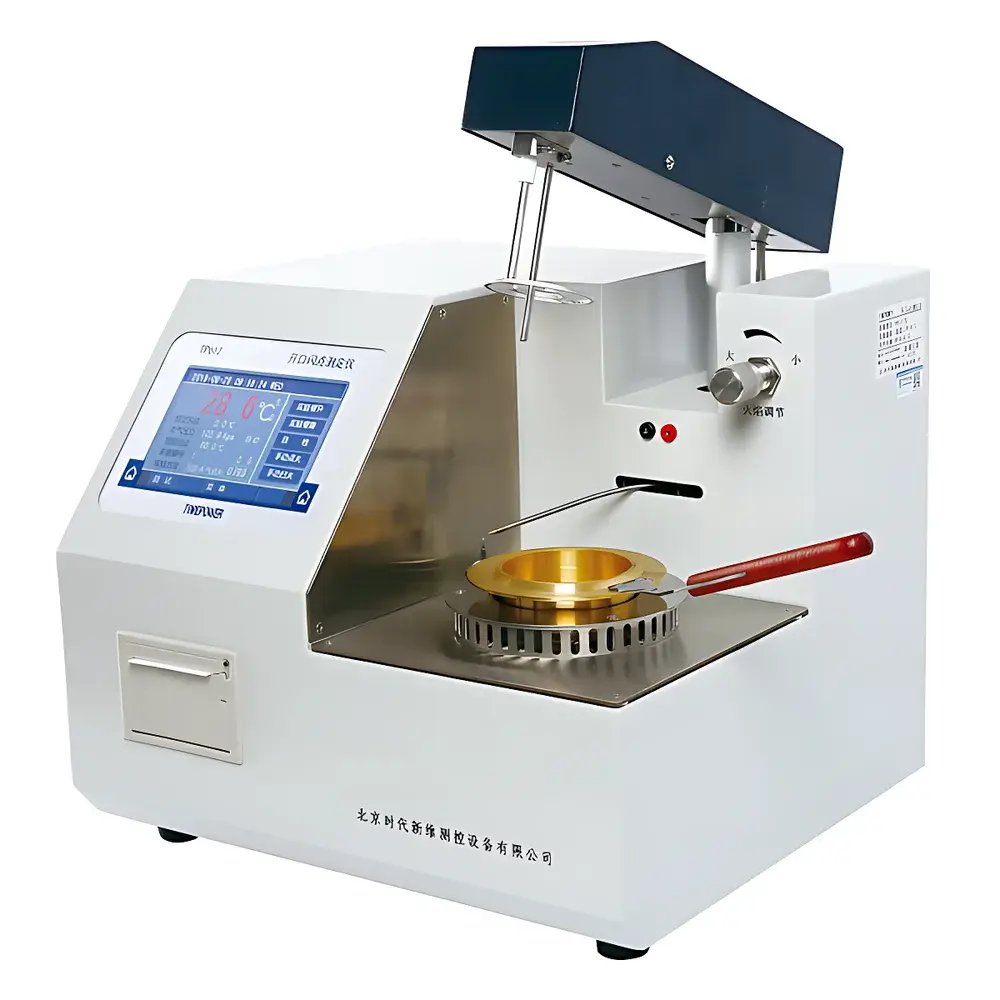
Timepower TP612 Automatic Cleveland Open-Cup Flash Point Tester
| Brand | Timepower |
|---|---|
| Origin | Beijing, China |
| Manufacturer | Timepower (OEM/ODM Capable) |
| Model | TP612 |
| Detection Method | Cleveland Open-Cup (ASTM D92 / GB/T 3536) |
| Measurement Range | 79–370 °C |
| Accuracy | ±2 °C |
| Repeatability | ≤4 °C |
| Resolution | 0.1 °C |
| Temperature Sensor | Pt100 (Imported, Stainless Steel Housing) |
| Display | 5.0-inch Touchscreen LCD (Chinese UI) |
| Cooling | Integrated High-Flow Air Cooling System |
| Printer | Thermal, 36-character Chinese/English Output |
| Power Supply | AC 220 V ±10%, 50 Hz ±10% |
| Power Consumption | ≤600 W |
| Dimensions | 350 × 310 × 300 mm |
| Weight | 14.5 kg |
| Environmental Operating Range | 5–40 °C, RH ≤85% |
| Safety Features | Overtemperature Auto-Shutoff, Atmospheric Pressure Compensation, Self-Diagnostic Fault Detection |
| Ignition Options | Switchable Gas Flame (LPG Propane/Natural Gas) or Electronic Spark Scanning Mode |
| Compliance | ASTM D92, GB/T 3536, ISO 2592 (Referenced), IEC 61000-4 EMC Immunity |
Overview
The Timepower TP612 Automatic Cleveland Open-Cup Flash Point Tester is a fully automated benchtop instrument engineered for precise determination of the open-cup flash point of petroleum products, lubricants, biodiesel blends, and other combustible liquids in accordance with internationally recognized standard test methods — primarily ASTM D92 and GB/T 3536. Based on the Cleveland Open-Cup (COC) principle, the instrument heats a standardized sample cup under controlled thermal ramping while continuously monitoring vapor concentration near the surface. Flash point is defined as the lowest temperature at which the evolved vapors form an ignitable mixture with ambient air and produce a momentary flame upon exposure to an externally applied ignition source. This thermally driven, stoichiometric combustion threshold serves as a critical safety parameter for storage, transportation, handling, and regulatory classification of flammable hydrocarbon-based fluids across energy, refining, power generation, and quality assurance laboratories.
Key Features
- Fully automated operation sequence: cup positioning, heating ramp control, ignition triggering, flash detection, data logging, cooling activation, and arm retraction — all synchronized without manual intervention.
- Programmable heating rate compliant with ASTM D92 requirements (typically 5–6 °C/min during final approach to flash point), adjustable via touchscreen interface.
- High-sensitivity ionization ring detector ensures reliable, low-noise flash event recognition with minimal false positives or missed detections.
- Integrated atmospheric pressure sensor enables real-time correction of flash point values to standard reference conditions (101.3 kPa), improving inter-laboratory reproducibility.
- Dual-mode ignition system: user-selectable between regulated LPG/propane gas flame scanning (with certified pressure regulator and leak-tight fittings) or contactless electronic spark ignition — optimized for lab infrastructure constraints and safety protocols.
- Pt100 platinum resistance thermometer housed in corrosion-resistant stainless steel sheath delivers traceable, NIST-compatible temperature measurement with 0.1 °C resolution and long-term stability.
- Embedded air-cooling module reduces post-test cooldown time by >40% compared to passive dissipation, supporting higher throughput in QC environments.
- Comprehensive self-diagnostic firmware monitors heater integrity, sensor continuity, ignition circuit status, and mechanical actuator feedback — flagging anomalies before test initiation.
Sample Compatibility & Compliance
The TP612 accommodates standard Cleveland open cups (ASTM D92-compliant geometry, 65 mL capacity) and supports viscous and semi-solid samples including residual fuel oils, transformer oils, hydraulic fluids, bitumen emulsions, and bio-derived feedstocks. It meets functional equivalency requirements for ISO 2592 (Petroleum products — Determination of flash point — Cleveland open cup method) and aligns with technical specifications referenced in API RP 2510 (Design and Construction of Petroleum Facilities), NFPA 30 (Flammable and Combustible Liquids Code), and EU CLP Regulation Annex VI hazard classification criteria. While not certified for GLP or FDA 21 CFR Part 11 out-of-the-box, its audit-ready data output (timestamped flash point, ambient pressure, ramp rate, operator ID field) supports integration into validated laboratory information management systems (LIMS) under client-defined SOPs.
Software & Data Management
Operation is managed through an embedded Linux-based firmware platform with a 5.0-inch capacitive touchscreen interface. All test parameters — including target ramp profile, ignition mode, pressure compensation toggle, and pass/fail thresholds — are configurable and stored per user profile. Each test generates a timestamped record containing initial/final temperatures, detected flash point, atmospheric pressure reading, and system health status. Data exports via thermal printer (36-character line width, UTF-8 Chinese/English support) include calibration verification stamps and operator initials. USB host port enables firmware updates and raw CSV log export for statistical process control (SPC) analysis. No cloud connectivity or remote access functionality is included; data residency remains local to the instrument.
Applications
- Quality control of insulating oils in electric utility substations per IEEE C57.106 and IEC 60296 specifications.
- Flash point verification of marine distillate fuels (DMA, DMZ) prior to bunkering, in compliance with IMO MARPOL Annex VI.
- Batch release testing of industrial lubricants against OEM specifications (e.g., Caterpillar EC-1, Komatsu HM).
- Regulatory submission support for SDS Section 9 (Physical and Chemical Properties) under GHS harmonized classification.
- R&D screening of alternative fuel formulations, including FAME biodiesel and hydrotreated vegetable oil (HVO) blends.
- Contract laboratory testing services accredited to ISO/IEC 17025:2017 (when operated within documented method validation scope).
FAQ
What standards does the TP612 comply with?
The instrument implements test procedures aligned with ASTM D92, GB/T 3536, and ISO 2592. It does not carry formal certification from third-party bodies but provides metrological performance consistent with these standards’ operational requirements.
Can the TP612 be used for closed-cup flash point testing?
No — the TP612 is strictly configured for Cleveland open-cup methodology. Closed-cup tests (e.g., ASTM D56, D3278) require fundamentally different cup geometry, vapor containment, and ignition mechanics.
Is external ventilation mandatory during operation?
Yes. ASTM D92 requires testing inside a draft-free environment with adequate fume extraction. The instrument must be installed within a certified chemical fume hood meeting ASHRAE 110 or EN 14175 airflow specifications.
How often should the Pt100 sensor be calibrated?
Timepower recommends annual calibration traceable to national metrology institutes (e.g., NIM China, NIST USA). Field verification using certified reference oils (e.g., NIST SRM 2721 series) is advised before each shift in high-precision applications.
Does the TP612 support network connectivity or LIMS integration?
It lacks Ethernet/Wi-Fi hardware and proprietary API interfaces. However, printed reports and exported CSV files are compatible with common LIMS ingestion protocols when paired with middleware or custom script automation.