
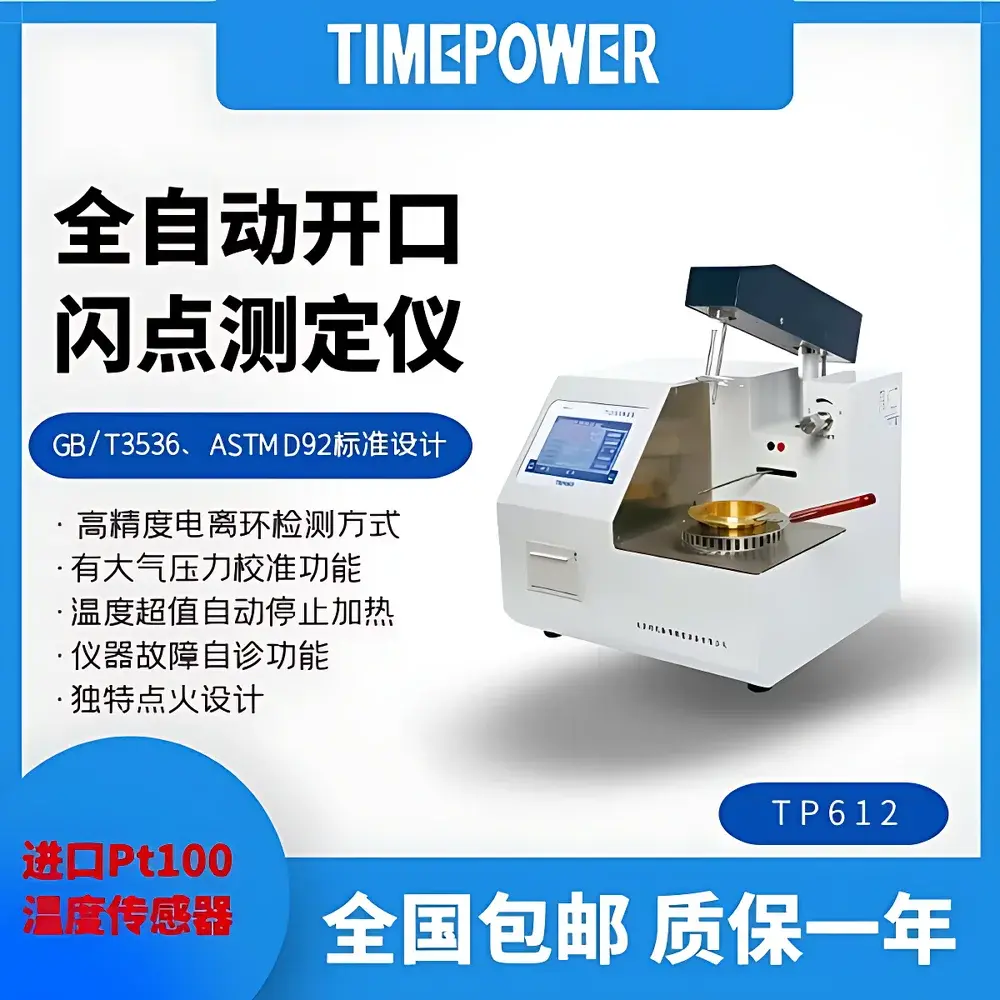
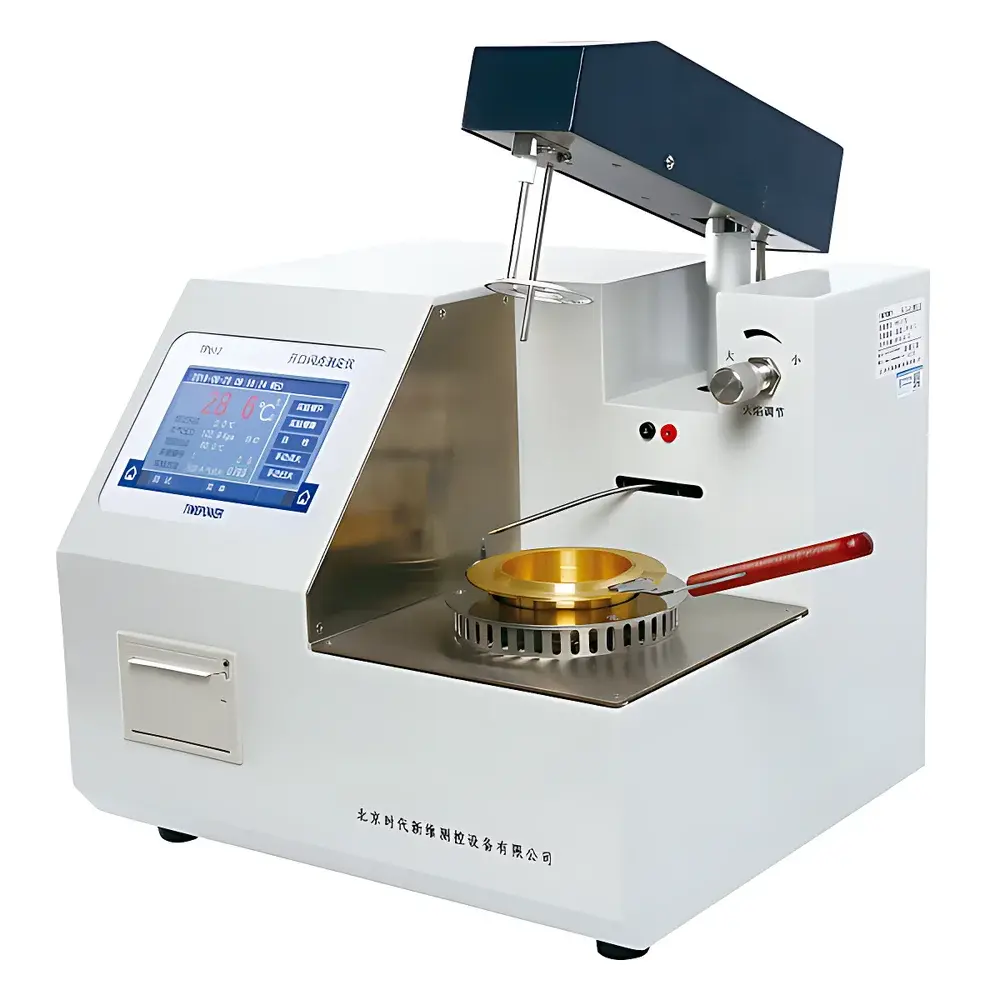

Timepower TP612 Automatic Cleveland Open-Cup Flash Point Tester
| Brand | Timepower |
|---|---|
| Origin | Beijing, China |
| Manufacturer Type | Manufacturer |
| Product Origin | Domestic (China) |
| Model | TP612 Cleveland Open-Cup Flash Point Tester |
| Detection Method | Cleveland Open-Cup (COC) |
| Operation Mode | Fully Automatic |
| Applicable Standards | GB/T 3536, ASTM D92 |
| Repeatability | ≤4 °C |
| Ignition Mode | Fully Automatic |
| Temperature Range | 79–370 °C |
| Accuracy | ±2 °C |
| Resolution | 0.1 °C |
| Cooling Method | Integrated Forced-Air Cooling |
| Display | TFT Color LCD (480×272, 260K colors) |
| Printer | Thermal, 36-character Chinese/English output |
| Power Supply | AC 220 V ±10 %, 50 Hz ±10 % |
| Power Consumption | ≤600 W |
| Dimensions | 350 × 310 × 300 mm |
| Weight | 14.5 kg |
Overview
The Timepower TP612 Automatic Cleveland Open-Cup Flash Point Tester is a precision-engineered instrument designed for the reliable and standardized determination of the open-cup flash point of petroleum products, bituminous materials, and related hydrocarbon-based fluids. It operates in strict compliance with the internationally recognized Cleveland Open-Cup (COC) method—codified in ASTM D92 and GB/T 3536. The instrument heats a standardized test cup containing the sample at a controlled, programmable rate while continuously monitoring vapor concentration near the surface. At the moment of sustained ignition—defined as a visible flash propagating across the vapor layer upon exposure to a calibrated test flame—the system records the corresponding equilibrium temperature as the flash point. This thermally driven, kinetically resolved measurement is essential for safety classification, regulatory compliance, and quality control in refining, power generation, lubricant formulation, and petrochemical logistics.
Key Features
- Fully automated operation sequence: cup positioning, heating ramp control, flame application, flash detection, data logging, cooling activation, and arm retraction—all synchronized without manual intervention.
- Dual ignition mode selection: user-switchable between propane-based gas flame scanning and solid-state electronic spark ignition—enabling flexibility across laboratory gas infrastructure constraints.
- High-fidelity temperature regulation: Pt100 platinum resistance thermometer (DIN Class A) housed in stainless-steel probe ensures long-term stability and traceable thermal response within ±2 °C accuracy.
- Intelligent atmospheric pressure compensation: integrated barometric sensor enables real-time correction of flash point values per ASTM D92 Annex A1, ensuring comparability across elevation zones and climatic conditions.
- Self-diagnostic firmware: continuous hardware status monitoring (heater continuity, sensor integrity, flame detection circuit, motor position feedback) with on-screen fault codes and operational lockout upon critical anomaly detection.
- Robust thermal management: built-in high-flow axial fan delivers rapid post-test cooldown, reducing turnaround time between consecutive determinations without compromising thermal equilibrium fidelity.
- Thermal runaway protection: independent overtemperature cutoff circuit terminates heating if measured cup temperature exceeds 375 °C or deviates >10 °C from programmed ramp profile.
Sample Compatibility & Compliance
The TP612 is validated for use with mineral oils, transformer oils, turbine oils, residual fuels, cutback asphalts, and other non-volatile or semi-volatile petroleum distillates exhibiting flash points between 79 °C and 370 °C. It excludes highly volatile solvents (e.g., gasoline, acetone) requiring closed-cup methods (ASTM D56/D3828). All mechanical, thermal, and electrical subsystems conform to IEC 61010-1:2010 safety requirements for laboratory equipment. Test reports generated by the instrument support audit-ready documentation under GLP and ISO/IEC 17025 frameworks. Data integrity is preserved via non-volatile memory storage and timestamped thermal profiles, satisfying foundational expectations for FDA 21 CFR Part 11–aligned environments when paired with appropriate networked validation protocols.
Software & Data Management
The embedded firmware supports full-cycle test automation with configurable ramp rates (0.5–10 °C/min), adjustable dwell times, and customizable pass/fail thresholds. Measurement data—including raw temperature vs. time traces, flash event timestamp, ambient pressure, operator ID, and calibration history—is stored locally in CSV-compatible format on internal flash memory (≥1000 test records). Thermal printouts include QR-coded metadata for traceability; optional USB export enables integration into LIMS or ELN platforms. Firmware updates are performed via secure USB key with SHA-256 signature verification to maintain configuration integrity across deployment lifecycles.
Applications
- Quality assurance of insulating oils in electric utility substations (IEC 60156 alignment via correlation studies).
- Batch release testing of industrial lubricants per OEM specifications referencing ASTM D92.
- Regulatory submission support for customs clearance and hazardous goods classification (UN GHS Category 3/4, TDG Class 3).
- R&D screening of bio-based hydraulic fluids and synthetic ester formulations during oxidative stability development.
- Field-deployable verification of fuel adulteration or contamination in marine bunkering operations (paired with reference standards).
- Teaching laboratories demonstrating fundamental flammability behavior governed by vapor pressure–temperature relationships.
FAQ
What standards does the TP612 explicitly comply with?
The instrument is fully compliant with ASTM D92 and GB/T 3536 for Cleveland Open-Cup flash point determination. It implements all mandatory procedural elements including cup geometry, thermometer placement, heating rate tolerances, and flame characteristics.
Can the TP612 be used for closed-cup flash point testing?
No. The TP612 is engineered exclusively for open-cup methodology. Closed-cup applications require dedicated instruments such as Pensky-Martens (ASTM D93) or Tag (ASTM D56) testers.
Is atmospheric pressure correction applied automatically during testing?
Yes. The integrated barometric sensor performs real-time pressure measurement and applies ASTM D92–specified correction factors to the raw flash point value prior to display and reporting.
What maintenance is required for long-term accuracy?
Routine cleaning of the test cup and ignition nozzle after each use; annual verification of Pt100 sensor calibration against NIST-traceable reference; biannual inspection of gas line integrity (if using propane mode) and fan performance.
Does the system support network connectivity or remote operation?
The base configuration operates as a standalone unit. Optional Ethernet or RS-232 modules enable SCADA integration and centralized data aggregation, subject to site-specific cybersecurity validation.






