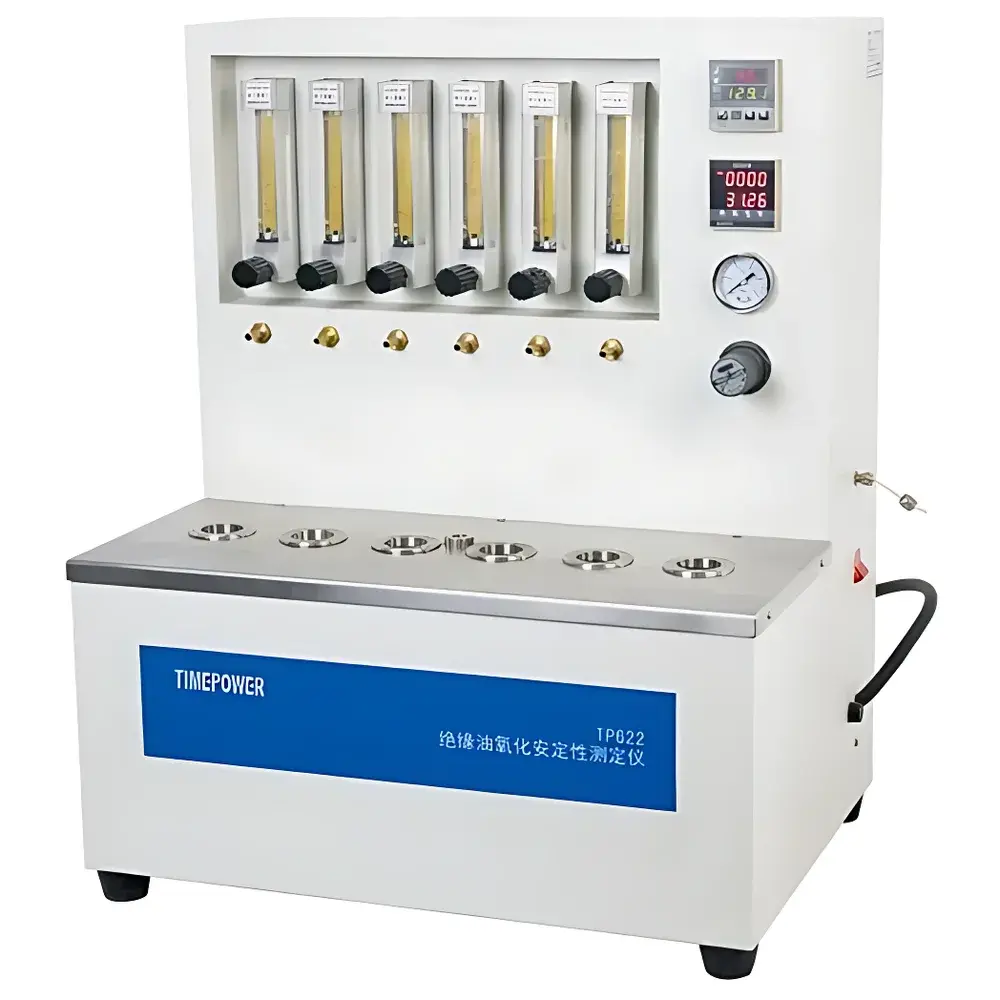
TimePower TP622 Insulating Oil Oxidation Stability Tester
| Brand | TimePower |
|---|---|
| Origin | Beijing, China |
| Manufacturer Type | Original Equipment Manufacturer (OEM) |
| Country of Origin | China |
| Model | TP622 |
| Pricing | Available upon request |
| Temperature Control Range | Ambient to 160 °C |
| Temperature Control Accuracy | ±0.5 °C |
| Power Supply | AC 220 V ±10%, 50 Hz ±10% |
| Power Consumption | ≤1100 W |
| Sample Capacity | 6 parallel test channels |
| Heating Method | Metal bath (oil-free) |
| Temperature Regulation | PID feedback control |
| Safety Features | Built-in over-temperature protection |
| Gas Flow Measurement | Calibrated soap-bubble flowmeter |
| Timing Function | Integrated digital timer |
| Calibration Documentation | NIST-traceable calibration certificate available |
Overview
The TimePower TP622 Insulating Oil Oxidation Stability Tester is a precision-engineered benchtop instrument designed for the quantitative evaluation of oxidative degradation resistance in electrical insulating oils—primarily mineral-based transformer oils. It operates in strict compliance with two key industry standards: SH/T 0811 (Determination of Oxidation Stability of Electrical Insulating Oils by Rotating Oxygen Bomb Method) and SH/T 0206 (Determination of Oxidation Stability of Transformer Oil by Accelerated Oxidation Test). The instrument implements an accelerated oxidation protocol wherein oil samples are exposed to elevated temperature (up to 160 °C), high-purity oxygen (typically ≥99.5%), and controlled agitation under pressurized conditions. Oxidation progress is monitored via pressure drop measurement over time, directly correlating with oxygen consumption and formation of sludge, acids, and insoluble sediments. This methodology provides predictive insight into long-term service life, thermal aging behavior, and compatibility with solid insulation systems in power transformers.
Key Features
- Metal-bath heating system eliminates the need for heat-transfer oil—reducing maintenance, contamination risk, and environmental footprint while ensuring uniform thermal distribution across all six sample positions.
- PID-controlled temperature regulation delivers rapid thermal equilibration and sustained stability within ±0.5 °C across the full operating range (ambient to 160 °C), critical for reproducible kinetic oxidation data.
- Six independent reaction channels enable parallel testing of multiple samples or replicates, improving throughput and statistical robustness without cross-contamination.
- Integrated soap-bubble flowmeter provides traceable, real-time verification of oxygen flow rate prior to and during test initiation—ensuring adherence to standard-specified gas delivery protocols.
- Digital programmable timer initiates and records test duration automatically, supporting unattended operation and minimizing operator-induced timing errors.
- Redundant safety architecture includes dual-stage over-temperature cutoff, pressure relief valves, and sealed reaction vessels rated for sustained operation at 1.0 MPa, fully aligned with laboratory safety management systems (LSMS) requirements.
Sample Compatibility & Compliance
The TP622 is validated for use with hydrocarbon-based insulating oils meeting IEC 60296, ASTM D3487, and GB/T 7595 specifications. It accommodates standard 100-mL oxidation bombs per SH/T 0811 and supports both new and in-service oil matrices—including inhibited and uninhibited formulations. All hardware components contacting oil or oxygen are constructed from passivated stainless steel (AISI 316) to prevent catalytic metal ion leaching. The system design conforms to GLP principles: electronic log files record operator ID, start/stop timestamps, setpoints, and ambient conditions; audit trails are exportable in CSV format. Optional calibration certificates are issued with NIST-traceable references for temperature and pressure sensors, satisfying internal quality audits and third-party accreditation (e.g., CNAS, ISO/IEC 17025).
Software & Data Management
While the TP622 operates as a stand-alone hardware platform, its embedded controller supports RS-232/USB connectivity for integration with laboratory information management systems (LIMS) or custom data acquisition software. Raw pressure decay curves, temperature profiles, and elapsed time stamps are logged at user-defined intervals (1–60 s resolution) and stored internally for up to 100 test sessions. Exported datasets include metadata fields compliant with ASTM E1447 (Standard Practice for Electronic Records in Laboratory Information Systems), enabling direct import into statistical analysis packages (e.g., JMP, Minitab) for Arrhenius modeling, induction period calculation, and comparative stability ranking. All firmware updates are delivered via secure USB interface and require digital signature validation.
Applications
- Quality assurance of new transformer oil batches prior to commissioning or storage.
- Condition monitoring of in-service oils in utility substations and industrial power systems.
- Formulation development and additive performance screening by lubricant manufacturers.
- Research on oxidation inhibition mechanisms, antioxidant depletion kinetics, and synergistic effects in multi-additive systems.
- Educational laboratories conducting standardized methods training for ASTM D2440, IEC 61125, and national equivalents.
- Third-party testing laboratories accredited to ISO/IEC 17025 seeking validated, low-maintenance oxidation stability instrumentation.
FAQ
What standards does the TP622 comply with?
It is engineered specifically for SH/T 0811 and SH/T 0206, and its operational parameters align with the technical requirements of ASTM D2440, IEC 61125, and GB/T 12583.
Can the TP622 be used for turbine oils or other lubricants?
While optimized for insulating oils, it may be adapted for other oxidatively stressed hydrocarbon fluids—provided method validation is performed per ASTM D943 or D2272 protocols and vessel geometry is verified for sample volume and headspace ratio.
Is remote monitoring or network connectivity supported?
The base unit features serial and USB interfaces; Ethernet or Wi-Fi modules are available as optional add-ons for centralized lab-wide instrument monitoring.
How often does the soap-bubble flowmeter require recalibration?
Annual verification against a certified rotameter or mass flow controller is recommended, with documentation retained for GLP/GMP traceability.
Does the system support automated pressure recording?
Yes—integrated pressure transducers log continuous data at configurable intervals, and raw files include timestamped pressure vs. time arrays suitable for induction period determination per SH/T 0811 Annex A.