
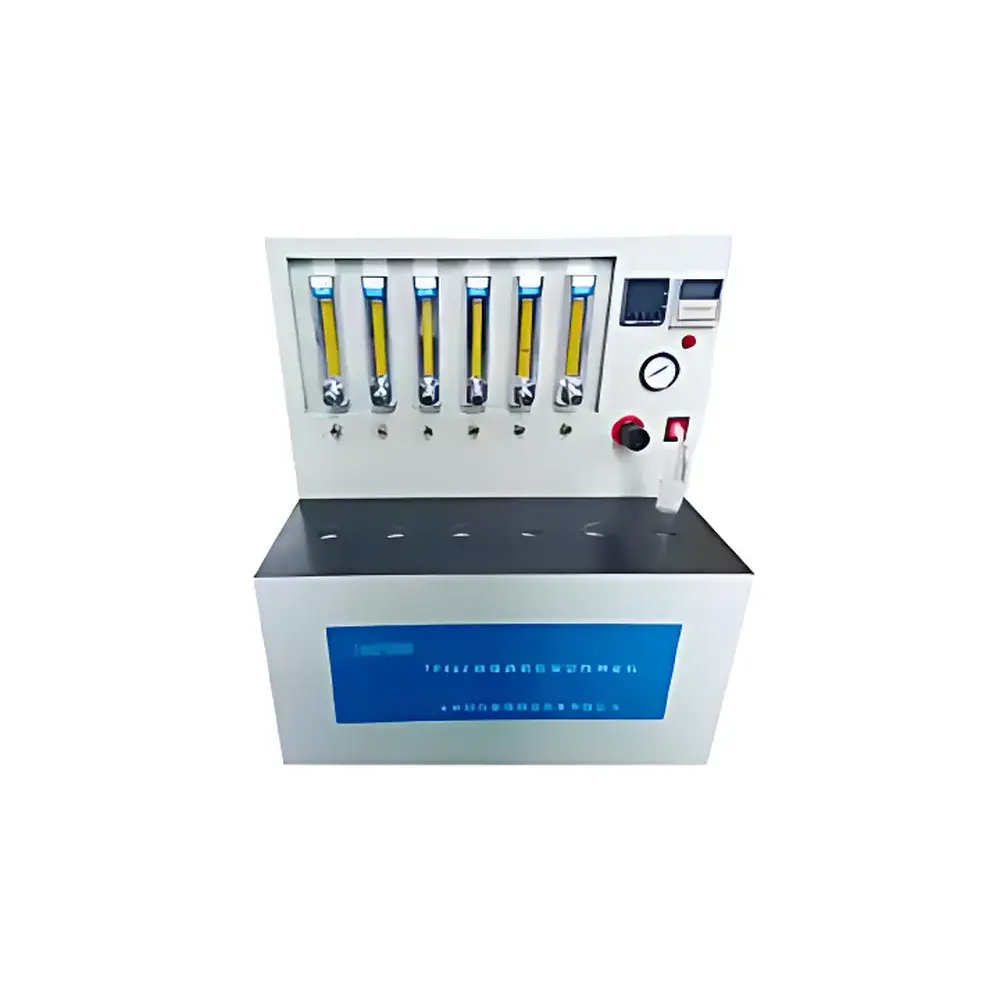
TimePower TP622 Petroleum Oxidation Stability Tester for Insulating Oil
| Brand | TimePower |
|---|---|
| Model | TP 622 |
| Origin | Beijing, China |
| Manufacturer | TimePower Instrument Co., Ltd. |
| Application Standard Compliance | SH/T 0811, SH/T 0206 |
| Heating Method | Metal Bath (Oil-Free) |
| Temperature Control | Digital PID Controller with RTD Sensor |
| Temperature Range | Ambient to 160 °C |
| Temperature Stability | ±0.5 °C at Setpoint |
| Sample Capacity | 6 Parallel Reaction Vessels |
| Gas Flow Measurement | Calibrated Soap-Bubble Flowmeter |
| Timing Function | Integrated Digital Timer |
| Power Supply | AC 220 V ±10%, 50 Hz ±10% |
| Power Consumption | ≤1100 W |
| Dimensions (W×D×H) | 480 mm × 350 mm × 595 mm |
| Safety Features | Dual-Stage Over-Temperature Protection, Automatic Gas Shutoff Interlock (Optional), Ventilation Monitoring Interface |
| Calibration Documentation | Optional NIST-Traceable Metrology Certificate Available |
Overview
The TimePower TP622 Petroleum Oxidation Stability Tester is an automated benchtop instrument engineered for the quantitative assessment of oxidation resistance in insulating oils—particularly transformer oils—under accelerated, standardized conditions. It operates on the principle of catalytic oxidative aging: samples (25 g each) are exposed to purified oxygen at controlled elevated temperatures (up to 160 °C) in the presence of copper wire catalysts, simulating long-term thermal-oxidative stress encountered in power transformers. The resulting degradation is quantified via gravimetric determination of insoluble sludge (precipitate mass) and potentiometric titration of acid number (mg KOH/g), both defined as primary endpoints in SH/T 0811 and SH/T 0206—the Chinese national standards aligned with ASTM D2440 and IEC 61125 methodologies. Unlike traditional oil bath systems, the TP622 employs a solid-state metal heating block, eliminating flammable oil media, reducing maintenance, and improving thermal uniformity across all six reaction positions.
Key Features
- Metal bath heating architecture ensures rapid thermal equilibration, zero fluid replenishment, and reduced risk of contamination or spillage.
- PID-controlled temperature regulation with platinum RTD sensing delivers ±0.5 °C stability at any setpoint between ambient and 160 °C—critical for reproducible oxidation kinetics.
- Six independent sample stations enable parallel testing under identical environmental conditions, increasing throughput while maintaining inter-sample comparability.
- Integrated soap-bubble flowmeter provides traceable, real-time verification of oxygen flow rate (typically 25–50 mL/min), essential for adherence to SH/T 0811 gas delivery specifications.
- Digital timer with auto-stop functionality supports precise exposure durations (e.g., 72 h, 164 h), synchronized with temperature and gas control logic.
- Redundant over-temperature protection includes primary electronic cutoff and secondary mechanical thermal fuse, compliant with IEC 61010-1 safety requirements for laboratory equipment.
- Modular accessory interface accommodates optional ventilation monitoring, pressure relief valves, and exhaust ducting for integration into certified fume hood environments.
Sample Compatibility & Compliance
The TP622 is validated for use with mineral-based, synthetic, and ester-based insulating oils meeting IEC 60296, ASTM D3487, and GB/T 7595 specifications. Its design conforms to the physical and procedural constraints outlined in SH/T 0811 (for inhibited oils) and SH/T 0206 (for uninhibited oils), including prescribed copper catalyst geometry (electrolytic Cu wire, ≥99.9% purity), sample volume (25.0 ±0.1 g), and oxidation duration. All critical parameters—including temperature profile, gas flow rate, and timing—are documented in instrument logs to support GLP-compliant data integrity. Optional metrological certification provides NIST-traceable calibration records for temperature, time, and flow, satisfying internal QA audits and regulatory readiness per ISO/IEC 17025.
Software & Data Management
While the TP622 operates as a standalone hardware platform, its digital controller supports RS-232/USB data export for time-stamped logging of temperature, elapsed time, and system status flags. Exported CSV files integrate directly with LIMS platforms or Excel-based reporting templates used in power utility laboratories. Audit trail functionality records operator ID (via optional keypad login), method version, start/stop timestamps, and deviation alerts (e.g., temperature excursion >±1.0 °C). For regulated environments, the instrument’s deterministic control loop and non-volatile event memory meet foundational requirements for FDA 21 CFR Part 11 compliance when deployed with validated third-party data acquisition software.
Applications
- Quality assurance of new transformer oil batches prior to commissioning.
- Condition monitoring of in-service oils during routine maintenance cycles.
- Formulation development and additive performance evaluation by lubricant manufacturers.
- Research into antioxidant depletion kinetics and sludge formation mechanisms.
- Educational laboratories conducting ASTM/SH-standardized experiments in petroleum engineering curricula.
- Third-party testing labs serving ISO/IEC 17025-accredited certification programs.
FAQ
What standards does the TP622 comply with?
The instrument is designed and verified to meet SH/T 0811 and SH/T 0206, which are functionally equivalent to ASTM D2440 and IEC 61125 for insulating oil oxidation testing.
Is oxygen supply included with the system?
No—oxygen must be supplied from an external regulated cylinder (Grade 3.0 or higher) with appropriate pressure-reducing regulator and particulate filter; connection fittings follow ISO 8573-1 Class 2 requirements.
Can the TP622 be used for turbine oils or hydraulic fluids?
While optimized for insulating oils, the core methodology may be adapted for other hydrocarbon-based lubricants; however, validation against ASTM D943 or D2272 is required prior to routine use.
How often does the metal bath require recalibration?
Annual verification using a calibrated reference thermometer (e.g., PRT or thermocouple standard) is recommended; full recalibration is performed during scheduled metrological service.
Does the system support remote monitoring or network connectivity?
Native Ethernet or Wi-Fi is not integrated; however, serial-to-Ethernet converters enable secure SCADA integration in industrial lab networks when configured per ISA/IEC 62443 guidelines.





