
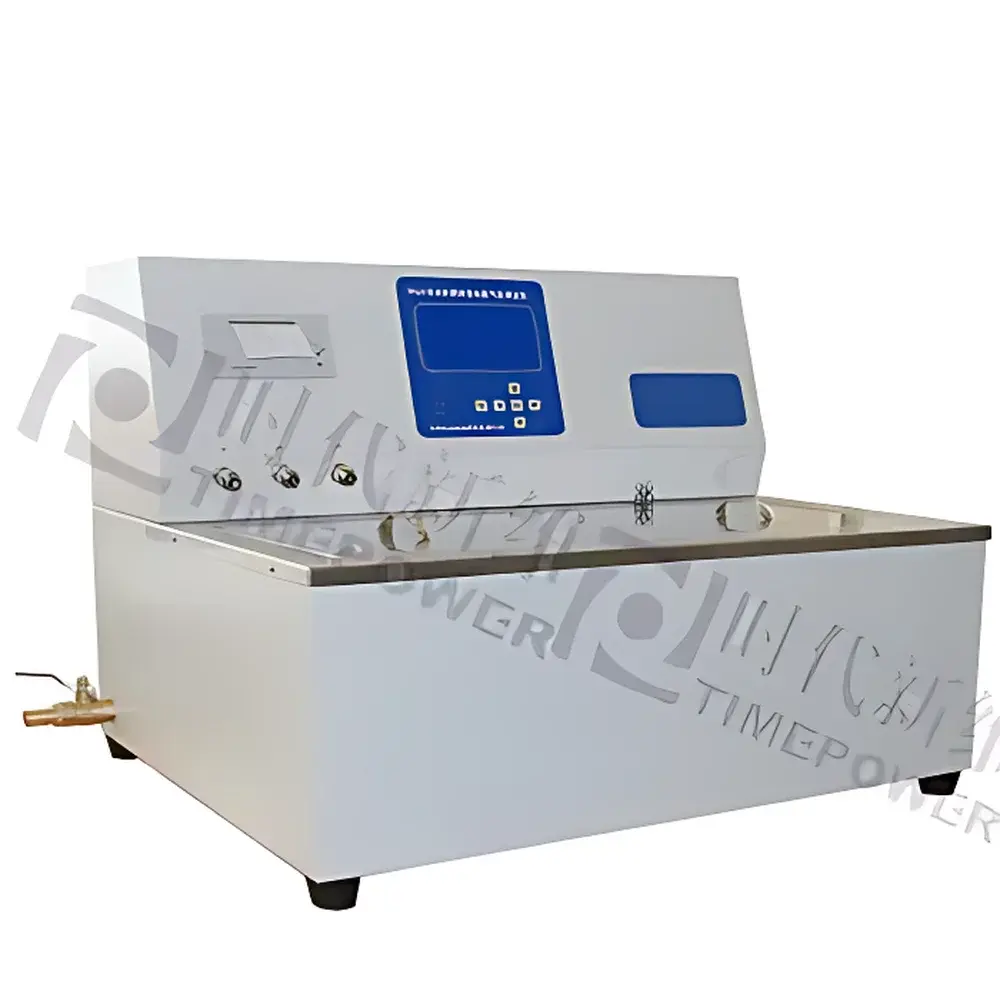
Timepower TP623 Automatic Vapor Pressure Tester for Engine Fuels
| Brand | Timepower |
|---|---|
| Model | TP623 |
| Origin | Beijing, China |
| Manufacturer | Timepower Measurement & Control Co., Ltd. |
| Compliance | GB/T 8017, ASTM D323 |
| Power Supply | AC 220 V ±10%, 50 Hz ±10% |
| Power Consumption | ≤1700 W |
| Bath Temperature | 37.8 °C ±0.1 °C |
| Heating Power | 1600 W |
| Sample Cells | 3 simultaneous test chambers |
| Pressure Range | 0–200 kPa (0–29 psi) |
| Chamber Rotation | 350° reciprocating motion |
| Ambient Operating Conditions | –10 to 35 °C, RH ≤85% |
| Display | LCD with Chinese interface |
| Output | Integrated thermal printer |
| Control System | Microcontroller-based fully automated operation |
Overview
The Timepower TP623 Automatic Vapor Pressure Tester is a precision-engineered instrument designed for the reliable and repeatable determination of Reid Vapor Pressure (RVP) of volatile petroleum products—including gasoline, reformulated fuels, naphthas, and light crude oils—according to internationally recognized standard test methods: GB/T 8017 (Chinese National Standard) and ASTM D323 (Standard Test Method for Vapor Pressure of Petroleum Products (Reid Method)). The instrument operates on the fundamental principle of equilibrium vapor pressure measurement in a sealed, temperature-controlled liquid–vapor system. A defined volume of sample is introduced into a calibrated test chamber (the “RVP bomb”), which is then immersed in a thermostatically regulated water bath held at 37.8 °C (100 °F). After equilibration, the total pressure exerted by the vapor phase above the liquid sample is measured under controlled agitation—simulating real-world storage and handling conditions where vapor–liquid equilibrium is critical for safety, emissions control, and fuel formulation.
Key Features
- Fully automated microcontroller-based operation eliminates manual timing, pressure reading, and temperature monitoring errors—ensuring high reproducibility across laboratories and shifts.
- Triple-chamber design enables concurrent testing of up to three samples, improving throughput without compromising inter-test consistency or calibration integrity.
- High-precision water bath with ±0.1 °C temperature stability at 37.8 °C, achieved via optimized heating element geometry and intelligent PID control—critical for meeting ASTM D323’s strict thermal requirements.
- Electro-mechanically driven 350° reciprocating rotation of each test chamber ensures uniform mixing and accelerates vapor–liquid equilibrium attainment, replicating standardized agitation protocols.
- Electrically isolated heating system maintains full electrical separation between water bath and power circuitry, enhancing operator safety and long-term system reliability.
- Integrated thermal printer provides immediate hard-copy documentation of final RVP values, test timestamps, and chamber identifiers—supporting traceability in quality control environments.
- LCD display with native Chinese interface simplifies local operator interaction while maintaining compliance with international test method logic and sequence.
Sample Compatibility & Compliance
The TP623 is validated for use with Class I and II volatile hydrocarbon liquids as defined in ASTM D4057 and ISO 3170. It accommodates gasoline blends (including ethanol-containing E10 and E15), motor fuels, aviation gasoline (avgas), and light distillates with initial boiling points below 120 °C. The instrument meets all mechanical, thermal, and procedural specifications outlined in GB/T 8017–2012 and ASTM D323–22, including chamber volume tolerances, pressure transducer accuracy class, bath immersion depth, and agitation frequency. Its design supports routine verification per ASTM D4057 sampling protocols and aligns with refinery QC workflows requiring GLP-compliant data generation.
Software & Data Management
While the TP623 operates as a standalone embedded system without PC connectivity, its firmware implements audit-ready operational logging: each test cycle records chamber ID, start/end time, bath temperature profile, final pressure reading, and pass/fail status relative to internal stability thresholds. All printed reports include unique session identifiers and timestamp metadata. For laboratories operating under FDA 21 CFR Part 11 or ISO/IEC 17025 frameworks, external data capture can be implemented via serial output (RS-232 optional) or manual entry into LIMS platforms. Firmware updates are performed locally via USB interface, ensuring version control and regulatory alignment during instrument lifecycle management.
Applications
- Refinery quality assurance: Monitoring RVP during blending to meet seasonal volatility specifications (e.g., EPA Tier 3 summer/winter limits).
- Fuel distribution centers: Verifying inbound shipments against contractual RVP limits prior to tank entry.
- Regulatory compliance labs: Generating legally defensible RVP data for environmental reporting under national air quality standards.
- R&D laboratories: Screening alternative fuel formulations (e.g., bio-blends, synthetic hydrocarbons) for vapor pressure behavior under standardized conditions.
- Educational institutions: Teaching fundamental thermodynamic concepts—including Clausius–Clapeyron relationships and phase equilibrium—using industrially relevant instrumentation.
FAQ
What standards does the TP623 comply with?
The instrument is designed and verified for full conformance with GB/T 8017–2012 and ASTM D323–22, including all requirements for apparatus geometry, temperature control, pressure measurement range, and agitation mechanics.
Can the TP623 be used for liquefied petroleum gas (LPG) or butane blends?
No—TP623 is not suitable for LPG or highly volatile C3/C4 streams. It is intended exclusively for Reid-method applications on liquid-phase petroleum products with vapor pressures below 200 kPa at 37.8 °C.
Is external calibration required before first use?
Yes. Users must perform initial calibration using NIST-traceable pressure and temperature references per ASTM D323 Annex A1 and manufacturer’s installation protocol.
Does the system support data export to Excel or LIMS?
The base configuration includes only thermal print output; optional RS-232 or USB-to-serial modules enable ASCII-formatted data streaming for integration with third-party software.
What maintenance is recommended for long-term accuracy?
Quarterly verification of bath temperature uniformity, annual pressure transducer recalibration, and routine cleaning of chamber O-rings and bath interior are advised per ISO/IEC 17025 preventive maintenance guidelines.






