
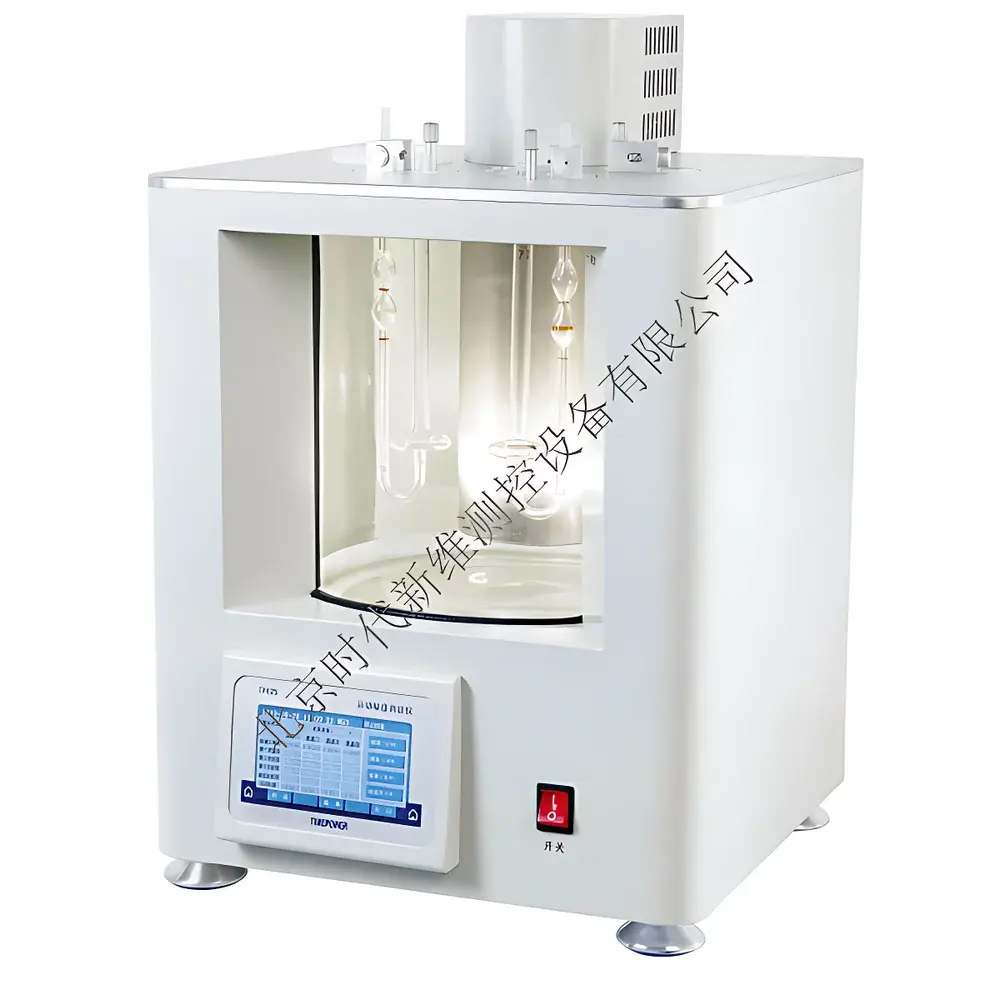
Timepower TP625 Kinematic Viscometer
| Brand | Timepower |
|---|---|
| Origin | Beijing, China |
| Manufacturer Type | Direct Manufacturer |
| Origin Classification | Domestic (China) |
| Model | TP625 |
| Pricing | Upon Request |
| Temperature Control Range | 0–120 °C (0 °C to ambient requires optional chiller) |
| Temperature Stability | ±0.05 °C |
| Temperature Resolution | 0.01 °C |
| Bath Capacity | 4 test positions |
| Power Supply | AC 220 V ±10%, 50 Hz ±10% |
| Heating Power | ≤1500 W |
| Ambient Operating Conditions | 5–40 °C, ≤85% RH |
| Dimensions | 510 × 360 × 470 mm |
| Weight | 20 kg |
| Display | Imported full-color LCD with real-time clock (year/month/day/hour/minute, battery-backed) |
| Control System | Microprocessor-based PID temperature regulation |
| Sensors | High-sensitivity imported platinum resistance thermometer (PT100-class equivalent) |
| Illumination | Integrated LED backlight for capillary observation |
| Optional Accessories | Ubbelohde-type viscometers (standard), reverse-flow (Cannon-Fenske) viscometers (optional), external refrigeration unit for sub-ambient testing |
Overview
The Timepower TP625 Kinematic Viscometer is a microprocessor-controlled, constant-temperature bath instrument engineered for precise determination of kinematic viscosity in transparent and opaque petroleum liquids—including lubricating oils, transformer oils, diesel fuels, and hydraulic fluids—according to ASTM D445, ISO 3104, and GB/T 265–1988. It operates on the capillary flow principle: a fixed volume of sample is drawn into a calibrated glass capillary tube (e.g., Ubbelohde or reverse-flow type), immersed in a thermostatically stabilized bath, and timed as it flows under gravity between two etched marks. Kinematic viscosity (ν, in mm²/s or cSt) is calculated as the product of the capillary constant (K) and the measured efflux time (t): ν = K × t. The TP625 integrates high-fidelity thermal regulation, real-time digital monitoring, and automated data computation to eliminate manual stopwatch dependency and reduce operator-induced variability—critical for laboratories requiring compliance with GLP, ISO/IEC 17025, and internal quality assurance protocols.
Key Features
- Four-position thermostatic bath with independent immersion zones—enables parallel testing of multiple samples or replicate runs for statistical validation.
- PID-based temperature control architecture with ±0.05 °C stability over 30-minute dwell time—validated per ASTM E644 and traceable to NIST-traceable reference thermometers.
- Imported high-linearity Pt100-class temperature sensor coupled with dual-point calibration capability (offset and span adjustment) ensures long-term measurement fidelity across the 0–120 °C range.
- Full-color LCD interface with embedded real-time clock (battery-backed memory) supports audit-ready timestamping of every test sequence—essential for 21 CFR Part 11–aligned environments when paired with optional data export modules.
- Integrated LED illumination system optimized for visual verification of meniscus position during timing—minimizing parallax error during manual start/stop operations.
- Modular design accommodates both standard Ubbelohde viscometers (included) and optional Cannon-Fenske reverse-flow units—supporting viscosity determinations across wide dynamic ranges (0.2–10⁶ mm²/s).
- Optional chiller interface enables controlled sub-ambient operation down to 0 °C—required for low-temperature viscosity profiling of multigrade engine oils per SAE J300.
Sample Compatibility & Compliance
The TP625 is validated for use with Newtonian and near-Newtonian petroleum-based liquids meeting ASTM D1298 density specifications (≤1.034 g/mL). It supports routine testing of insulating oils per IEC 60296, turbine oils per ISO 8502, and residual fuel oils per ISO 12185. All thermal and timing functions comply with the repeatability and reproducibility limits defined in ASTM D445 Annex A1 (within-lab R ≤ 0.35% for ν ≥ 2 mm²/s; between-lab Rr ≤ 1.2%). Instrument firmware adheres to electromagnetic compatibility standards IEC 61326-1 and safety requirements IEC 61010-1. Documentation includes factory calibration certificates, traceable to national metrology institutes, and supports IQ/OQ protocol execution for regulated QC laboratories.
Software & Data Management
While the TP625 operates as a standalone benchtop instrument with embedded firmware, its RS232 serial port (standard) and optional USB-to-serial adapter enable direct connection to LIMS or laboratory PCs. Exported data includes: test ID, date/time stamp, bath temperature (°C), efflux time (s), calculated kinematic viscosity (mm²/s), capillary constant (mm²/s²), and operator ID field. Raw timing logs are stored in non-volatile memory for up to 500 test records. When integrated with compliant third-party software (e.g., LabWare LIMS or custom Python-based parsers), the system supports electronic signatures, audit trails, and change control—meeting FDA 21 CFR Part 11 requirements for electronic records and signatures in pharmaceutical and energy-sector QA/QC applications.
Applications
- Quality control of transformer oil in power generation substations—verifying conformance to IEEE C57.106 viscosity thresholds prior to commissioning.
- Batch release testing of aviation turbine fuel (Jet A-1) per ASTM D1655—ensuring flow performance at −40 °C via optional chiller integration.
- R&D evaluation of synthetic ester-based biodegradable lubricants—tracking viscosity index (VI) shifts after oxidative aging per ASTM D2872.
- Contract testing laboratories performing accredited viscosity services to ISO/IEC 17025—leveraging four-position throughput and NIST-traceable calibration documentation.
- University research on nanoparticle-enhanced heat transfer fluids—where precise low-shear kinematic viscosity under controlled thermal gradients informs rheological modeling.
FAQ
What capillary viscometer types are supported?
Ubbelohde-type viscometers are supplied as standard; Cannon-Fenske reverse-flow viscometers are available as optional accessories—both conform to ASTM D446 dimensional tolerances.
Is the instrument suitable for opaque or dark-colored oils?
Yes—when used with reverse-flow viscometers and appropriate light-source alignment, the TP625 accommodates ASTM D445-compliant testing of black oils such as bitumen cutbacks and heavy fuel oils.
How is temperature calibration verified?
Users must perform periodic verification using a certified reference thermometer (e.g., ASTM E77 Class A); the instrument provides offset adjustment functionality to correct minor deviations.
Can test data be exported to Excel or LIMS?
Yes—via RS232 serial output with ASCII-delimited format; optional drivers support direct import into Microsoft Excel, LabWare, STARLIMS, and custom SQL databases.
What maintenance is required for long-term accuracy?
Annual recalibration of the temperature sensor and verification of bath fluid level and cleanliness are recommended; capillary viscometers require cleaning per ASTM D4294 procedures after each use.





