
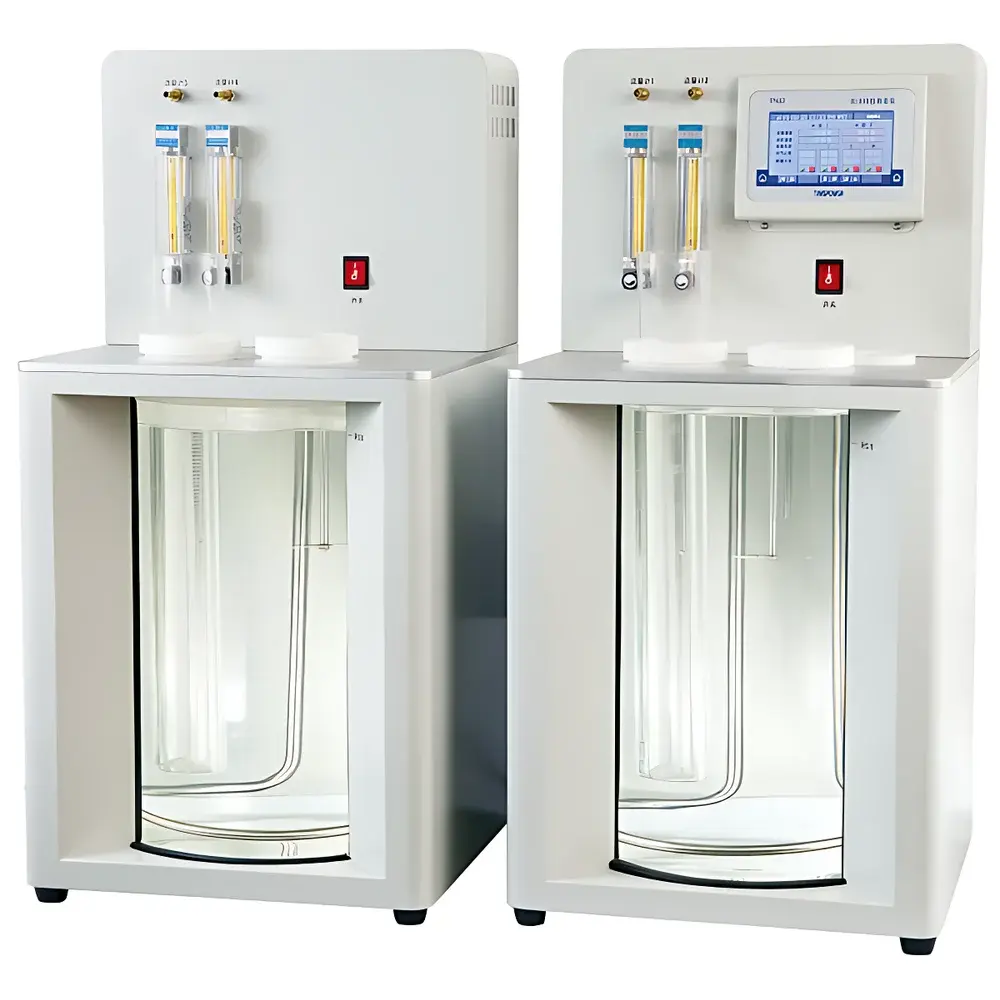
Timepower TP652 Foam Characteristic Tester for Petroleum Products
| Brand | Timepower |
|---|---|
| Origin | Beijing, China |
| Manufacturer | Timepower Instrument Co., Ltd. |
| Model | TP652 |
| Standards Compliance | ASTM D892, ISO 6247, GB/T 12579 |
| Temperature Control Range | 0–100 °C (with optional immersion chiller) |
| Temperature Accuracy | ±0.5 °C |
| Air Flow Rate | 16–160 mL/min (adjustable via rotameter) |
| Air Supply | Integrated quiet air pump (3 L/min capacity) |
| Gas Diffusion Head Flow Capacity | 3000–6000 mL/min at 2.45 kPa |
| Timing Resolution | ±1 s (automated) |
| Display | 5.0-inch capacitive touchscreen |
| Printer | Thermal printer (36-character Chinese/English support) |
| Power | AC 220 V ±10%, 50 Hz ±10%, ≤2300 W |
| Dimensions | 340 × 340 × 740 mm |
| Weight | 23 kg |
Overview
The Timepower TP652 Foam Characteristic Tester is an automated, temperature-controlled instrument engineered for the quantitative evaluation of foam tendency and foam stability in lubricating oils and other petroleum-based fluids. It operates on the principle of controlled air sparging through a standardized gas diffusion head into a calibrated cylindrical test vessel, under precisely defined thermal and temporal conditions. The instrument replicates the standardized test protocols outlined in ASTM D892 (Standard Test Method for Foaming Characteristics of Lubricating Oils), ISO 6247 (Petroleum products — Determination of foaming characteristics), and GB/T 12579 (Chinese national standard for foam testing of lubricants). Foam volume is measured visually or optically at designated intervals—immediately after 5 minutes of air injection (foam tendency) and again after a specified drainage period (foam stability)—at two mandatory temperatures: 24 °C (low-temperature test) and 93.5 °C (high-temperature test). This dual-temperature methodology enables comparative assessment of surfactant behavior, additive depletion, oxidation-induced surface activity, and formulation robustness across operational thermal regimes.
Key Features
- Microprocessor-based control system with real-time PID temperature regulation, ensuring ±0.5 °C thermal stability across the full 0–100 °C operating range—including optional immersion chiller integration for sub-ambient operation when ambient lab temperature exceeds 24 °C.
- Four independently adjustable air flow channels, each equipped with precision rotameters (16–160 mL/min range), enabling parallel or sequential testing with traceable flow calibration.
- Integrated low-noise air supply (3 L/min free-air delivery) compliant with ISO 8573-1 Class 3 particulate/oil-free requirements for laboratory-grade compressed air simulation.
- 5.0-inch industrial-grade capacitive touchscreen interface supporting multilingual prompts (English/Chinese), intuitive parameter setup, automated sequence execution, and on-device data logging.
- Dual-bath thermal architecture: high-precision stainless-steel thermostatic bath for sample immersion and auxiliary temperature-controlled housing for critical electronics and flow components.
- Thermal printer with 36-character line capacity supports direct hardcopy output of test ID, timestamps, temperature setpoints, airflow values, foam volumes (mL), and pass/fail status per ASTM D892 Annex A1 reporting conventions.
Sample Compatibility & Compliance
The TP652 accommodates standard ASTM D892-compliant glass graduated cylinders (100 mL nominal volume, Class A tolerance) and accepts all mineral-, synthetic-, and semi-synthetic-based lubricants, including turbine oils, hydraulic fluids, engine oils, and greases after appropriate solvent dilution. Its mechanical design and material selection (316 stainless steel diffusion heads, borosilicate glass vessel ports, PTFE-sealed valves) ensure chemical resistance to hydrocarbon solvents, additives, and oxidation byproducts. The instrument meets electromagnetic compatibility (EMC) requirements per IEC 61326-1 and electrical safety standards per IEC 61010-1. Data integrity features—including timestamped test records, operator ID input, and non-volatile memory retention—support alignment with GLP and GMP documentation practices. While not inherently 21 CFR Part 11 compliant, audit-trail-ready configurations are achievable via external LIMS integration and procedural SOP enforcement.
Software & Data Management
The embedded firmware implements deterministic real-time scheduling for all timing-critical operations: air injection initiation, duration enforcement (5.00 ±0.01 min), post-injection measurement windows, and thermal equilibration hold periods. All parameters—temperature setpoint, actual bath temperature, airflow rate, elapsed time, and recorded foam volume—are logged at 1-second intervals and stored internally for ≥1,000 test cycles. Export is supported via USB host port (CSV format) for post-processing in Excel, MATLAB, or statistical process control (SPC) platforms. No proprietary software installation is required; raw data files are human-readable and compatible with ASTM E1382-compliant data archiving systems. Firmware updates are delivered via signed binary packages validated using SHA-256 checksums.
Applications
- Quality control of new lubricant batches against foam specification limits (e.g., maximum 50 mL tendency at 24 °C per ASTM D892 Method A).
- Formulation development for anti-foam additive optimization—quantifying synergistic or antagonistic interactions between silicone polymers, polyacrylates, and defoamer carriers.
- Condition monitoring of in-service oils: progressive increase in foam tendency indicates additive depletion, water ingress, or glycol contamination.
- Compatibility testing of mixed lubricants—e.g., assessing foam response when topping up turbine oil with alternate OEM-specified grades.
- Research into interfacial rheology of oil–air interfaces, particularly correlation between foam half-life and dynamic surface tension measured via pendant drop or oscillating bubble methods.
FAQ
What calibration standards are recommended for routine verification?
Users must verify bath temperature daily using a NIST-traceable mercury-in-glass thermometer (ASTM E77 Class AA, ±0.1 °C) immersed at the same depth as the sample cylinder. Airflow should be checked monthly with a calibrated mass flow meter (±1% full scale).
Can the TP652 perform tests at temperatures outside 24 °C and 93.5 °C?
Yes—the instrument supports user-defined test profiles from 0 °C to 100 °C. However, only results obtained at the two standard temperatures are reportable per ASTM D892, ISO 6247, or GB/T 12579 without method deviation documentation.
How often must the gas diffusion head be cleaned?
After every test cycle, rinse immediately with naphtha or isooctane, followed by acetone, and dry under nitrogen. Clogged diffusion heads cause non-uniform bubble distribution and erroneous foam volume readings—verified weekly via visual inspection under 10× magnification.
Is the thermal printer field-replaceable?
Yes—the module uses standard 58-mm thermal paper rolls and connects via internal LVDS interface. Replacement requires no firmware reconfiguration; the unit auto-detects printer presence during boot.



