
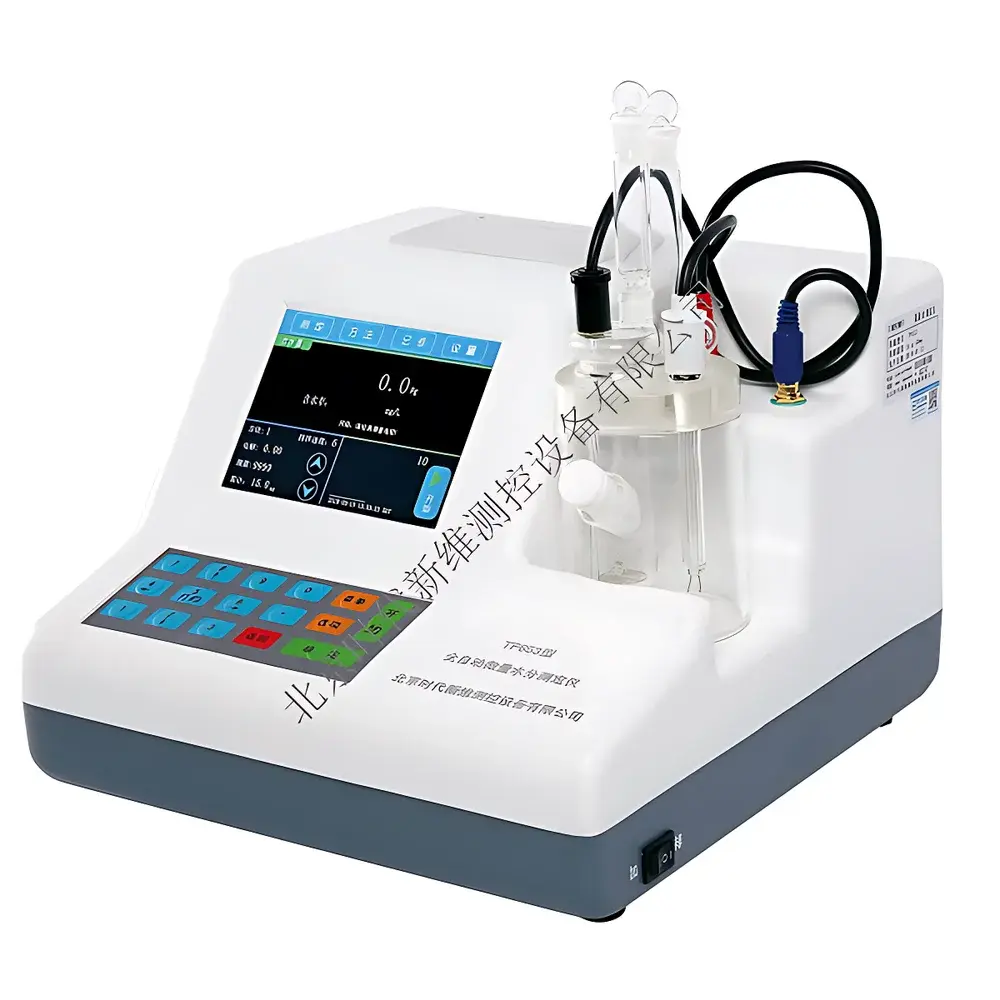
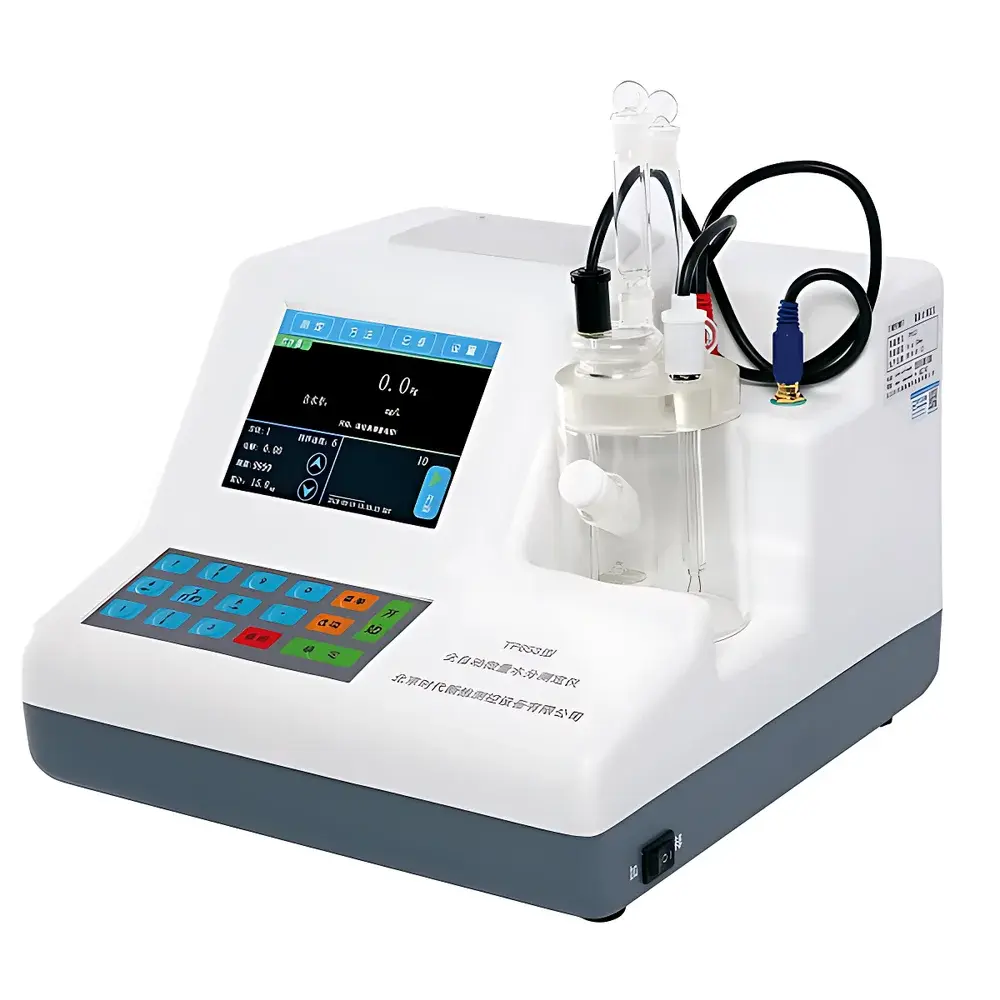
Timepower TP653 Automated Coulometric Karl Fischer Moisture Analyzer
| Brand | Timepower |
|---|---|
| Origin | Beijing, China |
| Manufacturer Type | Direct Manufacturer |
| Product Origin | Domestic (China) |
| Model | TP653 |
| Pricing | Upon Request |
Overview
The Timepower TP653 Automated Coulometric Karl Fischer Moisture Analyzer is a precision laboratory instrument engineered for trace water quantification in liquid, solid, and gaseous samples using the coulometric titration principle defined by ASTM D1364, ISO 760, and USP . It implements the classical Karl Fischer reaction—where iodine generated electrochemically at the anode reacts stoichiometrically with water (1 mol I₂ ≡ 1 mol H₂O)—enabling absolute quantification without volumetric standardization. Unlike volumetric KF systems, the TP653 produces iodine on-demand via controlled electrolysis of an iodide-containing reagent solution (comprising iodine, sulfur dioxide, pyridine or imidazole base, and methanol), ensuring high reproducibility, minimal reagent consumption, and negligible drift over extended operation. Designed for routine QC/QA environments in power generation, petrochemical refining, pharmaceutical manufacturing, agrochemical formulation, and food-grade excipient testing, the TP653 delivers sub-microgram detection capability with inherent compliance readiness for GLP and GMP workflows.
Key Features
- 32-bit embedded microprocessor core with real-time mini-OS for deterministic control and low-latency response
- Coulometric titration mode with auto-ranging current regulation (0–400 mA), enabling precise iodine generation across the full 3 µg–100 mg H₂O measurement span
- 5.6-inch color TFT LCD touchscreen interface complemented by tactile physical keys—ensuring operational reliability under gloves or in high-humidity lab conditions
- Integrated electrolytic cell with hermetic hydrophobic sealing to minimize ambient moisture ingress, reduce equilibration time (300 tests per 100 mL)
- Dual-mode sample introduction: manual syringe injection (0.5 µL and 50 µL calibrated injectors supplied) and optional automated balance coupling for gravimetric sample dosing
- Real-time electrolysis current curve display and cumulative charge tracking—providing immediate visual diagnostics of reagent activity and endpoint stability
- 12 programmable analysis methods; up to 6 user-defined methods stored non-volatile memory with timestamped execution logs
- Onboard thermal printer for audit-ready hardcopy output; RS-232 and USB interfaces for bidirectional data exchange with LIMS or ELN systems
Sample Compatibility & Compliance
The TP653 accommodates diverse matrices including polar solvents (methanol, ethanol, acetone), hydrophobic oils (transformer oil, lubricants, diesel), viscous substances (polymers, resins, waxes), and volatile organics (ethers, esters, ketones, aromatic hydrocarbons). It meets methodological requirements of GB/T 7600 (electric insulating oils), GB/T 6283 (general chemical products), SH/T 0246 (light petroleum fractions), and SH/T 0255 (additive packages). Its coulometric architecture inherently satisfies FDA 21 CFR Part 11 criteria for electronic records when paired with validated software configurations, and supports ALCOA+ data integrity principles through immutable audit trails, user access controls, and electronic signatures (via external PC integration).
Software & Data Management
Instrument firmware provides full data logging—including sample ID, operator ID, date/time stamp, measured water mass (µg), calculated %w/w or ppm, endpoint current profile, and reagent consumption counter. All records are exportable as CSV or PDF via USB drive or serial link. When connected to a Windows PC, the TP653 supports time-synchronized data streaming into third-party laboratory informatics platforms. Built-in memory retains ≥1,000 test results with automatic overwrite protection for critical batches. Calibration verification reports and system suitability checks (e.g., 1.00 mg water standard recovery) can be scheduled and archived per internal SOPs.
Applications
- Power industry: Moisture monitoring in transformer oil per IEC 60814 and IEEE C57.106 to prevent dielectric breakdown
- Petrochemical QA: Quantification of residual water in jet fuel (ASTM D6304), biodiesel (EN 14971), and refinery intermediates
- Pharmaceutical development: Water content verification in APIs, excipients, and lyophilized formulations per USP and Ph. Eur. 2.5.12
- Agrochemical R&D: Stability assessment of pesticide emulsifiable concentrates and wettable powders
- Electronics manufacturing: Detection of trace moisture in solder pastes and encapsulation resins affecting thermal cycling reliability
FAQ
What is the minimum detectable water mass?
The TP653 achieves a resolution of 0.1 µg with a lower limit of quantitation (LLOQ) of 3 µg, verified using certified water standards traceable to NIST SRM 2890.
Does the instrument support gravimetric sample introduction?
Yes—RS-232 or USB connectivity enables direct communication with analytical balances (e.g., Mettler Toledo XS series) for automatic mass input and %w/w calculation.
How often must the electrolyte be replaced?
Reagent replacement is triggered when the cumulative charge approaches the pre-set “reagent total” threshold (default: 100 C), typically after 200–300 analyses depending on sample water load and ambient humidity.
Is ventilation required during operation?
Yes—the KF reagent contains methanol and SO₂; operation must occur inside a certified fume hood compliant with OSHA 1910.1200 and local chemical hygiene plans.
Can the TP653 be integrated into a networked laboratory environment?
It supports TCP/IP via optional Ethernet adapter (sold separately), enabling remote status monitoring, batch report retrieval, and centralized firmware updates under IT-managed infrastructure.





