
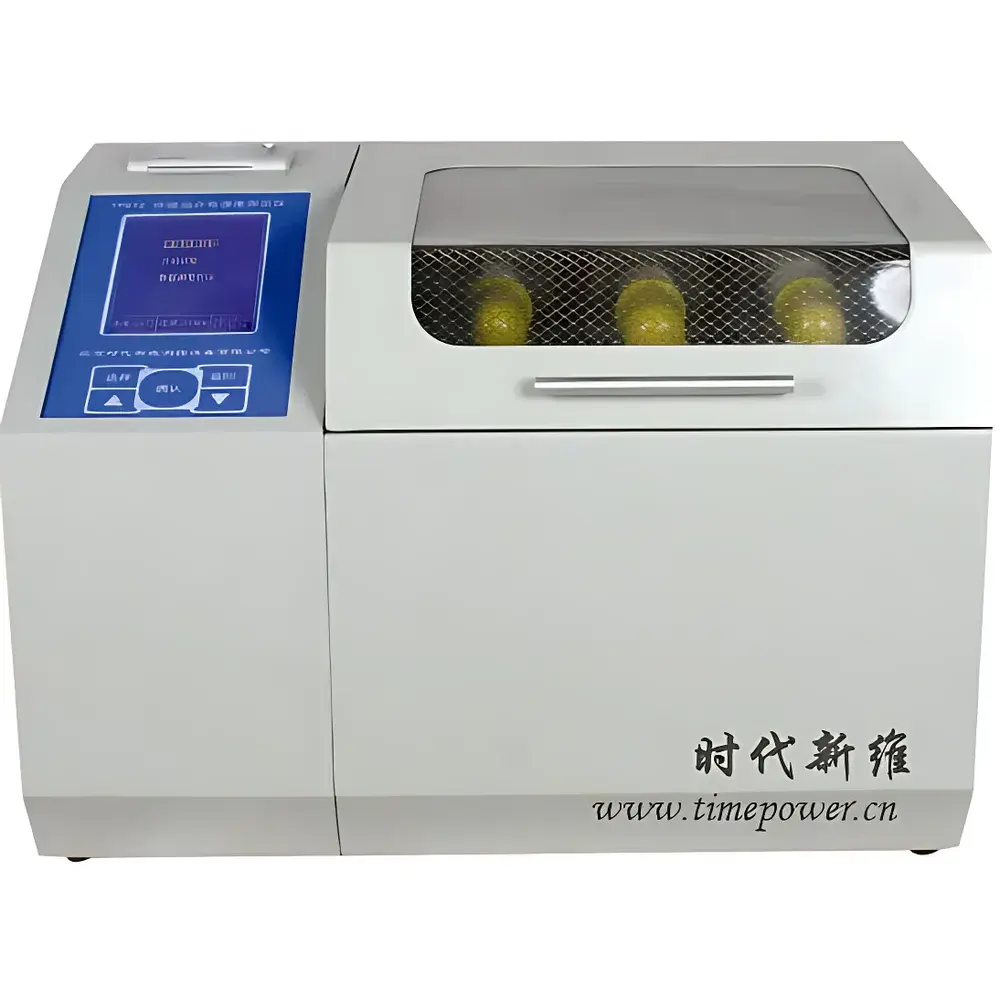
Timepower TP672 Insulating Oil Dielectric Strength Tester
| Brand | Timepower |
|---|---|
| Origin | Beijing, China |
| Manufacturer | Timepower (Beijing Shidai Xinwei Measurement & Control Equipment Co., Ltd.) |
| Model | TP672 |
| Compliance | GB/T 507, DL 429.9 |
| Voltage Ramp Rates | 2.0 ± 0.2 kV/s and 3.0 ± 0.2 kV/s |
| Accuracy | ±2% of full scale |
| Measurement Range | 0–80 kV |
| Resolution | 0.01 kV |
| Test Repetition | 1–9 cycles (default 6) |
| Stirring Time | Magnetic stirring |
| Standby Time | 15 min (adjustable 0–59 min) |
| Inter-test Interval | 3–5 min (adjustable 0–9 min) |
| Display | LCD |
| Power Supply | AC 220 V ±10%, 50 Hz ±10% |
| Operating Temperature | 5–40 °C |
| Relative Humidity | ≤85% RH |
| Dimensions | 610 × 410 × 425 mm |
| Weight | 45 kg |
Overview
The Timepower TP672 Insulating Oil Dielectric Strength Tester is an automated, microprocessor-controlled instrument engineered for precise determination of the dielectric breakdown voltage (BDV) of insulating oils used in power transformers, circuit breakers, and other high-voltage equipment. It operates on the principle of applying a steadily increasing AC voltage across two standardized electrodes immersed in a representative oil sample until electrical breakdown occurs—indicating the onset of conductive path formation due to contaminants such as water, particulates, or aging byproducts. Conformance to GB/T 507 and DL 429.9 ensures alignment with national standards governing test methodology, electrode geometry, sample conditioning, and reporting protocols widely adopted across China’s electric utility and transformer manufacturing sectors.
Key Features
- Dual-CPU architecture enables synchronized control of voltage ramping, electrode stirring, cup exchange, zero-return sequencing, data acquisition, display, calculation, and thermal printing—minimizing operator intervention and inter-test variability.
- Integrated dry-type high-voltage transformer module delivers compact footprint (610 × 410 × 425 mm), low mass (45 kg), and enhanced portability without compromising output stability or electromagnetic compatibility.
- Programmable ramp rates of 2.0 ± 0.2 kV/s and 3.0 ± 0.2 kV/s accommodate both routine QC screening and method validation per standard-defined tolerances; ramp accuracy is maintained via closed-loop feedback from real-time voltage sensing.
- Automatic magnetic stirring ensures homogeneous suspension of free water droplets and colloidal particles prior to each test cycle; standby time (0–59 min) and inter-test interval (0–9 min) are fully configurable to replicate field-relevant settling kinetics.
- Comprehensive safety architecture includes overvoltage cutoff, overcurrent limiting, automatic return-to-zero post-breakdown, and hardware interlocks—fully compliant with IEC 61010-1 requirements for laboratory electrical safety.
- Onboard non-volatile memory stores up to 100 test records with timestamp, ramp rate, breakdown voltage, and pass/fail status; data export supports traceable review and audit readiness.
Sample Compatibility & Compliance
The TP672 is optimized for mineral-based transformer oils, silicone fluids, and synthetic ester insulating liquids meeting ASTM D877 and ASTM D1816 specifications. Its dual-electrode test cell (standardized per GB/T 507) accepts 35–40 mL samples and accommodates three reusable oil cups for sequential multi-sample evaluation. All operational parameters—including stir duration, rest period, and voltage rise profile—are programmable to align with internal lab SOPs or external regulatory expectations. While primarily deployed in compliance with Chinese national standards, its measurement traceability, repeatability (<±2% full-scale), and documented uncertainty budget support cross-referencing against ISO/IEC 17025-accredited calibration practices.
Software & Data Management
No external PC software is required for basic operation; all functions execute autonomously via embedded firmware. However, the built-in thermal printer provides hard-copy reports including test number, date/time stamp, applied voltage at breakdown, selected ramp rate, and operator ID (manually entered). Stored results can be recalled, reviewed on the LCD interface, and reprinted on demand—supporting GLP-aligned record retention without dependency on proprietary desktop applications. Audit trails are implicitly preserved through deterministic firmware logic and non-erasable memory allocation; no electronic signatures or 21 CFR Part 11 functionality is implemented, consistent with its role as a standalone benchtop test instrument rather than a regulated production-line analyzer.
Applications
- Routine quality assurance of new insulating oil prior to transformer filling or retrofilling.
- Condition monitoring of in-service transformer oil during scheduled maintenance intervals.
- Root-cause analysis of dielectric failure events in substation assets.
- Validation of oil reclamation or filtration system performance.
- Supporting third-party certification testing for manufacturers supplying utilities under technical procurement specifications.
- Academic and vocational training in high-voltage engineering laboratories where reproducible BDV methodology instruction is required.
FAQ
What standards does the TP672 comply with?
It is designed and verified to meet GB/T 507–2002 and DL 429.9–1991, the primary Chinese national standards for insulating oil dielectric strength testing.
Can the TP672 test non-mineral insulating fluids?
Yes—it is compatible with silicone oils and synthetic esters, provided electrode gap, sample volume, and conditioning steps adhere to applicable ASTM or IEC methods referenced in the user manual.
Is calibration traceable to national metrology institutes?
The instrument supports external verification using NIST-traceable high-voltage dividers; factory calibration certificates reference CNAS-accredited reference standards per JJF 1001 and JJF 1059.1.
Does it support networked data transfer or LIMS integration?
No—the TP672 operates as a self-contained unit with local storage and thermal print output only. It does not feature USB, Ethernet, or RS-232 interfaces.
What maintenance is required for long-term reliability?
Routine cleaning of electrodes and oil cups with analytical-grade solvent, periodic verification of stir motor torque and HV transformer insulation resistance, and annual functional verification using certified reference oil samples are recommended.





