
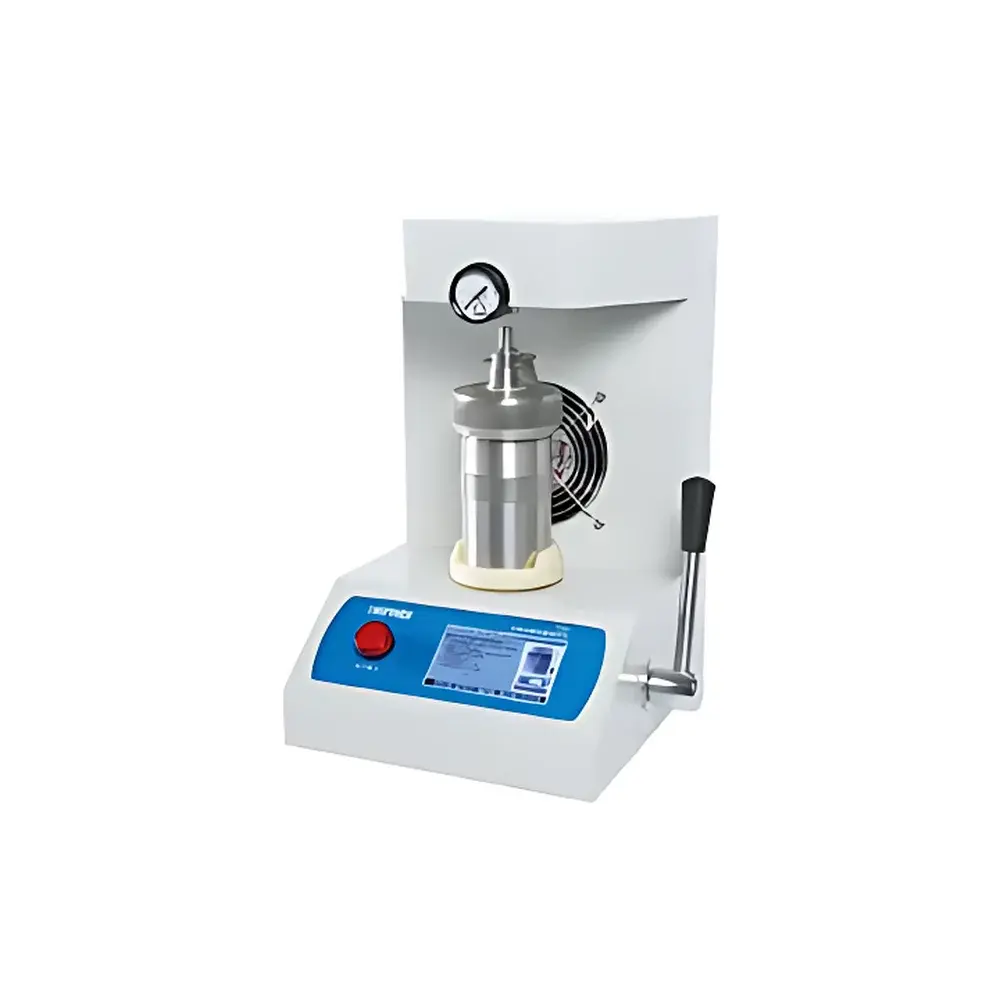
TimePower TP683 Chlorine Content Analyzer for Turbine Anti-Wear Oil
| Brand | TimePower |
|---|---|
| Model | TP683 |
| Origin | Beijing, China |
| Manufacturer | TimePower Instruments Co., Ltd. |
| Type | Domestic Benchtop Combustion-Based Halogen Analyzer |
| Power Supply | AC 220 V ±10%, 50 Hz ±10% |
| Power Consumption | ≤500 W |
| Dimensions (W×D×H) | 300 mm × 400 mm × 365 mm |
| Weight | 17 kg |
| Oxygen Bomb Pressure Rating | ≥20 MPa |
| Repeatability | ±0.0006 wt% Cl |
| Ignition Voltage | 12–24 V DC |
| Operating Temperature | 10–40 °C |
| Relative Humidity | 30–80 % RH |
| Cooling Method | Integrated High-Flow Air Cooling System |
| pH Adjustment Range | 3–4 (using HNO₃) |
| Titration Endpoint Detection | Visual colorimetric endpoint with diphenylcarbazide and bromophenol blue indicators |
| Compliance Standards | DL/T 433, GB/T 388 |
Overview
The TimePower TP683 Chlorine Content Analyzer is a dedicated benchtop instrument engineered for precise quantification of total chlorine in turbine anti-wear oils—particularly phosphate ester-based fluids used in critical power generation systems. It operates on the principle of high-temperature oxygen combustion followed by wet chemical titration, conforming to standardized test methods DL/T 433 (China’s electric power industry standard for chlorine in turbine oils) and GB/T 388 (Chinese national standard for sulfur and chlorine determination in petroleum products). In this method, a weighed oil sample is combusted quantitatively in an oxygen-rich environment inside a high-pressure oxygen bomb (rated ≥20 MPa), converting organically bound chlorine into hydrogen chloride (HCl) gas. The evolved HCl is absorbed into an alkaline hydrogen peroxide solution, where it forms chloride ions (Cl⁻). The absorption solution is subsequently acidified to pH 3–4 using nitric acid, then titrated with standardized mercury(II) nitrate solution. The endpoint is detected visually via formation of a pale red complex between excess Hg²⁺ and diphenylcarbazide—a well-established, stoichiometrically robust reaction (2Cl⁻ + Hg²⁺ → HgCl₂). This gravimetric-combustion-titrimetric approach ensures trace-level accuracy and inter-laboratory reproducibility required for condition monitoring of high-value hydraulic control fluids.
Key Features
- Built-in oxygen bomb combustion system with real-time ignition wire continuity and oxygen charging status verification—minimizing risk of incomplete combustion or failed assays.
- Automated countdown timer: once parameters are set, the instrument initiates combustion sequence with precise timing control, eliminating manual stopwatch dependency.
- Integrated high-flow air cooling module: activates automatically after ignition delay period to accelerate post-combustion thermal dissipation—reducing cycle time without compromising safety or analytical integrity.
- Color LCD touchscreen interface with intuitive navigation—designed for routine operation by QC technicians without specialized programming training.
- Robust mechanical architecture: stainless steel housing, reinforced oxygen bomb chamber, and sealed electronics compartment compliant with IP20 industrial environmental requirements.
- Comprehensive self-diagnostic routines covering electrical continuity, pressure integrity, and thermal sensor feedback prior to assay initiation.
Sample Compatibility & Compliance
The TP683 is validated for use with phosphate ester anti-wear oils (e.g., Fyrquel, Skydrol, and equivalent ISO L-HFDU grade fluids), as well as other heavy hydrocarbon matrices including lubricating oils, residual fuel oils, and industrial process oils. Its combustion-titration methodology satisfies the metrological requirements of DL/T 433 for detecting chlorine at levels down to 0.001 wt% with repeatability of ±0.0006 wt%. The instrument supports GLP-aligned documentation practices through timestamped operational logs and configurable user access levels. While not inherently 21 CFR Part 11 compliant, its data output format (ASCII text reports) facilitates integration into validated LIMS environments where electronic record retention and audit trail generation are managed externally. All reagents—including mercury(II) nitrate titrant, diphenylcarbazide indicator, and bromophenol blue—are commercially available from ISO/IEC 17025-accredited suppliers.
Software & Data Management
The TP683 operates via embedded firmware with no external PC dependency. All assay parameters (sample mass, titrant concentration, blank correction factor) are stored locally in non-volatile memory. Each analysis generates a timestamped report containing: date/time, operator ID, sample ID, gross mass, tare mass, net sample mass, titrant volume consumed, calculated Cl content (wt%), and pass/fail flag against user-defined specification limits. Reports are exportable via USB flash drive in plain-text (.txt) format compatible with Excel, statistical process control (SPC) software, and enterprise quality databases. No proprietary drivers or cloud connectivity are implemented—ensuring data sovereignty and minimizing cybersecurity exposure in regulated utility and refinery settings.
Applications
- Preventive maintenance of steam turbine electro-hydraulic control (EHC) systems: early detection of chloride ingress from seal degradation, steam contamination, or additive breakdown.
- Acceptance testing of new anti-wear oil batches prior to commissioning—verifying compliance with OEM-specified chlorine limits (typically <0.005 wt%).
- Root cause analysis during turbine trip events linked to servo valve stiction or corrosion—correlating elevated Cl levels with metallurgical failure modes.
- Extended oil life assessment in combined-cycle plants where thermal stress accelerates chlorine-generating decomposition pathways.
- Cross-application adaptation for sulfur determination in heavy fuels per GB/T 388—leveraging identical combustion hardware and titration chemistry with minor reagent substitution.
FAQ
What is the maximum recommended number of cycles for the oxygen bomb before mandatory hydrostatic testing?
The oxygen bomb must undergo a 20.0 MPa hydrostatic pressure test for 5 minutes after every 1000 combustion cycles—or immediately following replacement of any pressure-retaining component.
Which ignition wire materials are compatible with the TP683?
Copper, iron, nickel, or chromium wires with nominal diameter of 0.1 mm are acceptable; all must be free of organic coatings or oxidation layers that could interfere with ignition reliability.
How often must the pressure gauge be calibrated?
The integrated pressure gauge requires annual calibration by an accredited metrology laboratory to maintain traceability to national standards and ensure safe operational pressure monitoring.
Can the TP683 be used for chlorine analysis in transformer oils?
No—TP683 is optimized for high-chlorine, high-viscosity anti-wear oils. Transformer oils require lower detection limits and alternative methodologies such as ASTM D7359 (combustion ion chromatography) or ASTM D7042 (microcoulometry).
Is mercury waste disposal addressed in the instrument documentation?
Yes—the user manual includes regulatory guidance aligned with local hazardous waste classification (e.g., EPA 40 CFR Part 261, EU Directive 2006/12/EC) and recommends neutralization, precipitation, and third-party disposal per institutional EHS protocols.






