
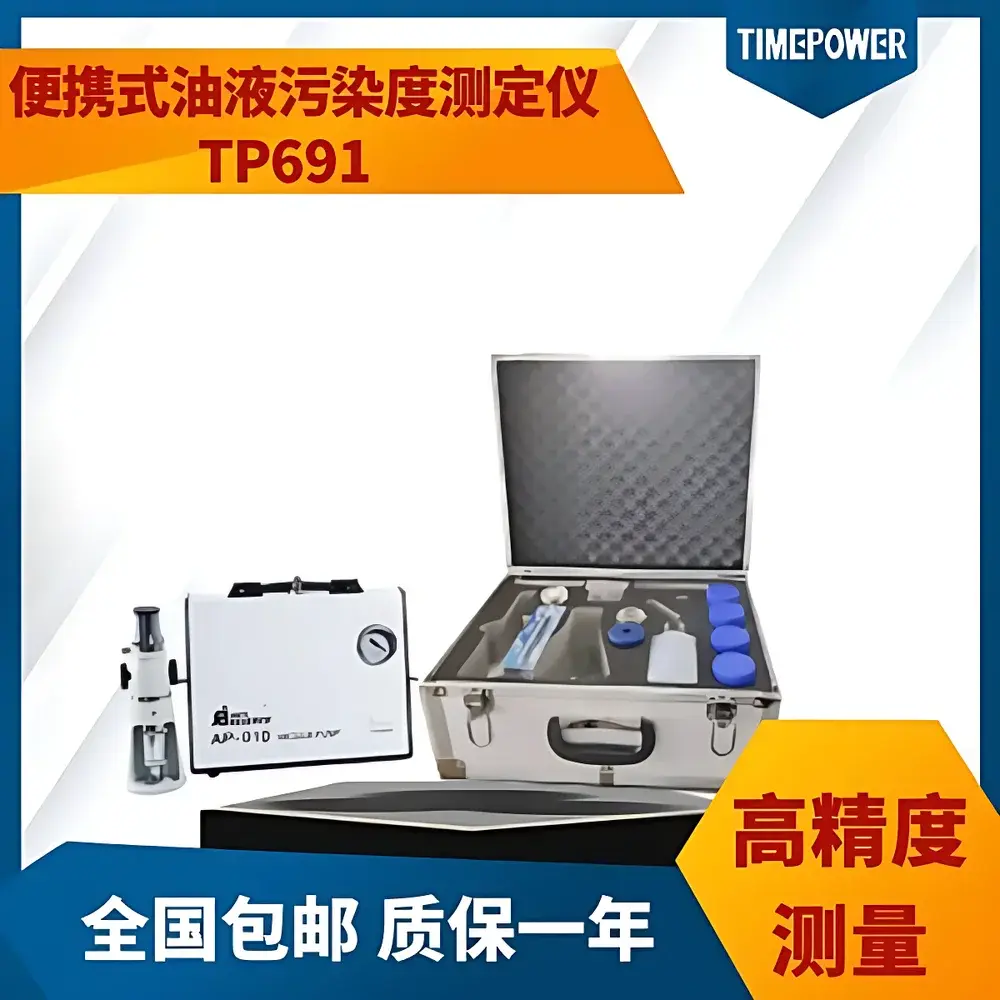
Timepower TP691 Portable Oil Particle Contamination Analyzer
| Brand | Timepower |
|---|---|
| Origin | Beijing, China |
| Manufacturer Type | Direct Manufacturer |
| Instrument Type | Optical Microscopic Particle Counter |
| Standards Compliance | DL/T 432, GB/T 20082, ISO 4406, NAS 1638, GB/T 18854, ISO 11171, GJB 420B, GJB 380.4A |
| Measurement Principle | Membrane Filter + Bright-Field Microscopy (Incident Illumination) |
| Particle Detection Threshold | ≥5 µm (length dimension) |
| Magnification | 100× with Integrated Illumination |
| Counting Method | Manual Visual Enumeration |
| Contamination Rating Range | NAS 4–12 |
| Dimensions | 410 mm × 310 mm × 230 mm |
| Weight | 6.4 kg |
Overview
The Timepower TP691 Portable Oil Particle Contamination Analyzer is a field-deployable, standards-compliant instrument engineered for quantitative assessment of solid particulate contamination in hydraulic fluids, lubricating oils, turbine oils, and aviation fuels. It operates on the well-established membrane filtration microscopy principle defined in ISO 11171 and ASTM D2276 (adapted for oil analysis), wherein a precisely measured sample volume is vacuum-filtered through a certified polycarbonate or mixed-cellulose ester (MCE) membrane. Particles retained on the filter surface are then visualized using bright-field incident illumination at 100× magnification. Unlike laser-based inline counters, the TP691 delivers morphologically resolved particle data—enabling differentiation of fiber, agglomerate, and metallic wear debris based on shape, edge contrast, and spatial distribution. Its design prioritizes metrological traceability in non-laboratory environments, making it suitable for on-site condition monitoring in power generation plants, offshore platforms, refinery maintenance bays, and mobile military depots.
Key Features
- Portable benchtop architecture (6.4 kg, 410 × 310 × 230 mm) with integrated LED illumination and vibration-dampened optical stage
- Manual particle enumeration per ISO 4406:2017 Annex A and NAS 1638 methodology, supporting both discrete size-bin counting (≥5 µm, ≥15 µm, ≥25 µm) and cumulative counts
- Calibrated 100× objective lens with adjustable focus, stage micrometer, and graticule for length-based sizing—consistent with GJB 420B and GB/T 18854 requirements
- Dual-standard compliance: fully aligned with Chinese national standards (DL/T 432, GB/T 20082) and international frameworks (ISO 4406, NAS 1638, ISO 11171)
- No consumable electronics or fluidic pumps—relies on standard laboratory vacuum manifolds and disposable 25 mm or 47 mm pore-size membranes (0.8 µm or 1.2 µm typical)
- Robust mechanical construction with aluminum alloy housing and ESD-safe surface finish for industrial environments
Sample Compatibility & Compliance
The TP691 accepts mineral oils, synthetic esters, phosphate esters, and hydrocarbon-based aviation fuels (e.g., JP-5, Jet A-1) within viscosity ranges up to 100 cSt at 40 °C. Sample volumes are typically 10–100 mL, adjusted per expected contamination level to ensure statistically valid particle density (5–200 particles/mm² on filter). All test procedures adhere to GLP-aligned documentation practices: filter lot numbers, operator ID, ambient temperature/humidity, and filtration time are recorded manually in accordance with internal QA protocols. The instrument itself does not generate electronic records; however, its output is fully compatible with LIMS integration when paired with standardized lab notebooks or digital audit trails compliant with ISO/IEC 17025 Clause 7.7.
Software & Data Management
The TP691 is a hardware-only platform with no embedded firmware or proprietary software. Data acquisition follows manual transcription into standardized reporting templates (e.g., ASTM D7690-compliant worksheets). Users may export final contamination codes (e.g., “17/14/11” per ISO 4406 or “Class 8” per NAS 1638) into Excel, LabWare LIMS, or SAP PM modules via CSV or PDF. While no automated image capture is included, the optical interface supports third-party USB microscopes (e.g., Celestron Handheld Digital Microscope) for optional digital archiving—provided such add-ons comply with local data integrity policies under FDA 21 CFR Part 11 if used in regulated pharmaceutical or aerospace QC settings.
Applications
- Routine acceptance testing of new oil batches prior to system commissioning in thermal power plants
- Troubleshooting abnormal wear in gas turbine lube systems using particle morphology classification (e.g., distinguishing cutting wear from fatigue spalling)
- Verification of filter performance during offline kidney-loop filtration campaigns
- Field validation of online particle counter drift in marine diesel engine lubrication circuits
- Compliance auditing against GJB 420B requirements for military hydraulic fluid certification
- Research-grade particle load trending in tribology laboratories studying additive depletion mechanisms
FAQ
Does the TP691 provide automated particle counting?
No. It requires trained personnel to perform visual enumeration under microscope observation, ensuring operator-controlled discrimination of ambiguous features such as overlapping particles or semi-transparent organics.
Can it measure particles smaller than 5 µm?
Not per its validated methodology. Sub-5 µm detection is outside the scope of ISO 11171 calibration and introduces high uncertainty due to diffraction limits and low contrast under incident light.
Is calibration traceable to NIST or CNAS standards?
The instrument itself is not calibrated; however, the reference filters, stage micrometers, and certified membranes used in daily operation must carry valid CNAS-accredited calibration certificates (or equivalent national metrology institute documentation).
What maintenance is required?
Annual verification of optical alignment and illumination uniformity; replacement of halogen/LED bulbs per manufacturer specifications; cleaning of optical surfaces with lens-grade solvents only.
How does it compare to laser obscuration counters?
The TP691 offers superior morphological insight and avoids refractive index bias but requires longer analysis time and higher operator skill. It serves as a reference method for validating automated instruments—not a replacement for high-throughput screening.



