
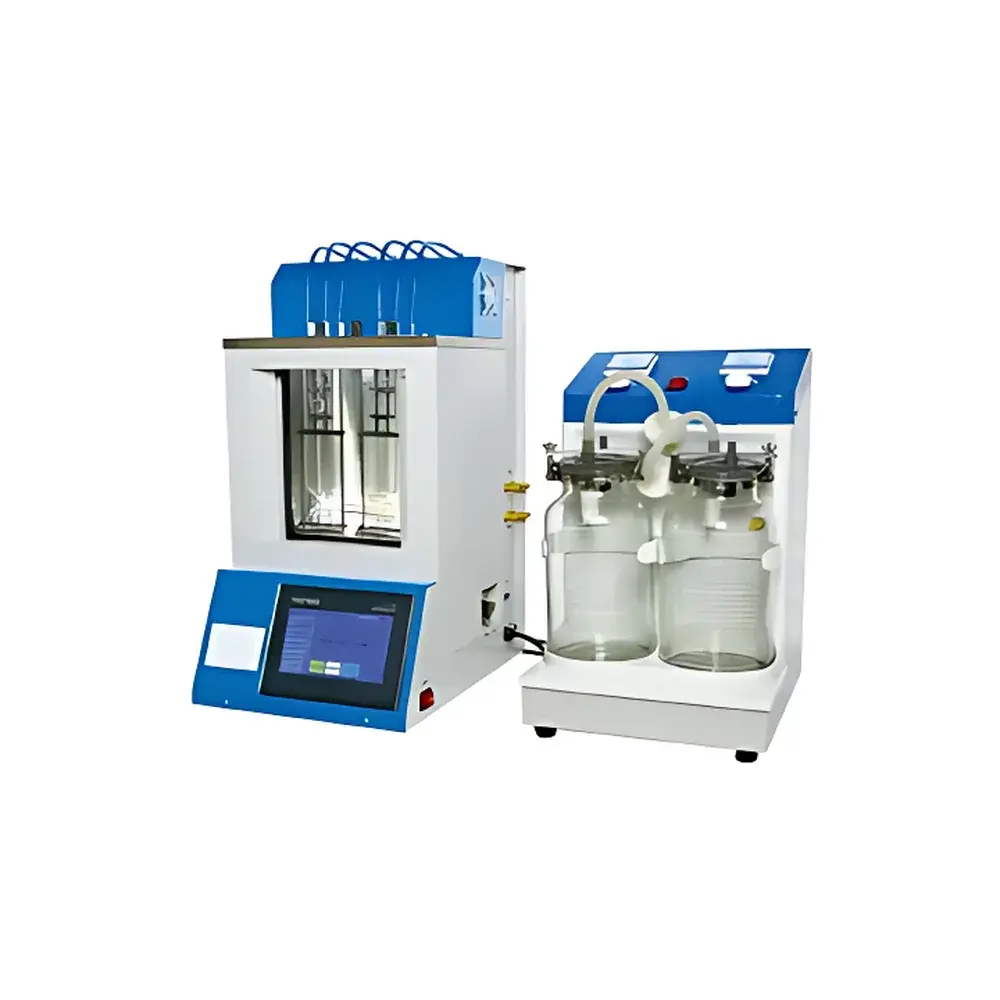
Timepower TP725 Fully Automated Kinematic Viscosity Tester
| Brand | Timepower |
|---|---|
| Model | TP725 |
| Origin | Beijing, China |
| Manufacturer | Timepower Instrument Co., Ltd. |
| Compliance | GB/T 265–1988 (Equivalent to ASTM D445 & ISO 3104) |
| Temperature Control Range | Ambient to 100 °C |
| Temperature Stability | ±0.01 °C |
| Temperature Resolution | 0.01 °C |
| Kinematic Viscosity Resolution | 0.00001 mm²/s |
| Power Supply | AC 220 V ±10%, 50 Hz ±10%, ≤1500 W |
| Dimensions | 370 × 300 × 650 mm |
| Weight | ~28 kg |
Overview
The Timepower TP725 Fully Automated Kinematic Viscosity Tester is an engineered solution for precise, repeatable determination of kinematic viscosity in transparent and opaque petroleum-based liquids—including transformer oils, turbine oils, hydraulic fluids, diesel fuels, and lubricants—according to the gravimetric capillary method defined in GB/T 265–1988, which aligns with internationally recognized standards such as ASTM D445 and ISO 3104. The instrument operates on the principle of measuring the time required for a fixed volume of liquid to flow under gravity through a calibrated glass capillary (Ubbelohde-type viscometer) immersed in a thermally stabilized bath. By combining high-precision temperature regulation (±0.01 °C stability), dynamic infrared liquid-level detection, and fully automated sample handling—including aspiration, efflux timing, calculation, capillary rinsing, and hot-air drying—the TP725 eliminates operator-dependent variability and supports unattended batch testing in quality control laboratories operating under GLP or ISO/IEC 17025 frameworks.
Key Features
- Dual independent test channels enable asynchronous analysis of two samples at identical or different setpoints—maximizing throughput without cross-contamination.
- Microprocessor-controlled dual-CPU architecture ensures deterministic real-time coordination between thermal regulation, fluid dynamics sequencing, and data acquisition.
- Integrated infrared liquid-level detection system is immune to ambient light interference, delivering consistent meniscus recognition across varying lab lighting conditions.
- Automated post-test capillary cleaning cycle uses solvent-compatible rinse protocols followed by forced hot-air drying—reducing carryover risk and extending viscometer service life.
- Self-diagnostic firmware continuously monitors heater performance, sensor integrity, fluid level status, and mechanical actuator response—logging fault codes for traceable maintenance.
- Optional chiller integration supports sub-ambient testing down to 4 °C, extending applicability to low-temperature aviation fuels and specialty synthetic lubricants per ASTM D7110.
- Front-panel human-sensing capacitive keys and backlit LCD interface provide tactile feedback and intuitive navigation—even with gloved operation.
Sample Compatibility & Compliance
The TP725 is validated for use with Newtonian and mildly non-Newtonian petroleum products meeting the transparency and volatility criteria specified in ASTM D445 Annex A1. It accommodates standard Ubbelohde viscometers (e.g., Cannon-Fenske Routine, SUS-type, or reverse-flow variants) with nominal capillary diameters from 0.4 mm to 1.2 mm. All thermal and timing parameters comply with mandatory requirements of GB/T 265–1988, including bath uniformity (±0.02 °C across immersion zone), temperature equilibration time (<15 min), and efflux time repeatability (RSD ≤ 0.35% per ASTM D445 Section 10). Instrument firmware supports audit-ready data logging with timestamped metadata (date/time, operator ID, calibration status, environmental conditions), satisfying documentation requirements for FDA 21 CFR Part 11–compliant environments when paired with secure networked storage.
Software & Data Management
The embedded control software records raw efflux times, calculated kinematic viscosity (mm²/s), and intermediate thermal profiles in non-volatile memory with battery-backed real-time clock (RTC) functionality. Data export is supported via RS-232 serial interface or USB host port in CSV format for integration into LIMS or statistical process control platforms. Optional PC-based software provides advanced features including multi-point calibration curve management, viscosity-temperature regression (ASTM D341), uncertainty propagation analysis per GUM (JCGM 100:2008), and automated report generation compliant with ISO/IEC 17025 clause 7.8. All measurement events—including manual overrides, error recoveries, and maintenance interventions—are immutably logged with user attribution and timestamps.
Applications
- Power generation: Routine monitoring of insulating oil viscosity in transformers and circuit breakers per IEC 60429 and DL/T 429.6.
- Petrochemical QC: Batch release testing of base oils, finished lubricants, and fuel blends against internal specifications aligned with API RP 1529.
- Research laboratories: Temperature-dependent viscosity profiling for formulation development and rheological modeling.
- Third-party testing labs: Accredited viscosity certification services requiring documented traceability to NIM (China National Institute of Metrology) standards.
- Marine engineering: On-site verification of cylinder oil and system oil viscosity prior to engine commissioning.
FAQ
What capillary viscometers are compatible with the TP725?
Standard Ubbelohde-type viscometers conforming to GB/T 265–1988 dimensional tolerances—including Cannon-Fenske Routine, suspended-level, and reverse-flow designs—with calibrated constants ranging from 0.001 to 10.0 mm²/s² are supported.
Does the TP725 support ASTM D445-compliant reporting?
Yes—the instrument calculates kinematic viscosity using the standard formula ν = C × t and applies required corrections for thermometer calibration, atmospheric pressure, and kinetic energy correction per ASTM D445 Section 9.
Can test results be exported to LIMS without manual re-entry?
Yes—CSV-formatted output includes all raw and derived values, metadata, and instrument identification fields, enabling direct ingestion into most modern LIMS platforms via configurable import templates.
Is validation documentation available for regulatory audits?
Timepower provides IQ/OQ documentation templates, factory calibration certificates traceable to NIM, and a comprehensive user manual detailing operational qualification procedures per ISO/IEC 17025 Annex A.
What maintenance intervals are recommended for long-term accuracy?
Viscometer calibration verification every 6 months; bath oil replacement annually or after 2000 operating hours; infrared sensor cleaning weekly; and full system performance verification semiannually using NIST-traceable viscosity standards.





