
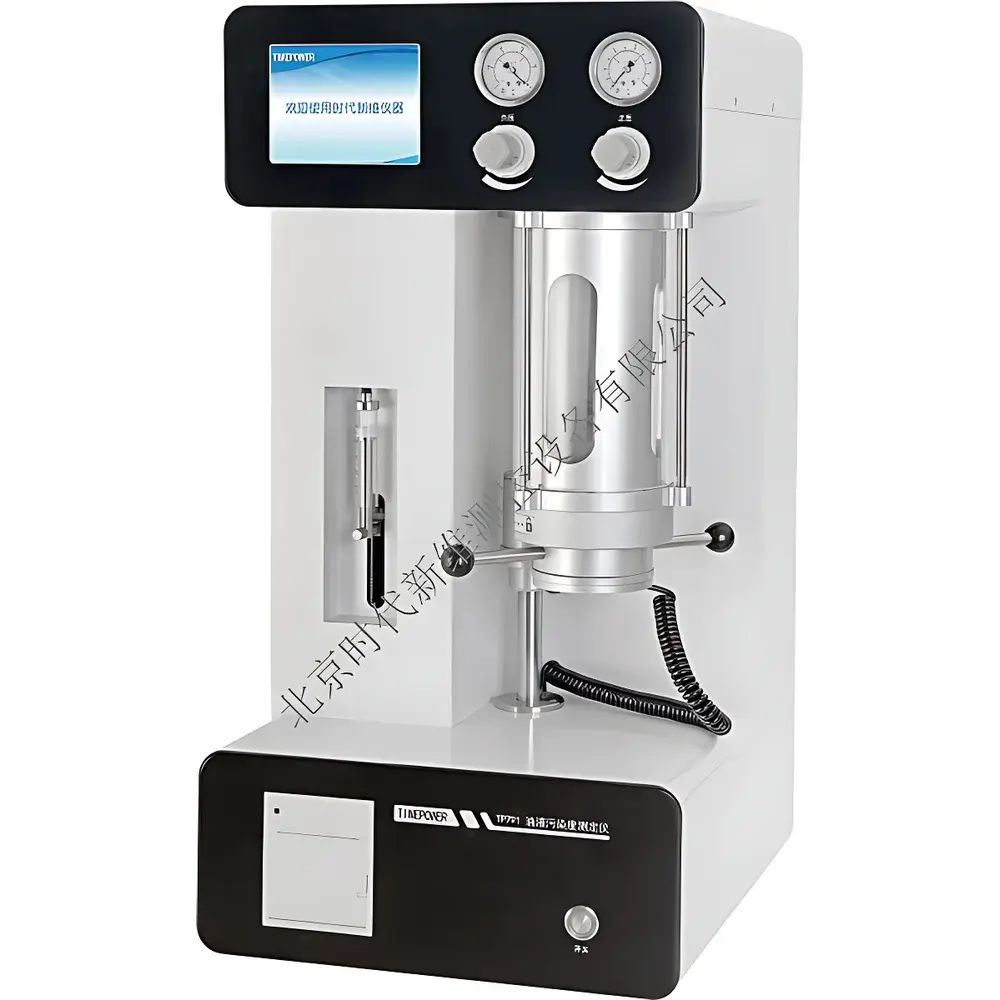
TimePower TP791 Oil Particle Contamination Analyzer
| Brand | TimePower |
|---|---|
| Origin | Beijing, China |
| Manufacturer Type | OEM Manufacturer |
| Region | Domestic (China) |
| Model | TP791 |
| Pricing | Upon Request |
Overview
The TimePower TP791 Oil Particle Contamination Analyzer is a precision laboratory instrument engineered for quantitative assessment of solid particulate contamination in liquid media—primarily hydraulic oils, lubricants, insulating oils (e.g., transformer oil), turbine oils, gear oils, aviation fuels, and water-based hydraulic fluids. It operates on the internationally standardized light-blockage (optical obscuration) principle defined in ISO 11171, ASTM F658, and GB/T 18854. In this method, particles suspended in a flowing liquid stream pass through a precisely dimensioned sensing zone intersected by a collimated semiconductor laser beam. Each particle obstructs a portion of the incident light proportional to its projected area, generating a voltage pulse whose amplitude correlates directly with particle size. Pulse counting and amplitude classification across 16 user-configurable channels enable statistically robust determination of particle concentration per unit volume and assignment of contamination grade per multiple international standards.
Key Features
- Optically calibrated semiconductor laser source ensuring long-term stability, low noise, and high signal-to-noise ratio across the 0.8 µm to 600 µm detection range (sensor-dependent).
- Precision syringe pump sampling system with programmable volumetric aspiration (0.2–1000 mL), accuracy better than ±0.5%, and adjustable flow rate (5–80 mL/min).
- Dual-pressure (positive/negative) sample handling module enabling controlled deaeration—critical for viscous or volatile samples up to 650 cSt.
- Pre-loaded calibration curves compliant with NAS 1638, ISO 4406:2021, GJB 420B, SAE AS4059F, DL/T 432, GB/T 14039, and GOCT 17216; supports user-defined calibration protocols.
- Integrated color touchscreen interface with Chinese-language input, automated data logging, on-board thermal printer, and intuitive workflow navigation.
- Embedded grading engine that automatically assigns contamination class per selected standard (e.g., ISO code “20/18/15”) based on cumulative particle counts in specified size bins.
- RS232 serial interface for bidirectional communication with LIMS, ELN, or custom lab informatics platforms.
Sample Compatibility & Compliance
The TP791 accommodates diverse sample matrices including mineral- and synthetic-based oils, ester fluids, polyalkylene glycols (PAG), and polymer solutions—provided they are optically transparent at the laser wavelength and non-corrosive to wetted materials (stainless steel 316, borosilicate glass, PTFE). Its dual-pressure architecture ensures reliable analysis of low-volatility, high-viscosity, or gas-saturated samples common in aerospace hydraulic systems and power generation turbines. The instrument conforms to the physical measurement requirements of ISO 4406:2021 Annex A (light extinction), ISO 11171:2010 (calibration particle certification), and GB/T 18854–2002 (Chinese national standard equivalent). While not inherently 21 CFR Part 11 compliant, audit-ready data export (CSV, PDF reports) and full traceability of calibration events, operator ID, and test parameters support GLP/GMP-aligned workflows when deployed with validated SOPs.
Software & Data Management
Data acquisition, classification, and reporting are managed via embedded firmware with no external PC dependency. All measurements—including raw pulse histograms, channel-specific counts, calculated contamination codes, and environmental metadata (temperature, pressure, operator ID)—are timestamped and stored internally. Reports include full compliance statements referencing applicable standards, sensor identification, calibration date, and pass/fail status against predefined acceptance criteria. Export options include RS232 transmission of structured ASCII data for integration into enterprise laboratory systems. Optional factory-issued calibration verification certificates—traceable to NIM (National Institute of Metrology, China) certified reference materials—are available upon request.
Applications
The TP791 serves as a core asset in predictive maintenance programs across regulated and safety-critical sectors. In aviation, it verifies hydraulic fluid cleanliness prior to aircraft acceptance (per SAE AS4059F Class 5–8). In power generation, it monitors turbine oil integrity per DL/T 432 to prevent bearing wear and electrostatic discharge. In wind energy, it assesses gear oil degradation in offshore nacelles where field servicing is logistically constrained. In semiconductor manufacturing, it qualifies process coolants and dielectric fluids for sub-micron particle control. Its adaptability to varied container formats (standard ISO 3722 vials, disposable cups, pressurized sample bottles) enables seamless deployment in mobile labs, OEM QC lines, and third-party testing facilities.
FAQ
What particle size ranges does the TP791 support?
Detection spans 0.8 µm to 600 µm, contingent on the installed optical sensor configuration; standard configurations cover 4 µm(c), 6 µm(c), 14 µm(c), and 21 µm(c) thresholds per ISO 4406.
Is the instrument suitable for highly viscous oils?
Yes—its dual-pressure fluidics system supports samples up to 650 cSt, with vacuum-assisted degassing minimizing bubble interference in thick lubricants.
Can contamination grades be reported in multiple standards simultaneously?
Yes—the software allows concurrent evaluation against up to three selected standards (e.g., ISO 4406, NAS 1638, GJB 420B) within a single test run.
Does the TP791 require annual recalibration?
While not mandated by regulation, TimePower recommends biannual verification using NIST-traceable latex sphere suspensions (ISO 11171 compliant) to maintain measurement confidence.
What maintenance is required between analyses?
Post-run cleaning with petroleum ether is essential to prevent cross-contamination; syringe and flow cell components are designed for rapid disassembly and solvent rinse.





