
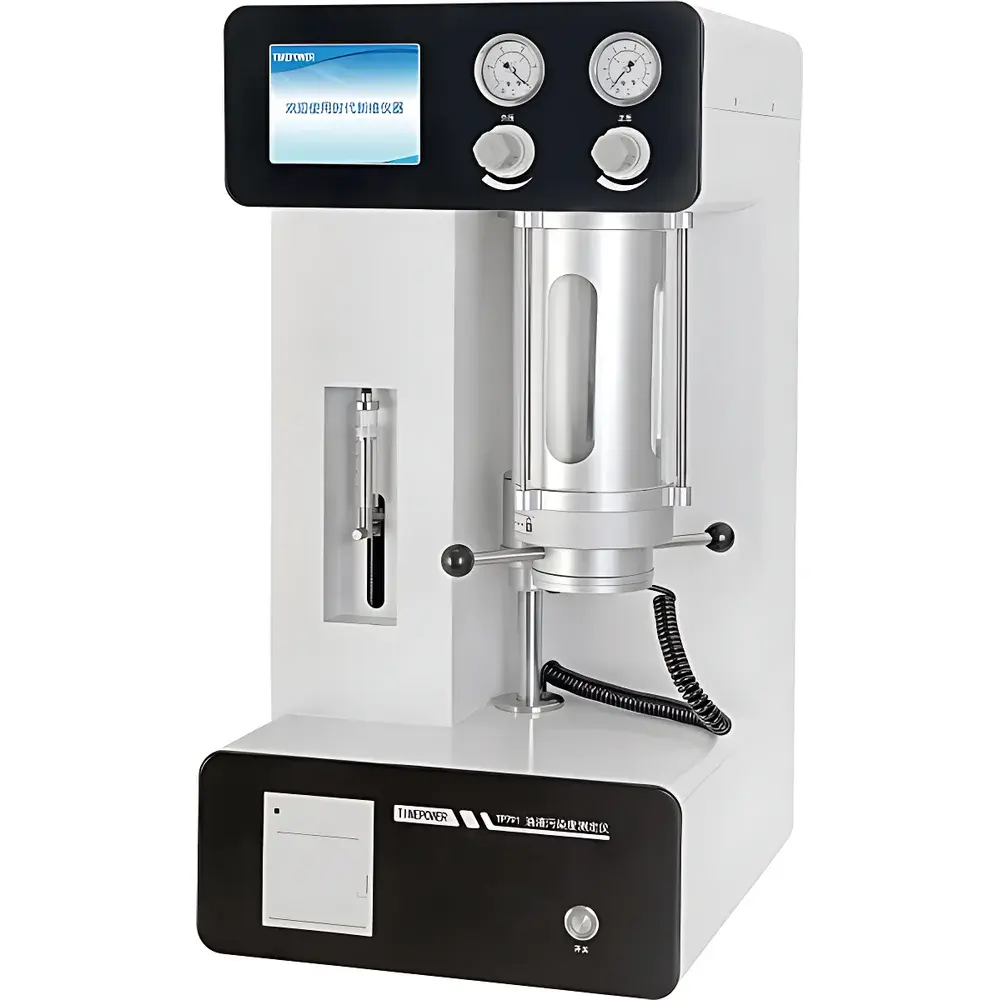
Timepower TP791 Optical Blockage Particle Counter for Oil Contamination Analysis
| Brand | Timepower |
|---|---|
| Origin | Beijing, China |
| Manufacturer | Timepower Co., Ltd. |
| Instrument Type | Optical Blockage (Light Obscuration) Particle Counter |
| Model | TP791 |
| Measurement Principle | ISO 21501-4 / ISO 4402 compliant light obscuration |
| Light Source | Semiconductor laser |
| Detection Range | 0.8 µm to 500 µm (sensor-dependent) |
| Channels | 8 adjustable size thresholds within calibration range |
| Sample Volume | 0.2–1000 mL (user-selectable) |
| Flow Rate | 5–80 mL/min |
| Resolution | <10% (per ISO 21501-4) |
| Coincidence Limit | 10,000 particles/mL |
| Pressure Chamber | +0.8 MPa (positive), –0.08 MPa (negative) |
| Data Interface | RS232 |
| Environmental Operating Range | 10–40 °C |
| Power Supply | AC 220 V ±10%, 50 Hz ±10% |
| Power Consumption | ≤200 W |
| Dimensions | 390 × 340 × 660 mm |
| Weight | 23.5 kg |
| Built-in Standards | GJB-420B, NAS 1638, ISO 4406, GOCT 17216 |
| Calibration Support | Multi-curve internal calibration, custom standard configuration enabled |
| Sample Handling | Syringe pump aspiration with degassing capability, compatibility with standard sampling bottles and cups |
| Display & Output | Color touchscreen interface, Chinese-language input, integrated thermal printer, automatic data storage |
| Air Purification System | Integrated HEPA-filtered clean air module |
| Software Compliance | Audit trail-ready data logging |
Overview
The Timepower TP791 Optical Blockage Particle Counter is an ISO 21501-4 and ISO 4402 compliant instrument engineered for quantitative analysis of solid particulate contamination in liquid media—primarily lubricants, hydraulic fluids, insulating oils, turbine oils, and other industrial process liquids. It operates on the internationally standardized light obscuration (also known as optical blockage or photometric blocking) principle: as particles suspended in a fluid pass through a precisely defined sensing zone orthogonal to a collimated semiconductor laser beam, they attenuate incident light proportionally to their projected area. This analog signal is digitized and classified across eight user-configurable size channels—enabling direct enumeration and size distribution profiling from 0.8 µm to 500 µm, depending on sensor selection and calibration traceability. Designed for laboratories requiring regulatory-grade repeatability and metrological integrity, the TP791 meets core requirements of aerospace, power generation, and defense sectors where particle contamination directly correlates with system reliability, component wear, and operational safety.
Key Features
- High-stability semiconductor laser source with low-noise photodetector architecture, ensuring consistent signal-to-noise ratio across extended measurement cycles.
- Precision syringe pump sampling system with programmable volume (0.2–1000 mL) and flow rate control (5–80 mL/min), enabling reproducible volumetric throughput under variable viscosity conditions.
- Dual-mode pressure chamber (±0.08 MPa to +0.8 MPa) supporting both positive-pressure pressurization and vacuum-assisted degassing—critical for accurate counting in viscous or volatile samples prone to microbubble interference.
- Integrated HEPA-filtered air purification system maintains ISO Class 5 cleanroom-equivalent ambient conditions within the optical path enclosure, minimizing background contamination during analysis.
- Eight-channel configurable detection with user-defined threshold sizing, aligned to international calibration curves including GJB-420B, NAS 1638, ISO 4406, and GOCT 17216—each traceable to NIST-traceable reference materials.
- Full audit trail support via timestamped data logging, password-protected user roles, and electronic signature-capable operation—facilitating compliance with FDA 21 CFR Part 11 and GLP/GMP documentation protocols.
Sample Compatibility & Compliance
The TP791 accommodates a broad spectrum of non-aqueous and low-conductivity liquids, including mineral- and synthetic-based hydraulic oils, transformer (insulating) oils, turbine oils, gear oils, aviation fuels (e.g., Jet A-1), water-glycol hydraulic fluids, and polymer solutions. Its optical design avoids electrochemical interference, making it unsuitable for conductive aqueous suspensions but optimal for hydrocarbon and ester-based matrices. The instrument complies with ISO 4406:2017 (fluid cleanliness coding), ISO 11171 (calibration standard for particle counters), and ASTM D6786 (standard test method for particle count in aviation turbine fuels). All internal calibration curves are validated against certified reference materials per ISO/IEC 17025-accredited procedures. Optional factory-issued calibration certificates—including metrological verification reports traceable to national standards institutes—are available upon request.
Software & Data Management
The embedded firmware features a real-time operating system with dual-mode data handling: local storage (≥10,000 test records) and external export via RS232 serial interface to LIMS, ELN, or custom laboratory informatics platforms. Raw pulse-height histograms, cumulative/differential counts per channel, and ISO-coded cleanliness grades are automatically generated and annotated with operator ID, sample ID, environmental parameters (temperature, pressure), and calibration status flags. Data files conform to ASTM E2911-compliant ASCII format for interoperability. Firmware supports customizable report templates—including bilingual (English/Chinese) output—and enables batch-level statistical summaries (mean, SD, CV%) across multiple runs. Audit logs record all configuration changes, calibration events, and user logins with immutable timestamps.
Applications
- Routine monitoring of hydraulic system fluid integrity in aerospace ground support equipment and flight-critical actuators.
- Acceptance testing of new oil batches prior to commissioning in power plant turbine lube systems.
- Root-cause analysis of premature bearing failure in wind turbine gearboxes via trending of >4 µm and >6 µm particle populations.
- Verification of filter performance efficiency (β-ratio testing) in high-pressure hydraulic circuits per ISO 16889.
- Quality control of insulating oil in HV substations, where sub-10 µm metallic wear debris signals incipient arcing or contact erosion.
- Validation of cleaning validation protocols in pharmaceutical manufacturing equipment using non-aqueous solvents.
FAQ
What particle size standards does the TP791 support natively?
The instrument includes preloaded calibration curves for GJB-420B, NAS 1638, ISO 4406, and GOCT 17216. Custom threshold configurations can be defined within the 0.8–500 µm range using user-provided reference data.
Can the TP791 analyze water-based coolants or glycol solutions?
It is not recommended for highly conductive or aqueous media due to optical scattering artifacts and lack of conductivity compensation; its design targets low-dielectric organic liquids.
Is degassing capability built-in?
Yes—the dual-pressure chamber allows vacuum-assisted sample conditioning to remove entrained microbubbles prior to counting, critical for viscous oils and high-sensitivity measurements.
How is data integrity ensured for regulated environments?
All measurements include digital signatures, time-stamped audit trails, and role-based access controls. Exported data retains full metadata required for FDA 21 CFR Part 11 and EU Annex 11 compliance.
What maintenance is required between tests?
Post-run cleaning with petroleum ether is mandatory for the syringe assembly; optical windows require periodic inspection and solvent wiping. No routine laser recalibration is needed under normal operating conditions.



