
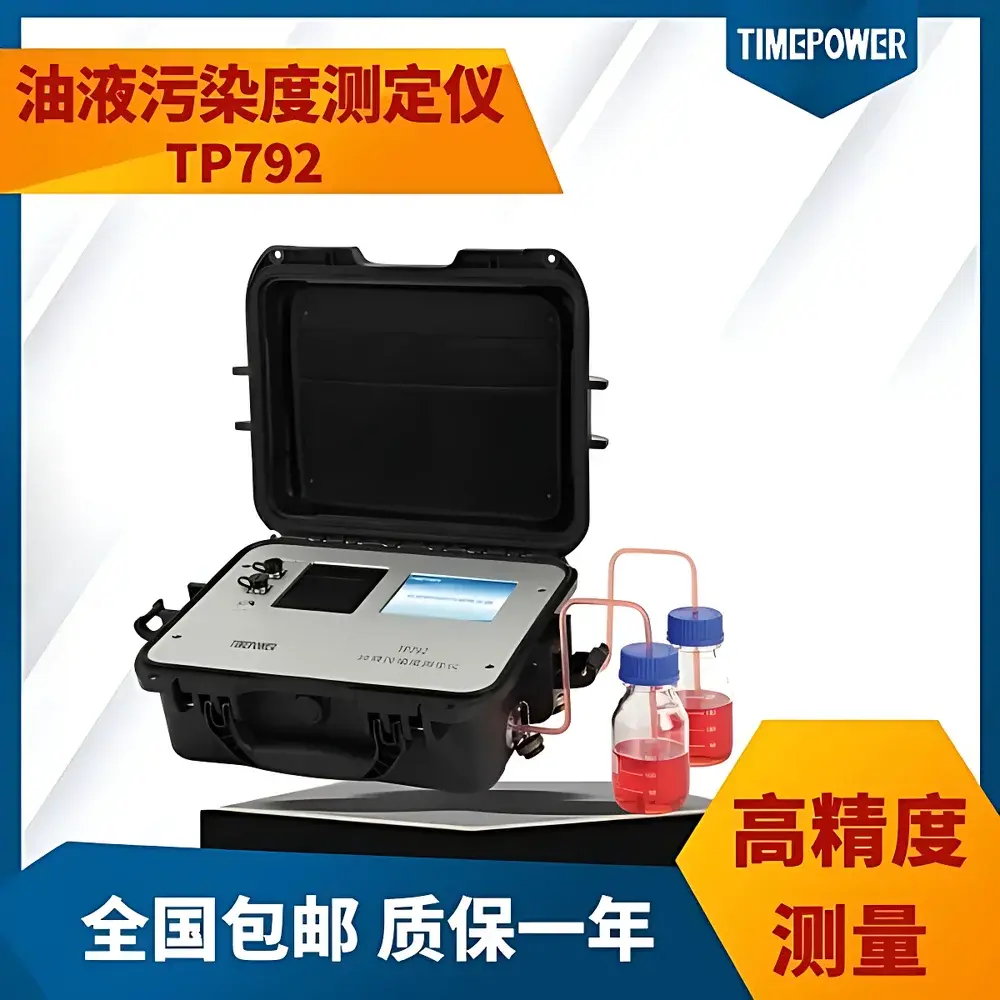
Timepower TP792 Optical Particle Counter for Oil Contamination Analysis
| Brand | Timepower |
|---|---|
| Model | TP792 |
| Origin | Beijing, China |
| Manufacturer | Timepower (Domestic Producer) |
| Instrument Type | Optical Particle Counter (Light Obscuration Principle) |
| Measurement Principle | Light Obscuration (LO) / Light Blockage |
| Particle Size Range | 1–400 µm |
| Sensitivity | 1 µm (per ISO 4402) or 4 µm(c) (per GB/T 18854 & ISO 11171) |
| Number of Detection Channels | 32 (user-configurable size thresholds) |
| Sample Volume per Test | 10 mL |
| Sample Volume Accuracy | ±3% |
| Analysis Time | 30 s per run |
| Flow Rate (Sampling) | 20 mL/min (adjustable 5–35 mL/min) |
| Flow Rate (Rinse) | 20 mL/min (adjustable 5–35 mL/min) |
| Rinse Volume | 0–90 mL (1 mL increments) |
| Coincidence Error Limit | ≤24,000 particles/mL (at 5% coincidence error) |
| Counting Repeatability | RSD < 2% (for concentrations ≥1000 particles/mL) |
| Net Weight | 7 kg |
Overview
The Timepower TP792 Optical Particle Counter is a precision-engineered instrument designed for quantitative assessment of solid particulate contamination in liquid media—primarily lubricants, hydraulic fluids, insulating oils, turbine oils, and other industrial process liquids. It operates on the internationally standardized light obscuration (also known as light blockage or photometric blocking) principle, as defined in ISO 11171, ISO 4402, GB/T 18854, and ASTM F658. In this method, a collimated light beam passes through a precisely dimensioned flow cell; when suspended particles traverse the sensing zone perpendicular to the beam, they attenuate the incident light proportionally to their projected cross-sectional area. The resulting pulse amplitude is digitized and classified into user-defined size channels (32 programmable thresholds), enabling simultaneous quantification of particle concentration across multiple size bins per unit volume (e.g., particles/mL). This physics-based detection mechanism ensures high linearity, low dependence on particle optical properties (e.g., refractive index, color), and robust performance in complex oil matrices—critical for compliance-driven environments such as aerospace hydraulics, power generation, and military-grade fluid maintenance.
Key Features
- Compliant with major international standards including ISO 11171 (calibration), ISO 4406 (contamination code reporting), NAS 1638, GJB 420B, DL/T 432, and GB/T 18854—enabling traceable, auditable results for quality control and regulatory reporting.
- High-resolution 32-channel particle sizing architecture supports flexible binning strategies—from broad ISO code classification to granular sub-micron trend analysis (down to 1 µm per ISO 4402 or 4 µm(c) per ISO 11171).
- Dual-mode operation: supports both offline laboratory analysis (10 mL syringe-driven sampling) and optional inline integration via compatible flow cells and pressure-rated manifolds.
- Programmable fluid handling: independent control of sample aspiration (5–35 mL/min), rinse cycle flow rate, and precise rinse volume (0–90 mL in 1 mL steps), minimizing carryover and ensuring inter-run consistency.
- Validated counting repeatability: RSD < 2% at particle concentrations ≥1000 particles/mL—meeting stringent requirements for GLP-compliant laboratories and long-term fleet oil health monitoring.
- Compact benchtop design (7 kg net weight) with integrated touchscreen interface, eliminating dependency on external PCs for routine operation while retaining full data export capability.
Sample Compatibility & Compliance
The TP792 is validated for use with mineral- and synthetic-based hydrocarbon oils (e.g., aviation turbine fuel, engine oils, gear oils), ester-based dielectric fluids (e.g., transformer insulating oils), water-glycol and phosphate-ester hydraulic fluids, and select polymer solutions. Its optical path design minimizes scattering artifacts from highly viscous or optically dense samples. All calibration protocols follow ISO 11171 using NIST-traceable PSL (polystyrene latex) reference particles. Instrument qualification documentation—including installation qualification (IQ), operational qualification (OQ), and performance verification reports—can be generated to support FDA 21 CFR Part 11–compliant environments, ISO/IEC 17025-accredited testing labs, and defense sector GJB 9001C quality management systems.
Software & Data Management
Embedded firmware provides real-time histogram display, ISO 4406 contamination code auto-generation, and customizable pass/fail logic based on user-defined limits per size channel. Raw pulse data and metadata (time stamp, operator ID, sample ID, environmental conditions) are stored in CSV and XML formats compliant with LIMS integration protocols. Optional PC-based software enables advanced statistical process control (SPC), historical trending, multi-instrument fleet comparison, and audit trail generation with electronic signature support—fully aligned with 21 CFR Part 11 requirements for electronic records and signatures.
Applications
- Condition-based maintenance of hydraulic systems in aerospace platforms (per GJB 420B Class 5–12) and naval vessels.
- Transformer oil cleanliness verification prior to energization (DL/T 432 Class 1–3) and during predictive maintenance cycles.
- Acceptance testing of new lubricants against OEM specifications (e.g., SAE AS4059F, ISO 4406:2022).
- Monitoring filter efficiency and wear debris accumulation in closed-loop turbine and gearbox systems.
- QC release testing of batch-manufactured specialty fluids, including fire-resistant hydraulic media and biodegradable lubricants.
FAQ
What calibration standards does the TP792 support?
The instrument is calibrated using ISO 11171–compliant PSL reference particles; calibration verification can be performed with certified reference materials traceable to NIST or PTB.
Can the TP792 measure particles in water-based coolants?
Yes—provided the coolant is optically stable and free of air bubbles or emulsified oils that may cause false counts; method validation per ISO 21501-4 is recommended for non-oil media.
Is online (in-line) measurement possible?
The base configuration supports offline analysis; optional flow modules with pressure-rated wetted parts (up to 10 bar) enable continuous in-process monitoring when integrated with bypass loops.
How is data integrity ensured for regulated environments?
All data entries include immutable timestamps, operator authentication, and change logs; optional software adds role-based access control, electronic signatures, and audit trail export per 21 CFR Part 11.
What maintenance is required to sustain accuracy?
Annual recalibration against primary standards is recommended; daily system suitability checks using clean solvent and reference suspension ensure ongoing performance verification.



