
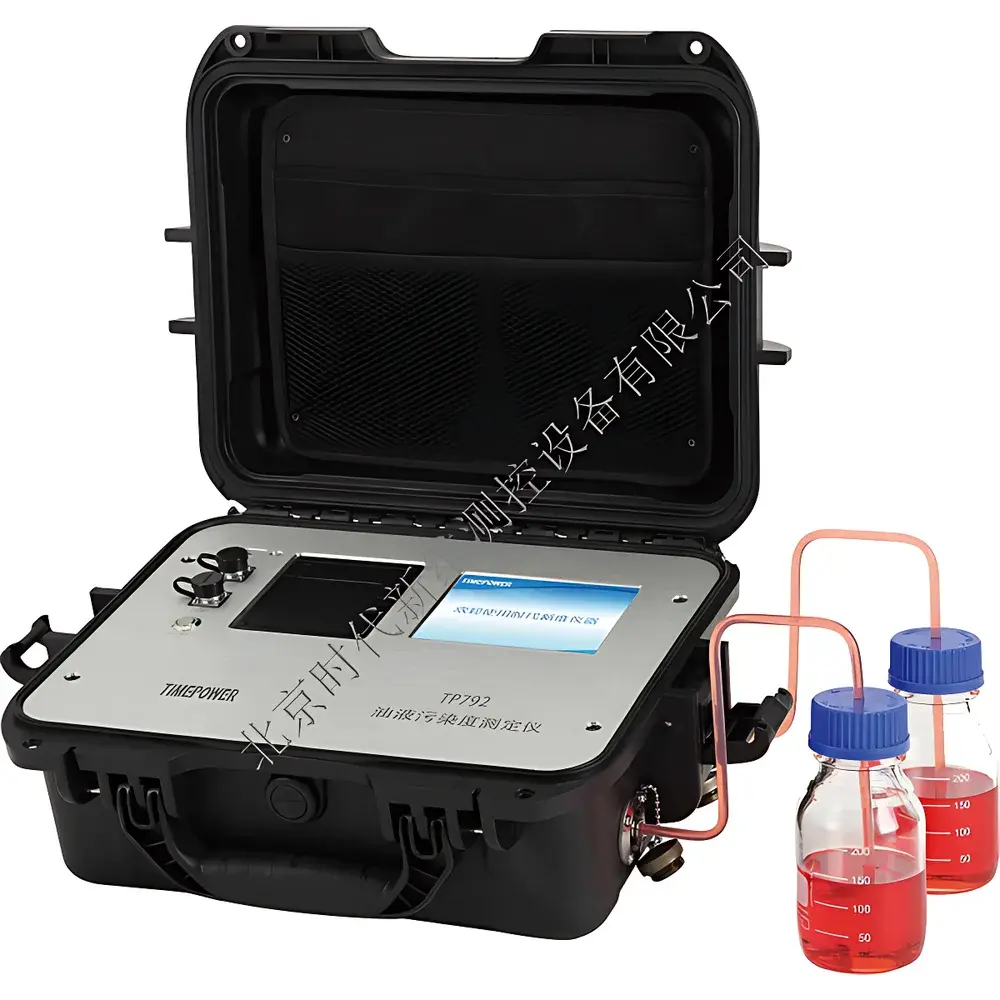
Timepower TP792 Portable Oil Contamination Analyzer (Light-Blockage Particle Counter)
| Brand | Timepower |
|---|---|
| Origin | Beijing, China |
| Manufacturer Type | Direct Manufacturer |
| Instrument Type | Light-Blockage (Optical Obstruction) Particle Counter |
| Model | TP792 |
| Compliance Standards | GB/T 18854, ISO 11171, ISO 4406, NAS 1638, GJB 420B, DL/T 432, AS4059F, SAE 749D |
| Detection Principle | Light-Blockage (Optical Obstruction) |
| Particle Size Range | 1 µm to 400 µm |
| Sensitivity | 1 µm (per ISO 4402) or 4 µm(c) (per GB/T 18854 & ISO 11171) |
| Number of Adjustable Detection Channels | 32 |
| Sample Volume per Test | 10 mL ±3% |
| Analysis Time | ≤30 s per run |
| Flow Rate | 5–35 mL/min (adjustable, default 20 mL/min) |
| Counting Repeatability | RSD <2% (at ≥1000 particles/mL) |
| Counting Accuracy | ±10% |
| Coincidence Limit | 24,000 particles/mL (5% coincidence error) |
| Offline Viscosity Range | ≤100 cSt (up to 400 cSt with optional pneumatic sampler) |
| Online Pressure Range | 0.1–0.6 MPa (up to 40 MPa with optional pressure-reduction module) |
| Operating Temperature | −20 °C to +60 °C |
| Storage Temperature | −30 °C to +80 °C |
| Power Supply | 100–265 VAC / 24 VDC / Optional External Li-ion Battery |
| Dimensions | 415 × 310 × 170 mm |
| Weight | 7 kg |
Overview
The Timepower TP792 Portable Oil Contamination Analyzer is an ISO 11171– and GB/T 18854–compliant optical particle counter engineered for quantitative assessment of solid particulate contamination in liquid lubricants and hydraulic fluids. It operates on the internationally standardized light-blockage (optical obstruction) principle: as particles suspended in a fluid stream pass through a precisely defined sensing zone perpendicular to a collimated semiconductor laser beam, they attenuate incident light proportionally to their projected cross-sectional area. This analog signal is digitized and classified across 32 user-configurable size channels (1–400 µm), enabling direct determination of particle concentration per unit volume and subsequent assignment of contamination grades per ISO 4406, NAS 1638, GJB 420B, AS4059F, and other globally recognized standards. Designed for both offline laboratory verification and continuous online monitoring, the TP792 integrates metrological traceability, flow-controlled sampling, and multi-standard compliance into a rugged, field-deployable platform weighing only 7 kg.
Key Features
- High-stability semiconductor laser source with calibrated optical path geometry ensuring long-term signal fidelity and minimal drift.
- 32-channel programmable detection matrix supporting custom binning schemes aligned with ISO, NAS, GJB, or proprietary specifications.
- Integrated precision volumetric metering system delivering consistent 10 mL sample aspiration with ±3% volumetric accuracy—critical for reproducible ISO 4406 reporting.
- Dual-mode operation: offline analysis using syringe or pneumatic bottle sampling (viscosity support up to 400 cSt), and online continuous monitoring via pressure-rated flow cell (0.1–40 MPa with optional pressure regulator).
- Onboard calibration management supporting three independent reference curves (ACFTD, ISO MTD, ROST) to minimize inter-standard conversion uncertainty.
- 5.6-inch capacitive touchscreen interface with intuitive navigation, real-time histogram display, and embedded thermal printer for immediate report generation—including alphanumeric and Chinese character annotation.
- Comprehensive data handling: internal flash memory storage plus USB host port for U-disk export; RS232/RS485 serial interfaces for integration into SCADA, LIMS, or PLC-based asset health systems.
Sample Compatibility & Compliance
The TP792 is validated for use with mineral- and synthetic-based hydraulic oils, turbine oils (including steam and gas turbine grades), transformer (insulating) oils, gear oils, engine oils, aviation kerosene (Jet A-1), water-glycol and phosphate-ester hydraulic fluids, and polymer solutions requiring insoluble particulate quantification. Its optical architecture accommodates fluids with kinematic viscosities up to 400 cSt when equipped with the optional pneumatic sampler, and withstands line pressures up to 40 MPa during online deployment. All measurement protocols conform to ASTM D6786 (for light-blockage counters), ISO 4406:2017 (fluid cleanliness coding), ISO 11171:2010 (calibration standard), and GJB 420B–2015 (Chinese military specification). The instrument supports audit-ready data integrity through timestamped test records, operator ID logging, and full parameter traceability—features essential for GLP, GMP, and ISO/IEC 17025 environments.
Software & Data Management
Firmware v3.2+ includes built-in support for 11 international contamination grading standards—including ISO 4406, NAS 1638, GJB 420A/B, AS4059E/F, SAE AS749D, GB/T 14039, and ROCT 17216—with seamless switching between grading schemas without recalibration. Raw count data (channel-by-channel particle counts per mL) are stored with full metadata: date/time, operator ID, sample ID, viscosity setting, temperature reading (0–80 °C), and calibration curve identifier. Export formats include CSV (for Excel/Statistica), PDF (printer-generated reports), and XML (for LIMS ingestion). Optional PC software provides advanced trend analysis, fleet-level aggregation, alarm threshold configuration (e.g., exceedance of ISO 4406 Class 16/13), and FDA 21 CFR Part 11–compatible electronic signatures and audit trails.
Applications
- Condition-based maintenance of hydraulic systems in aerospace ground support equipment, naval vessels, and wind turbine pitch/yaw actuators.
- Transformer oil quality assurance in power generation substations and HVDC converter stations, supporting IEEE C57.106 and IEC 60429 requirements.
- Acceptance testing of new oil batches prior to commissioning in critical rotating machinery (turbocompressors, steam turbines).
- In-process monitoring of filter performance and breather efficiency in centralized lubrication systems.
- Root-cause analysis of wear debris spikes in gearbox oil used in rail traction motors and mining conveyors.
- Validation of cleaning validation protocols for pharmaceutical hydraulic systems operating under cGMP Annex 1 guidelines.
FAQ
What particle sizing standard does the TP792 use for calibration?
The instrument supports three certified calibration standards: ACFTD (Air Cleaner Fine Test Dust), ISO MTD (Medium Test Dust), and ROST (Russian Standard Test Dust), each traceable to NIST or equivalent national metrology institutes.
Can the TP792 perform unattended continuous monitoring?
Yes—when configured for online mode, it supports programmable sampling intervals from 1 second to 10 hours 59 minutes 59 seconds, with automatic flush cycles and data logging synchronized to external PLC triggers.
Is the instrument suitable for high-viscosity gear oils?
With the optional pneumatic bottle sampler, the TP792 reliably analyzes oils up to 400 cSt; however, samples exceeding 100 cSt require pre-heating to ≤60 °C and confirmation of Newtonian behavior to ensure laminar flow in the sensing zone.
How is data integrity ensured for regulated industries?
All measurements include immutable timestamps, operator authentication, and full parameter logging; optional PC software enables 21 CFR Part 11–compliant electronic records with role-based access control and audit trail review functionality.
Does the TP792 require annual recalibration?
Per ISO 21501-4 and manufacturer recommendations, optical alignment and volumetric accuracy should be verified annually using NIST-traceable reference particles and certified pipettes; sensor drift checks are recommended quarterly in high-use environments.



