
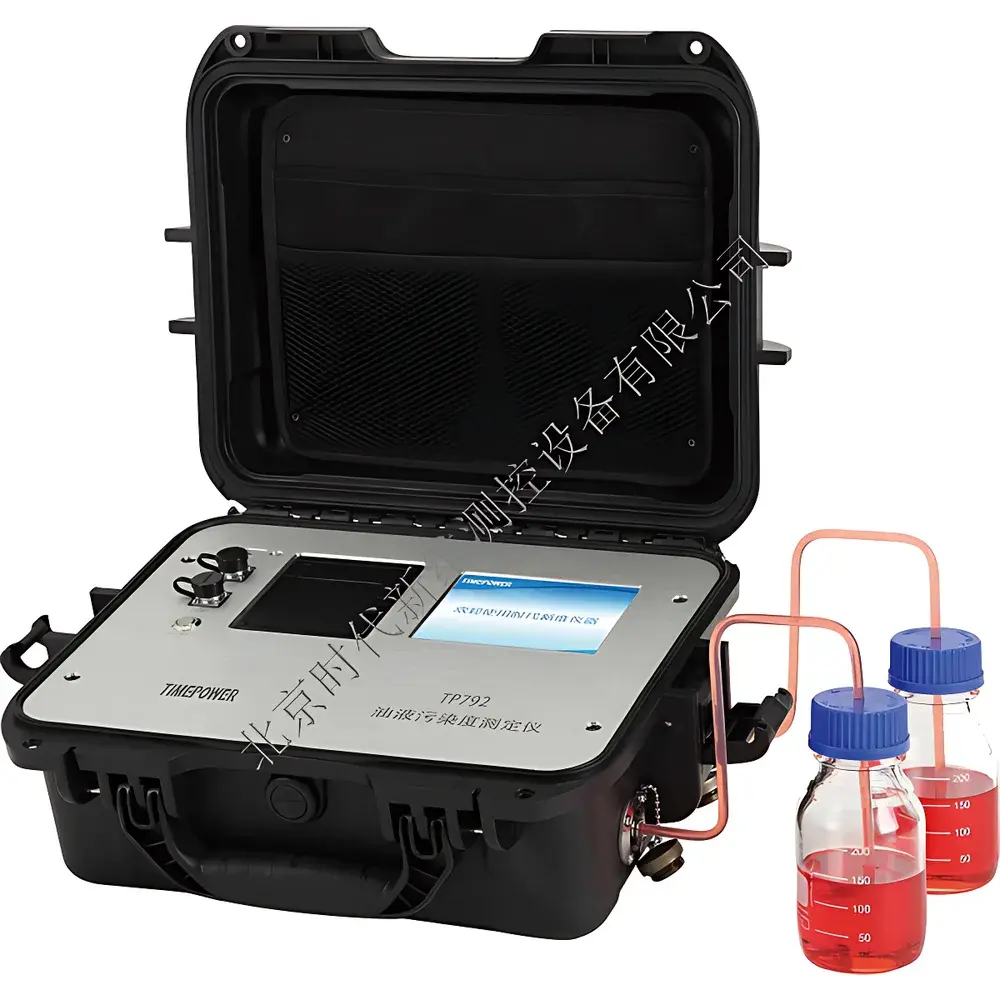
Timepower TP792 Portable Oil Particle Counter
| Brand | Timepower |
|---|---|
| Origin | Beijing, China |
| Manufacturer Type | OEM Manufacturer |
| Country of Origin | China |
| Model | TP792 |
| Instrument Type | Light-Blockage (Optical Obstruction) Particle Counter |
| Light Source | Semiconductor Laser |
| Particle Size Range | 1–400 µm |
| Sensitivity | 1 µm (per ISO 4402) or 4 µm(c) (per GB/T 18854 & ISO 11171) |
| Detection Channels | 32 user-configurable size thresholds |
| Sample Volume per Test | 10 mL ±3% |
| Detection Time | 30 s per run |
| Flow Rate | 5–35 mL/min (adjustable |
| Rinse Volume | 0–90 mL (1 mL increments) |
| Coincidence Limit | 24,000 particles/mL (5% coincidence error) |
| Counting Repeatability | RSD < 2% (at ≥1000 particles/mL) |
| Counting Accuracy | ±10% |
| Offline Viscosity Range | ≤100 cSt (up to 400 cSt with optional pneumatic bottle sampler) |
| Online Operating Pressure | 0.1–0.6 MPa (up to 40 MPa with optional pressure-reduction module) |
| Online Interval Setting | 1 s to 10 h 59 min 59 s |
| Sample Temperature Range | 0–80 °C |
| Operating Ambient Temperature | −20–60 °C |
| Storage Temperature | −30–80 °C |
| Power Supply | 100–265 VAC / 24 VDC / Optional External Li-ion Battery |
| Max Power Consumption | ≤100 W |
| Dimensions | 415 × 310 × 170 mm |
| Weight | 7 kg |
Overview
The Timepower TP792 Portable Oil Particle Counter is an engineered solution for quantitative assessment of solid particulate contamination in liquid media—primarily hydraulic oils, lubricants, transformer (insulating) oils, turbine oils, gear oils, aviation fuels, and water-glycol hydraulic fluids. It operates on the internationally standardized light-blockage (optical obstruction) principle defined in ISO 11171, GB/T 18854, and ASTM D7647. As a particle passes through a precisely collimated laser beam within a laminar-flow detection zone, it attenuates incident light proportionally to its projected cross-sectional area. This analog signal is digitized, classified across 32 programmable size channels (1–400 µm), and converted into statistically valid particle counts per unit volume. Designed for both offline laboratory analysis and online process monitoring, the TP792 delivers traceable, repeatable data compliant with critical industry contamination control frameworks—including NAS 1638, ISO 4406, GJB 420B, AS4059F, and SAE AS749D.
Key Features
- Field-deployable portable architecture (7 kg, compact 415 × 310 × 170 mm footprint) with dual power options: universal AC input (100–265 VAC), 24 VDC, or optional external lithium-ion battery pack for uninterrupted operation in remote or mobile environments.
- High-fidelity optical detection system featuring a stable semiconductor laser source and precision-engineered flow cell, enabling sensitivity down to 1 µm (ISO 4402) or 4 µm(c) (ISO 11171/GB/T 18854) with counting repeatability better than RSD < 2% at ≥1000 particles/mL.
- 32-channel configurable sizing matrix supporting user-defined bin boundaries, facilitating alignment with multiple international reporting standards without post-processing conversion.
- Integrated calibration management: stores three independent reference curves (ACFTD, ISO MTD, ROST) and allows on-device switching to minimize inter-standard uncertainty during data interpretation.
- Full-featured 5.6-inch capacitive touchscreen interface with intuitive navigation, multilingual support (English, Chinese), and real-time visualization of count histograms, cumulative distributions, and pass/fail status against selected contamination codes.
- Dual-mode sampling capability: offline mode via precision syringe or pneumatic bottle sampler (optional, up to 400 cSt viscosity); online mode via pressurized bypass line (0.1–0.6 MPa standard; up to 40 MPa with pressure-reduction kit).
- Onboard thermal management ensures stable performance across ambient temperatures from −20 °C to +60 °C, with sample temperature tolerance up to 80 °C.
Sample Compatibility & Compliance
The TP792 is validated for use with mineral-based, synthetic, and bio-based oils—including aviation turbine fuel (Jet A-1), phosphate ester fire-resistant fluids, polyalphaolefin (PAO) synthetics, and water-glycol emulsions. Its flow path is constructed from chemically inert materials (PTFE tubing, stainless-steel wetted components) to prevent adsorption or leaching. The instrument supports full compliance with GLP and GMP documentation requirements: all measurements include embedded timestamps, operator ID fields, instrument serial number, and audit-trail-capable event logging. Data output conforms to ASTM E29, ISO/IEC 17025 traceability expectations, and is compatible with LIMS integration via RS232/RS485 serial protocols. Calibration verification adheres to ISO 21501-4 for light-scattering/obstruction particle counters.
Software & Data Management
Data acquisition, reporting, and archival are handled through embedded firmware with no external PC dependency. Each test record includes raw channel counts, calculated contamination codes (e.g., ISO 4406 [X/Y/Z]), statistical confidence metrics, and user-entered metadata (sample ID, location, operator). Reports can be printed directly via integrated thermal printer—with support for alphanumeric and Unicode (Chinese) characters—or exported in CSV format via USB 2.0 to removable flash drives. For centralized fleet management, optional Timepower DataLink software enables secure bidirectional communication over RS232/RS485, supporting batch export, trend charting, deviation alerts, and electronic signature workflows aligned with FDA 21 CFR Part 11 requirements.
Applications
- Aerospace: In-service oil monitoring for turbine engines, hydraulic systems, and landing gear actuators per SAE AS4059F and GJB 420B.
- Power Generation: Transformer oil cleanliness verification prior to commissioning and during routine maintenance (DL/T 432, IEC 60296).
- Marine & Offshore: Real-time lubricant health assessment in main propulsion gearboxes and servo-valve circuits under variable pressure and temperature conditions.
- Manufacturing: Hydraulic fluid certification for CNC machine tools, injection molding presses, and robotic assembly lines governed by ISO 4406 Class 16/13 or stricter internal specs.
- R&D Laboratories: Quantitative evaluation of filter efficiency, additive depletion kinetics, and wear debris generation in tribological testing rigs.
FAQ
What standards does the TP792 comply with for calibration and reporting?
It complies with ISO 11171 (calibration), ISO 4402 (historical calibration), GB/T 18854 (Chinese national standard), and supports direct reporting in NAS 1638, ISO 4406, GJB 420A/B, AS4059E/F, and SAE AS749D formats.
Can the TP792 perform continuous online monitoring?
Yes—it supports fully automated unattended operation with programmable sampling intervals ranging from 1 second to 10 hours 59 minutes 59 seconds, including automatic rinse cycles between measurements.
Is the instrument suitable for high-viscosity oils?
Standard configuration handles oils up to 100 cSt; with the optional pneumatic bottle sampler, viscosity tolerance extends to 400 cSt.
How is data integrity ensured during field deployment?
All measurements include immutable timestamps, operator identification, instrument serial number, and checksum-verified binary storage. Optional DataLink software provides encrypted transmission and 21 CFR Part 11-compliant electronic signatures.
What maintenance is required for long-term accuracy?
Routine cleaning of the flow cell and sensor window using petroleum ether is recommended after each offline test. Annual recalibration against NIST-traceable reference particles is advised for metrological assurance.



