
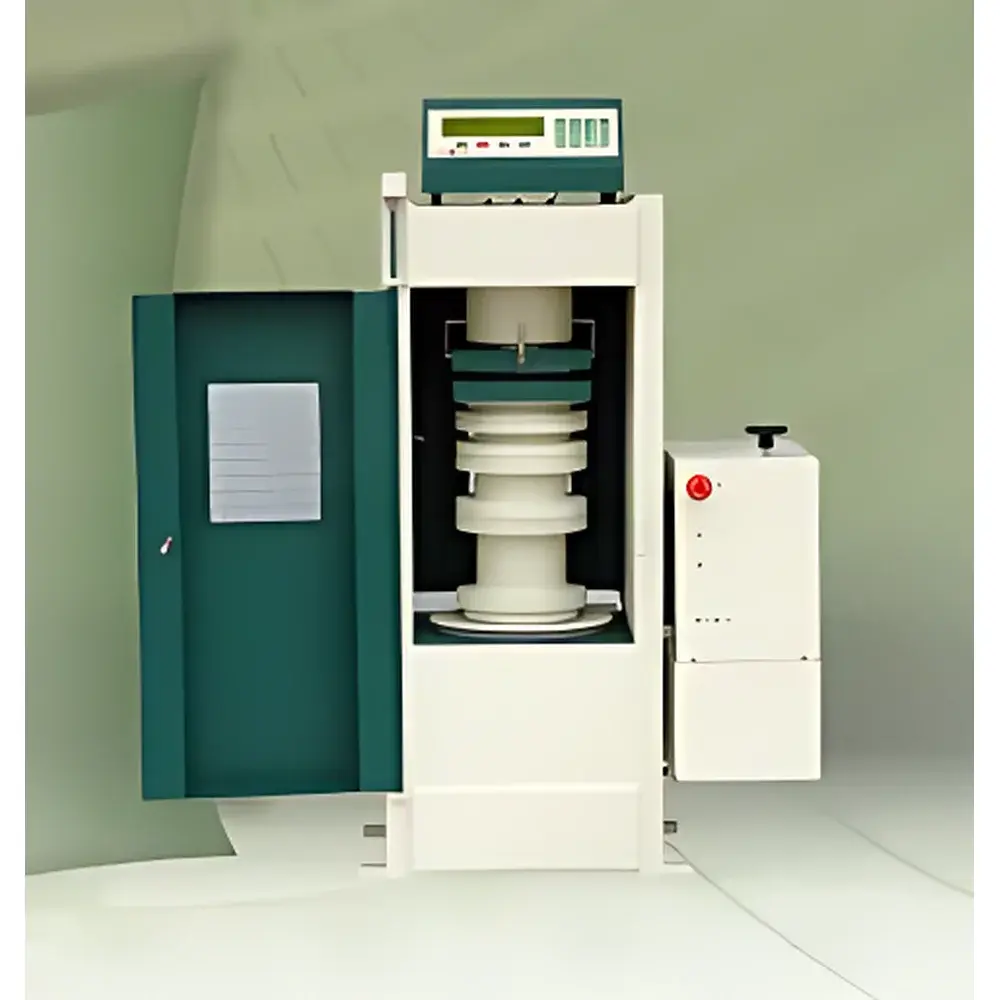
Tinius Olsen MU Series Semi-Automatic Compression Testing Machine
| Brand | Tinius Olsen |
|---|---|
| Origin | United Kingdom |
| Model | MU |
| Load Capacity Options | 50 kN, 100 kN, 250 kN, 500 kN, 1000 kN, 1500 kN, 2000 kN, 3000 kN |
| Compliance | ASTM C39, ASTM C469, ASTM C78, AASHTO T22, EN 12390-3, BS 1881-116, ISO 7500-1 Class 1 |
| Control System | Microprocessor-based with dual-speed hydraulic pump, programmable loading rate, peak load hold, auto-shutdown, emergency stop |
| Data Handling | Onboard memory (2000 test records), real-time clock, RS232 & parallel port outputs, unit conversion (lbf, kN, MPa, psi) |
| Structural Design | Fully welded frame with precision-ground hydraulic piston, hardened & polished platens, self-aligning upper platen, spherical seating base, interlocked front/rear safety doors |
| Calibration Range | 1–100% of full scale |
Overview
The Tinius Olsen MU Series Semi-Automatic Compression Testing Machine is an engineered solution for high-reliability compressive strength evaluation of construction materials—including concrete cylinders, cubes, prisms, bricks, and mortar specimens—under standardized mechanical loading conditions. Built upon a rigid, fully welded structural frame with precision-ground hydraulic actuation, the MU system delivers consistent force application in accordance with fundamental principles of uniaxial compression testing defined in ASTM C39, AASHTO T22, EN 12390-3, and BS 1881-116. Its dual-speed hydraulic pump enables rapid approach to target load followed by fine-controlled, programmable loading rates—critical for achieving reproducible stress–strain response in brittle and quasi-brittle materials. The machine operates within a calibrated force range of 1% to 100% of full-scale capacity, meeting ISO 7500-1 Class 1 verification requirements for static force measurement systems.
Key Features
- Rigid monolithic frame architecture with reinforced side columns, top crosshead, and heavy-duty base—designed to minimize deflection under maximum rated load.
- Precision-ground, hardened, and lapped compression platens (standard upper platen with self-aligning spherical seat; lower platen with optional automatic centering for 2000/3000 kN models).
- Dual-speed hydraulic system controlled via single-lever valve—enabling efficient coarse positioning and precise load ramping with real-time rate feedback on display.
- Microprocessor-based controller featuring a 4-line alphanumeric LCD interface, menu-driven navigation, and integrated real-time clock for timestamped test logging.
- Onboard non-volatile memory storing up to 2000 complete test records—including peak load, failure mode indicator, test duration, date/time stamp, and user-defined ID.
- Interlocked front and rear safety doors compliant with EN 61010-1 and CE Machinery Directive 2006/42/EC; rear debris chute with removable tray for rapid specimen residue clearance.
- Emergency stop button (hardwired, fail-safe), automatic power-down after idle timeout, and programmable load-hold function for creep or relaxation studies.
- RS232 serial and parallel port outputs supporting direct connection to laboratory PCs or industrial printers for traceable data export and hardcopy reporting.
Sample Compatibility & Compliance
The MU Series accommodates standard civil engineering specimens per international specifications: cylindrical concrete samples (2″, 3″, 4″, 6″ diameters), cubic specimens (50 mm, 70.6 mm, 100 mm, 150 mm, 200 mm), prismatic beams (up to 475 × 250 mm cross-section), and masonry units. Optional accessories include ASTM-compliant bearing caps (TO-320-5519, TO-320-5524), Shore A 60 rubber pads (TO-320-5520, TO-320-5525), splitting tensile fixtures (TO-320-5528), flexural test frames (TO-33101-ASTM/BS), and high-capacity prism support stands (TO-320-LU-SPL). All configurations comply with electromagnetic compatibility (EN 50081-1, EN 55011) and low-voltage safety directives (73/23/EEC, EN 61010-1). CE marking confirms conformity with EU health, safety, and environmental protection standards.
Software & Data Management
While the MU operates as a stand-alone instrument without proprietary PC software, its embedded controller supports full audit-trail functionality essential for GLP and ISO/IEC 17025 environments. Each stored test record includes operator ID (user-configurable), test method code, specimen geometry, applied load (kN/lbf), calculated stress (MPa/psi), time-to-failure, and pass/fail flag based on preset limits. Data export via RS232 permits integration with third-party LIMS or custom database applications. Unit conversion is supported across SI, imperial, and metric pressure formats—enabling seamless alignment with regional reporting conventions. Calibration history—including date, technician ID, reference standard used, and deviation values—is retained alongside operational logs for regulatory review.
Applications
The MU Series serves core quality control and research functions in cementitious materials laboratories, precast concrete producers, highway materials testing agencies, and university civil engineering departments. Typical use cases include compressive strength validation of concrete mix designs per ACI 318 or EN 206; acceptance testing of structural masonry units (ASTM C67); modulus of elasticity determination (ASTM C469); flexural strength assessment using complementary bending fixtures; and split tensile strength evaluation of cylindrical specimens (ASTM C496). Its robust mechanical design and repeatable hydraulic control make it suitable for routine daily testing as well as long-term durability studies involving cyclic or sustained loading protocols.
FAQ
What standards does the MU Series comply with?
The MU Series conforms to ASTM C39, C469, C78, AASHTO T22, EN 12390-3, BS 1881-116, and ISO 7500-1 Class 1 for force measurement accuracy.
Can the MU be used for flexural or tensile testing?
Yes—when equipped with optional bending frames (e.g., TO-33101 series) or splitting tensile fixtures (TO-320-5528), the MU platform supports three-point bending and indirect tensile testing per ASTM standards.
Is calibration traceable to national standards?
Calibration is performed using certified deadweight standards traceable to NIST, UKAS, or DAkkS-accredited laboratories; certificate includes uncertainty budget and as-found/as-left data.
What electrical configurations are available?
Standard variants support 110 VAC/60 Hz, 220 VAC/50 Hz, and 220 VAC/60 Hz single-phase inputs—specified at time of order (e.g., TO-302E-MU-01 through TO-320E-MU-03).
Does the MU meet FDA or ISO 13485 requirements?
While not designed for medical device testing, its documentation package—including design history file excerpts, risk analysis (ISO 14971), and verification reports—supports adaptation into regulated manufacturing QA/QC workflows where mechanical property verification is required.
Related Products



