
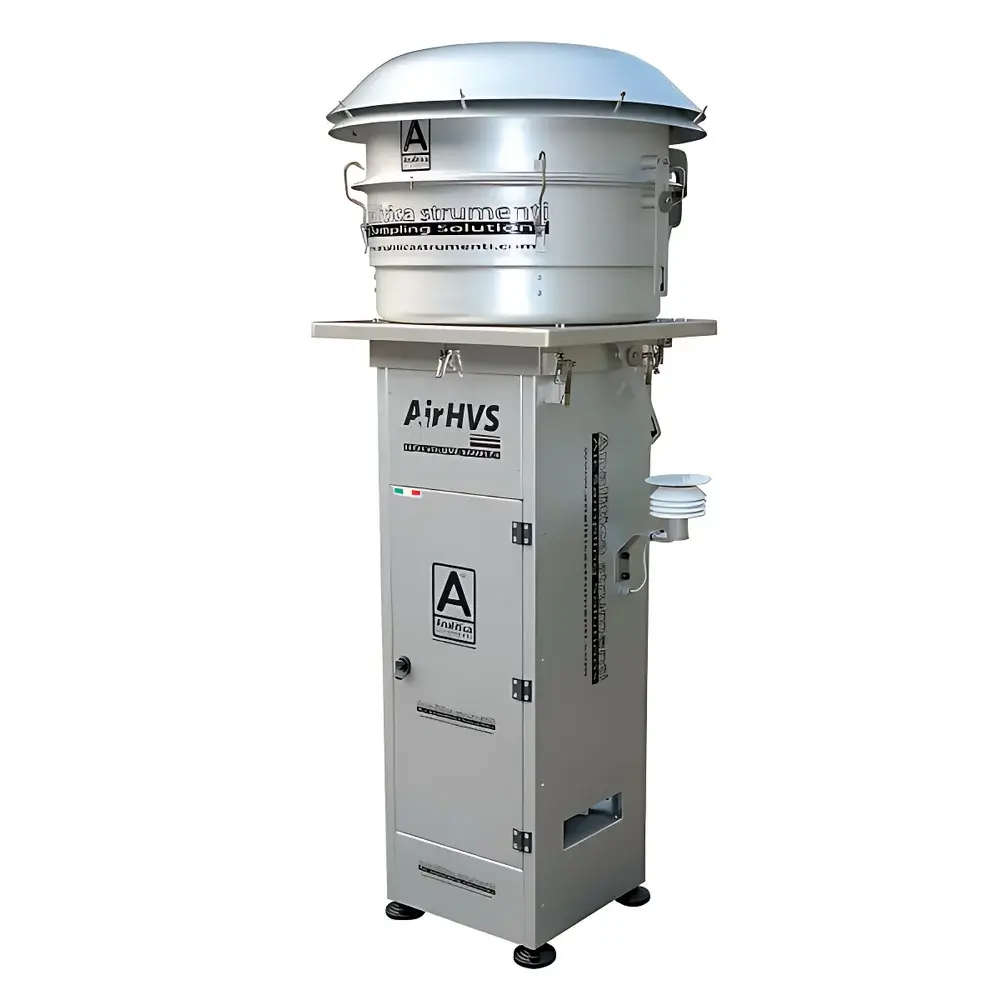
Tisch AirHVS Marine-Grade High-Volume Intelligent Aerosol Sampler
| Brand | Tisch |
|---|---|
| Origin | Italy |
| Manufacturer Status | Authorized Distributor |
| Origin Category | Imported |
| Model | AirHVS |
| Pricing | Upon Request |
| Flow Rate | 200–1300 L/min |
| Standard Cut-Point Flow | 40 CFM (1.133 m³/min) for TSP, PM₁₀, and PM₂.₅ |
| Operating Temperature Range | –30 °C (with optional low-temp kit) |
| Power Supply | 220 VAC |
| Dimensions (H×L×W) | 120 × 37 × 37 cm |
| Weight | 14 kg |
| Housing | Anodized Aluminum |
| Motor | Three-Stage Magnetic Induction Brushless DC Motor |
| Data Interfaces | RS232, USB |
| Display | High-Resolution Backlit LCD |
| Optional Features | GSM/GPRS Remote Monitoring, RH/Temperature Sensors, PM₂.₅ Retrofit Kit |
Overview
The Tisch AirHVS Marine-Grade High-Volume Intelligent Aerosol Sampler is an engineered solution for continuous, regulatory-compliant atmospheric particulate matter sampling aboard research vessels, offshore platforms, and coastal monitoring stations. Designed specifically for dynamic marine environments, it employs a high-volume, constant-flow sampling architecture based on ISO 5167-compliant Venturi flow measurement and closed-loop electronic control. Unlike terrestrial samplers subject to static ambient conditions, the AirHVS integrates real-time meteorological compensation—leveraging ultrasonic time-of-flight wind sensors immune to salt corrosion and mechanical drift—to maintain volumetric accuracy despite vessel pitch, roll, and variable wind vectors. It supports standardized gravimetric analysis of total suspended particulates (TSP), inhalable fraction (PM₁₀), and fine particulate matter (PM₂.₅) under EU EN 12341:2014 and US EPA Method IO-3.2 (CFR Title 40, Part 50, Appendix L), ensuring data integrity for regulatory reporting, source apportionment studies, and long-term trend analysis in maritime air quality programs.
Key Features
- Marine-hardened anodized aluminum enclosure (IP54-rated) with corrosion-resistant fasteners and sealed electronics housing for extended deployment in high-humidity, saline atmospheres.
- ISO 5167-certified Venturi tube assembly coupled with precision differential pressure transducers and PID-controlled brushless DC motor (three-stage magnetic induction) enabling stable flow regulation across 200–1300 L/min, with <±2% full-scale repeatability.
- Ultrasonic wind sensor using time-of-flight principle—no moving parts, zero mechanical hysteresis, and immunity to ship motion-induced bias; outputs true wind speed and direction referenced to vessel heading.
- Configurable sampling logic: programmable by elapsed time, total sampled volume (actual or STP-corrected), number of cycles, or conditional triggers (e.g., wind sector gating).
- Onboard non-volatile memory stores all operational metadata—including ambient temperature, barometric pressure, relative humidity (with optional probe), motor RPM, filter temperature, and real-time flow deviation—timestamped to UTC with internal RTC.
- Integrated STP correction engine applies ISO 10780 and EPA 40 CFR Part 50 algorithms to convert raw volumetric flow to standard cubic meters (at 25 °C, 101.325 kPa), traceable to NIST standards.
Sample Compatibility & Compliance
The AirHVS accommodates standard 8″ × 10″ (203 × 254 mm) quartz fiber or PTFE membrane filters in stainless-steel filter holders compatible with EPA TO-13A, EN 12341 Annex B, and ISO/IEC 17025-accredited gravimetric laboratories. Optional PM₂.₅ retrofit kits include impactor stages with aerodynamic cut-points validated per ISO 25541-1. All flow calibration certificates are issued with NIST-traceable documentation. The system meets electromagnetic compatibility requirements per IEC 61000-6-2/-6-4 and marine vibration standards per IEC 60068-2-64. Its firmware architecture supports audit trails compliant with GLP and 21 CFR Part 11 when paired with validated data management software.
Software & Data Management
Field data export is supported via RS232 serial interface (ASCII protocol) or high-speed USB 2.0 mass storage mode—no drivers required. The embedded GUI displays real-time diagnostics including remaining sampling duration, accumulated STP volume, flow deviation histogram, and sensor health status. Optional Tisch SAM-Link software enables remote configuration, firmware updates, and automated CSV/NetCDF export with embedded QA/QC flags (e.g., flow excursion alerts, pressure drop thresholds). All logged parameters are structured to align with ICOS, ACTRIS, and GAW metadata schemas for interoperability with global atmospheric databases.
Applications
- Long-term PM characterization across oceanic transects (e.g., Atlantic Meridional Transect, Southern Ocean Time Series).
- Emission factor derivation from ship exhaust plumes using synchronized wind-sector-resolved sampling.
- Validation of satellite aerosol optical depth (AOD) retrievals over open water.
- Source apportionment modeling requiring speciated filter samples (IC, ICP-MS, OC/EC analysis).
- Baseline monitoring for offshore wind farm environmental impact assessments (EIAs).
- Calibration reference for low-cost sensor networks deployed on autonomous surface vehicles (ASVs).
FAQ
Does the AirHVS meet US EPA equivalency requirements for PM₁₀ monitoring?
Yes—the AirHVS is configured to operate at the EPA-specified 40 CFM (1.133 m³/min) nominal flow with certified PM₁₀ impactors and undergoes annual field verification per EPA Guidance for PM₂.₅ and PM₁₀ Continuous Ambient Air Monitors.
Can the ultrasonic wind sensor function accurately during heavy sea spray?
Yes—the transducer elements are hydrophobic-coated and mounted in a self-draining acoustic chamber; validation testing per IEC 60529 confirms uninterrupted operation under simulated salt fog (IEC 60068-2-52) and continuous 95% RH conditions.
Is STP correction applied in real time or post-processing only?
Both: real-time STP volume is displayed and logged continuously, while raw flow, T, and P values are preserved for retrospective reprocessing using alternate temperature/pressure references if required.
What maintenance intervals are recommended for marine deployments?
Venturi bore inspection and flow calibration every 2000 operating hours; ultrasonic sensor cleaning every 3 months in high-salinity zones; brushless motor service interval exceeds 20,000 hours per manufacturer specification.
Is the system compatible with third-party telemetry platforms (e.g., ARGOS, Iridium SBD)?
Yes—via optional GSM/GPRS modem module supporting MQTT and HTTP(S) payloads; custom API integration available under NDA for fleet-wide remote supervision.







