
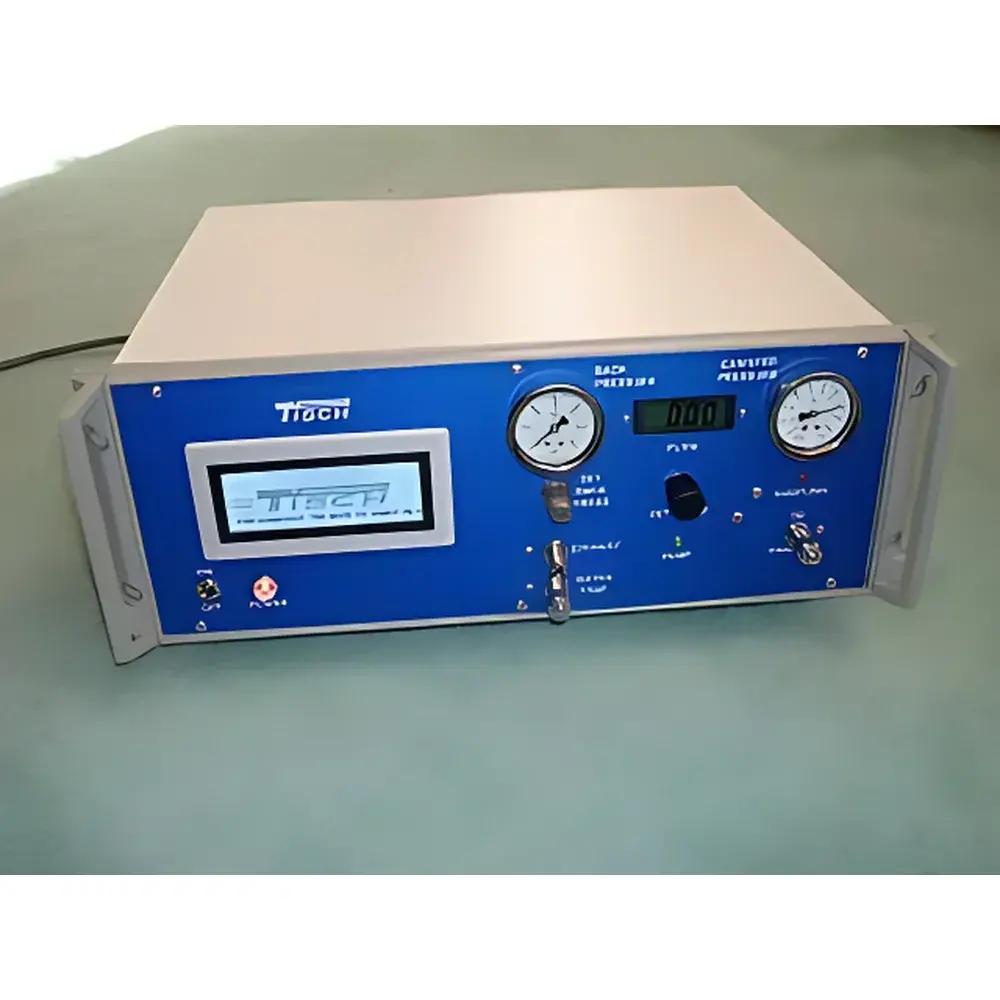
Tisch TE-423 Carbonyl Air Sampler
| Brand | Tisch |
|---|---|
| Origin | USA |
| Manufacturer Status | Authorized Distributor |
| Product Origin | Imported |
| Model | TE-423 |
| Pricing | Upon Request |
| Channels | 3 |
| Sampling Flow Rate | 1 mL/min to 2 SLPM |
| Power Supply | 118 VAC, 50/60 Hz, 3 A |
| Control Interface | Touchscreen + Front-panel LCD |
| Ozone Scrubber | Temperature-controlled with cumulative runtime timer |
| Mounting | 19-inch rack-mountable or desktop (with rubber feet) |
| Remote Channel Control | Yes |
| Controller Architecture | PLC-based with front-panel operational interface |
| Structural Design | Ruggedized for long-term field deployment and mobile operation |
| Compliance Basis | DRI Standard Method for Carbonyl Collection |
Overview
The Tisch TE-423 Carbonyl Air Sampler is a precision-engineered, multi-channel environmental sampling system designed for the quantitative collection of low-concentration carbonyl compounds—including formaldehyde, acetaldehyde, and acetone—from ambient or workplace air. It operates on the principle of derivatization-based passive adsorption: carbonyls are trapped on solid-phase cartridges impregnated with acidified 2,4-dinitrophenylhydrazine (DNPH), forming stable hydrazone derivatives suitable for subsequent high-performance liquid chromatography (HPLC) or gas chromatography (GC) analysis. The instrument implements the standardized methodology developed by the Desert Research Institute (DRI), widely adopted in U.S. EPA reference methods and international air quality monitoring protocols. Its tri-channel architecture enables parallel sampling across multiple locations or under varying flow conditions, supporting both time-integrated and sequential exposure assessment strategies in compliance with ISO 16000-3 and ASTM D5197.
Key Features
- Three independently controllable sampling channels—each configurable for discrete flow rates (1 mL/min to 2 SLPM) and programmable run durations.
- Integrated temperature-regulated ozone scrubber with real-time thermal stabilization and cumulative runtime logging—critical for eliminating ozone interference during DNPH cartridge exposure.
- Dual-mode operation: front-panel touchscreen interface with backlit LCD display, plus full remote control via RS-485 or optional Ethernet module for centralized lab or field network integration.
- Industrial-grade PLC-based control core ensures deterministic timing accuracy, repeatable valve sequencing, and robust fault detection—engineered for unattended operation over extended campaigns.
- Rack-mount (19-inch) and desktop configurations supported; vibration-dampening rubber feet and reinforced chassis facilitate transport between monitoring sites without recalibration.
- Low-power consumption design (118 VAC, 50/60 Hz, ≤3 A) meets CE and FCC Class B emissions requirements for indoor and mobile laboratory use.
Sample Compatibility & Compliance
The TE-423 is validated for use with standard 4–6 mL DNPH-coated silica gel cartridges (e.g., Supelco, SKC, or Thermo Scientific), as well as custom-packed tubes meeting EPA TO-11A specifications. Each channel accommodates either single- or dual-tube configurations to support VOC co-sampling protocols. All wetted materials comply with USP Class VI biocompatibility standards and exhibit negligible carbonyl background leaching. The system supports audit-ready operation per GLP and ISO/IEC 17025 requirements: event logs capture start/stop times, flow deviations (>±5%), scrubber temperature excursions, and power interruptions. Optional data export enables alignment with FDA 21 CFR Part 11-compliant electronic record systems when paired with validated LIMS interfaces.
Software & Data Management
Onboard firmware stores up to 1,000 sampling events with timestamps, channel-specific flow profiles, and scrubber thermal history. Data export is supported via USB mass storage or serial ASCII dump (CSV-compatible). No proprietary software installation is required; raw logs integrate directly into common environmental data management platforms (e.g., EQuIS, ArcGIS Environmental Data Manager). Firmware updates are delivered via signed .bin files with SHA-256 checksum verification. Audit trail functionality includes immutable operator ID tagging (via optional RFID badge reader integration) and tamper-evident log encryption for regulatory submissions.
Applications
- Ambient air quality monitoring networks tracking formaldehyde hotspots near industrial zones or traffic corridors.
- Indoor air quality (IAQ) assessments in schools, hospitals, and office buildings per ASHRAE Standard 62.1.
- Occupational hygiene surveys evaluating worker exposure to carbonyls in chemical manufacturing, resin production, and wood-processing facilities.
- Method validation studies supporting ISO 16000-3 interlaboratory comparisons and NIST-traceable calibration transfer.
- Mobile monitoring deployments using vehicle-mounted racks or portable power stations (12 VDC adapter available upon request).
FAQ
What carbonyl compounds does the TE-423 specifically target?
Formaldehyde, acetaldehyde, propionaldehyde, acetone, methyl ethyl ketone (MEK), and other C1–C6 aliphatic and aromatic carbonyls amenable to DNPH derivatization.
Is the ozone scrubber replaceable, and how often does it require maintenance?
Yes—the scrubber cartridge is field-replaceable; typical service interval is 6 months under continuous operation at 25°C ambient, verified by integrated runtime counter and temperature log review.
Can the TE-423 be used with non-DNPH sorbents?
No—it is optimized for DNPH chemistry; alternative sorbents (e.g., Carboxen, Tenax) require flow path revalidation and are not supported under factory calibration.
Does the unit meet explosion-proof certification for hazardous locations?
Not inherently; however, intrinsically safe barrier kits (Class I, Division 2) are available as an engineering modification subject to site-specific ATEX/IECEx review.
How is flow calibration performed and documented?
Primary calibration uses NIST-traceable dry calibrators (e.g., Bios International Series 400); onboard flow sensors are zeroed and span-checked annually per ISO 17025-accredited procedures—certificates provided with each unit shipment.







