
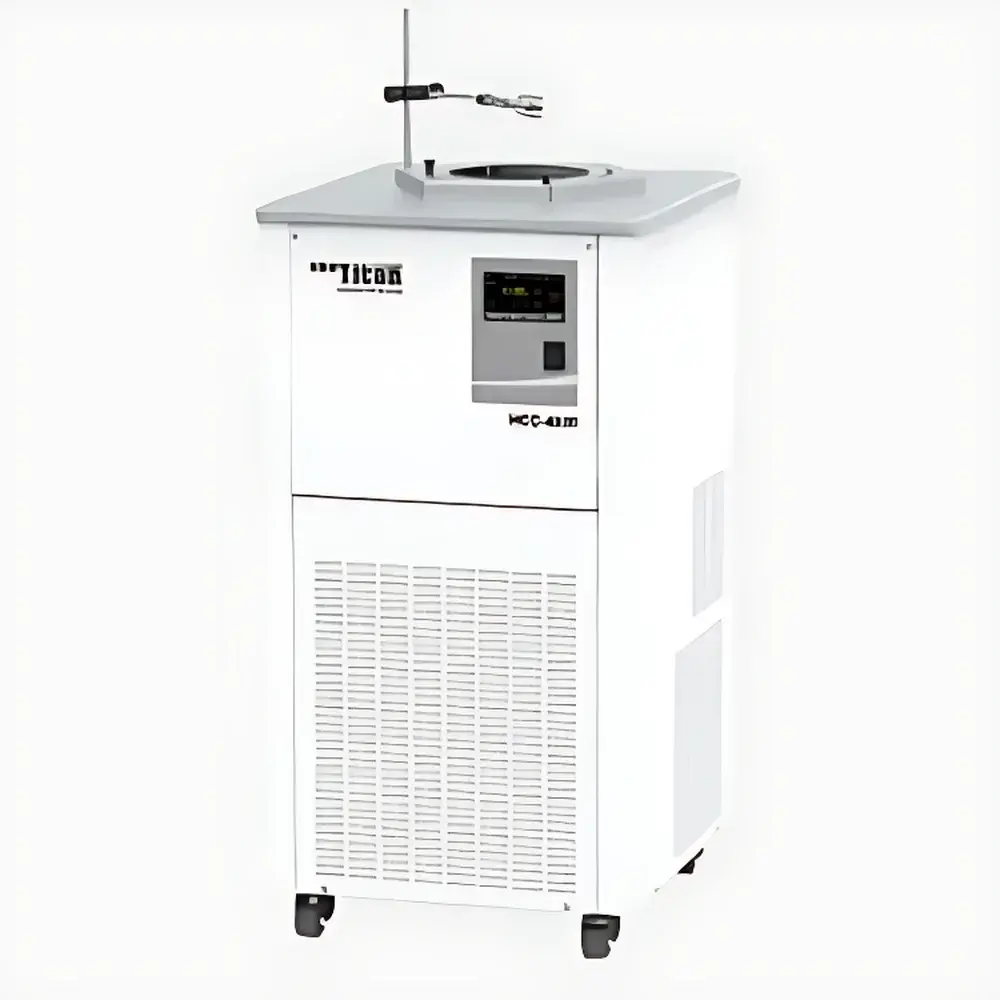
Titan HCC-4020 Vertical Constant-Temperature Magnetic Stirring Circulating Bath
| Brand | Titan |
|---|---|
| Origin | Shanghai, China |
| Manufacturer Type | Direct Manufacturer |
| Product Origin | Domestic (China) |
| Model | HCC-4020 |
| Temperature Range | −40 °C to +40 °C |
| Temperature Accuracy | ±0.1 °C / ±0.01 °C / ±0.001 °C (selectable) |
| Heating/Cooling Timer | 0–999 h 59 min |
| External Dimensions | 450 mm × 515 mm × 865 mm (W × D × H) |
| Net Weight | 86 kg |
Overview
The Titan HCC-4020 is a vertically oriented, high-stability constant-temperature magnetic stirring circulating bath engineered for precise thermal control and homogeneous mixing in demanding laboratory applications. It integrates a closed-loop refrigeration-heating system with a high-torque magnetic stirrer and a large-capacity stainless-steel bath chamber—enabling simultaneous temperature regulation, active agitation, and fluid circulation across a wide operational range from −40 °C to +40 °C. Unlike conventional water or oil baths, the HCC-4020 employs a dual-mode thermoelectric-compressor hybrid cooling architecture, ensuring rapid thermal response and exceptional stability at sub-zero setpoints without cryogenic fluids. Its vertical configuration optimizes bench space utilization while maintaining ergonomic access to the bath well and intuitive front-panel operation.
Key Features
- Wide temperature span: Stable operation from −40 °C to +40 °C with selectable accuracy modes (±0.1 °C, ±0.01 °C, or ±0.001 °C), verified via internal Pt100 sensor and independent calibration traceability.
- Integrated high-performance magnetic stirring: Adjustable speed range (0–1200 rpm), programmable ramp profiles, and torque-sensing feedback to maintain consistent agitation under variable viscosity or low-temperature conditions.
- Dual-mode thermal management: Compressor-based primary cooling augmented by Peltier-assisted fine temperature modulation for enhanced stability below 0 °C and reduced thermal overshoot during transitions.
- Programmable timer function: Independent heating/cooling duration control up to 999 hours and 59 minutes, supporting unattended long-term experiments including crystallization kinetics, polymerization monitoring, or enzymatic reaction profiling.
- Rugged industrial build: 304 stainless-steel bath chamber, reinforced structural frame, and IP22-rated electrical enclosure compliant with IEC 61010-1 for laboratory safety.
- Front-access design with large LCD interface: Real-time display of setpoint, actual temperature, stirring speed, elapsed time, and system status indicators—including refrigerant pressure monitoring and overtemperature/overcurrent fault alerts.
Sample Compatibility & Compliance
The HCC-4020 accommodates standard laboratory vessels—including jacketed reactors (up to 5 L), round-bottom flasks (50 mL–2 L), and custom immersion probes—via its 180 mm diameter × 220 mm depth bath well. The bath fluid medium is compatible with silicone oil, ethanol/water mixtures, and low-freezing-point heat transfer fluids meeting ASTM D471 and ISO 6743-12 specifications. All electronic controls conform to CE marking requirements under Directive 2014/30/EU (EMC) and 2014/35/EU (LVD). Temperature calibration procedures align with ISO/IEC 17025 guidelines, and optional NIST-traceable calibration certificates are available upon request. The unit supports GLP-compliant operation through password-protected parameter locking and audit-ready event logging.
Software & Data Management
The HCC-4020 features RS485 Modbus RTU and USB-B connectivity for integration into centralized lab automation systems. Optional TitanLab Control Suite (v3.2+) enables remote parameter setting, real-time data streaming (1 Hz sampling), and synchronized logging of temperature, stirring speed, and timer status. Export formats include CSV and Excel-compatible .xlsx; all datasets embed timestamp, operator ID, and instrument serial number metadata. Audit trail functionality complies with FDA 21 CFR Part 11 requirements when used with validated user authentication and electronic signature modules. Data integrity safeguards include cyclic redundancy check (CRC) validation on all transmitted packets and non-volatile memory retention of last 10,000 events.
Applications
- Low-temperature catalytic reactions requiring precise thermal control and continuous mixing (e.g., asymmetric hydrogenation, Grignard additions).
- Stability testing of pharmaceutical formulations per ICH Q1A(R3) guidelines at controlled sub-zero storage conditions.
- Calibration of reference thermometers and temperature sensors across extended ranges (−40 °C to +40 °C).
- Material science studies involving phase transition analysis (e.g., wax crystallization, lipid polymorphism) under dynamic shear.
- QC/QA workflows in biotechnology labs for enzyme activity assays where both temperature drift and mixing homogeneity directly impact kinetic reproducibility.
- Environmental simulation studies requiring sustained cold-stage operation with mechanical agitation (e.g., microplastic degradation kinetics in seawater analogs).
FAQ
What bath fluids are recommended for operation at −40 °C?
Ethanol/water (70/30 v/v) or specialized low-viscosity silicone oils (e.g., DC200 series) with pour points ≤ −50 °C are validated for use. Avoid glycerol-water mixtures due to excessive viscosity below −20 °C.
Can the stirring function operate independently of temperature control?
Yes—the magnetic stirrer can be activated or deactivated regardless of whether heating or cooling is engaged, enabling mixing-only protocols or post-cooling homogenization steps.
Is external communication supported for LIMS integration?
Yes—Modbus RTU over RS485 allows seamless interfacing with LabVantage, STARLIMS, and Thermo Fisher SampleManager via standard protocol drivers.
Does the unit meet GMP documentation requirements for regulated environments?
When configured with TitanLab Control Suite and enabled audit trail, it satisfies Annex 11 and ALCOA+ principles for electronic records and signatures in pharmaceutical manufacturing settings.
What maintenance intervals are recommended for optimal performance?
Compressor oil level and refrigerant pressure should be verified annually; stirring magnet alignment and bath seal integrity inspected every 6 months per Titan Preventive Maintenance Protocol PM-HCC-4020 Rev. 2.
Related Products



