
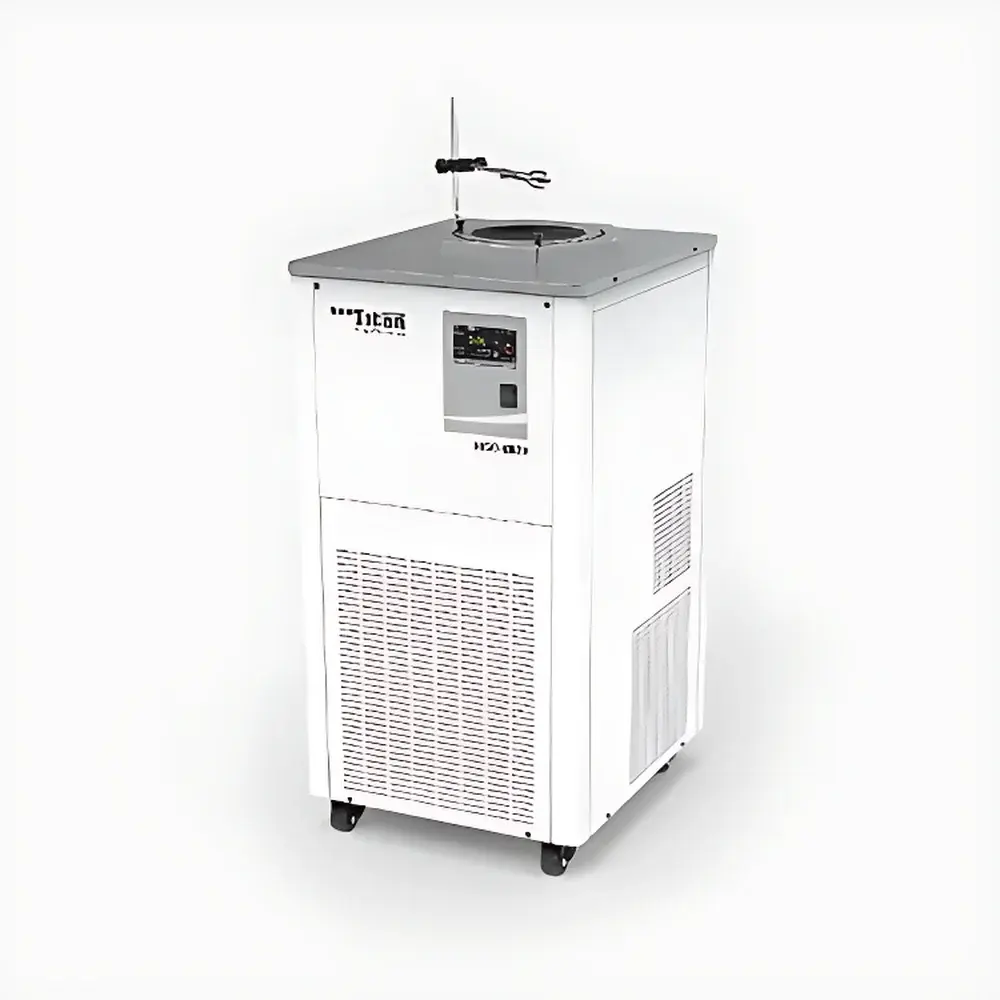
Titan HCC-8020 Vertical Constant-Temperature Magnetic Stirring Cryobath
| Brand | Titan |
|---|---|
| Origin | Shanghai, China |
| Manufacturer Type | Direct Manufacturer |
| Country of Origin | China |
| Model | HCC-8020 |
| Temperature Range | −80 °C to +20 °C |
| Temperature Stability | ±0.1 °C / ±0.01 °C / ±0.001 °C (selectable) |
| Timer Range | 0–999 h 59 min |
| External Dimensions | 450 mm × 515 mm × 865 mm |
| Net Weight | 86 kg |
Overview
The Titan HCC-8020 is a vertically oriented, high-stability constant-temperature magnetic stirring cryobath engineered for precise low-temperature reaction control in analytical, synthetic, and materials science laboratories. Unlike conventional water or oil baths, the HCC-8020 integrates a dual-mode refrigeration-heating system with a built-in high-torque magnetic stirrer and PID-controlled temperature regulation—enabling stable thermal environments from −80 °C to +20 °C. Its operation relies on a cascade refrigeration cycle coupled with resistive heating elements and real-time feedback via platinum RTD (Pt100) sensors, ensuring minimal thermal drift and high reproducibility across extended experimental durations. This architecture supports applications requiring strict thermal management under inert or ambient atmospheres—including cryogenic catalysis, polymerization kinetics, low-temperature electrochemistry, and controlled crystallization studies.
Key Features
- Vertical design optimizes bench space utilization while enhancing accessibility to reaction vessels up to 500 mL capacity; accommodates standard round-bottom flasks, jacketed reactors, and custom glassware via adjustable clamping fixtures.
- Triple-level temperature stability options (±0.1 °C, ±0.01 °C, and ±0.001 °C) selectable via front-panel interface—calibrated traceably to NIST-traceable standards and verified per ISO/IEC 17025 protocols.
- Integrated brushless DC magnetic stirrer delivering torque up to 1200 g·cm at speeds from 0–1200 rpm, with soft-start functionality and stall detection to prevent motor overload during viscous or frozen-state mixing.
- Programmable timer with resolution down to 1 minute supports unattended operation for durations up to 999 hours and 59 minutes—compatible with GLP-compliant experiment logging when paired with optional RS485 or USB data export.
- Stainless steel 316L inner bath chamber with reinforced insulation minimizes condensation and thermal leakage; external housing features powder-coated steel construction rated IP20 for laboratory environments.
- Dual safety architecture includes over-temperature cutoff (±5 °C deviation threshold), refrigerant pressure monitoring, and door-open interlock to halt cooling upon lid removal.
Sample Compatibility & Compliance
The HCC-8020 accepts borosilicate glass, quartz, and PTFE-lined reaction vessels ranging from 10 mL to 500 mL volume. Its open-top vertical configuration permits simultaneous integration with reflux condensers, gas inlet/outlet manifolds, and pH or conductivity probes. The unit complies with IEC 61010-1:2010 for electrical safety in laboratory equipment and meets CE marking requirements for electromagnetic compatibility (EN 61326-1). Temperature calibration certificates are provided with each unit, documenting as-found/as-left data against certified reference standards. For regulated environments, the device supports audit-ready operation when configured with optional time-stamped event logging (start/stop, setpoint changes, fault triggers) aligned with FDA 21 CFR Part 11 principles for electronic records.
Software & Data Management
While the HCC-8020 operates autonomously via its embedded controller, optional PC connectivity enables advanced data handling. Through USB or RS485 interfaces, users may deploy Titan’s proprietary LabLink™ software (Windows/Linux compatible) to monitor real-time temperature and stir speed, configure multi-step ramp-soak profiles, and export CSV-formatted datasets with millisecond timestamps. All logged parameters include metadata such as operator ID, batch number, and environmental conditions—facilitating traceability in quality-controlled workflows. Raw data files are digitally signed and stored with SHA-256 checksums to ensure integrity during archival or regulatory submission.
Applications
- Cryogenic synthesis of organometallic complexes requiring sub-zero homogeneity and continuous agitation.
- Controlled precipitation of nanoparticles where nucleation kinetics are highly temperature-dependent.
- Stability testing of biopharmaceutical formulations under accelerated cold-chain stress conditions (−40 °C to +5 °C).
- Calibration of low-temperature sensors and thermocouples using fixed-point references (e.g., dry ice/acetone slurry at −78.5 °C).
- Low-temperature enzymatic assays where activity loss must be minimized through precise thermal hold prior to kinetic initiation.
FAQ
What refrigerant does the HCC-8020 use, and is it compliant with current environmental regulations?
The unit employs R-513A—a low-global-warming-potential (GWP = 631), ASHRAE Class A1 refrigerant approved under EU F-Gas Regulation (EU) No 517/2014 and EPA SNAP Program.
Can the magnetic stirrer operate continuously at −80 °C?
Yes—the stirrer motor and coupling assembly are rated for continuous duty across the full temperature range; performance validation includes 72-hour endurance tests at −80 °C with 300 mL methanol/ethanol mixtures.
Is external circulation possible with this model?
No—the HCC-8020 is a static bath system without external pump ports; for circulating cryogenic fluids, Titan recommends the companion CCX-8020 chiller series with integrated recirculation manifold.
How often does the unit require recalibration?
Titan recommends annual verification against accredited reference standards; internal diagnostics log sensor drift trends and trigger alerts when deviation exceeds 0.02 °C over 24-hour stabilization.
Does the HCC-8020 support remote monitoring via Ethernet or Wi-Fi?
Not natively—but optional Ethernet-to-RS485 gateways enable integration into facility-wide SCADA or LIMS platforms using Modbus RTU protocol.



