
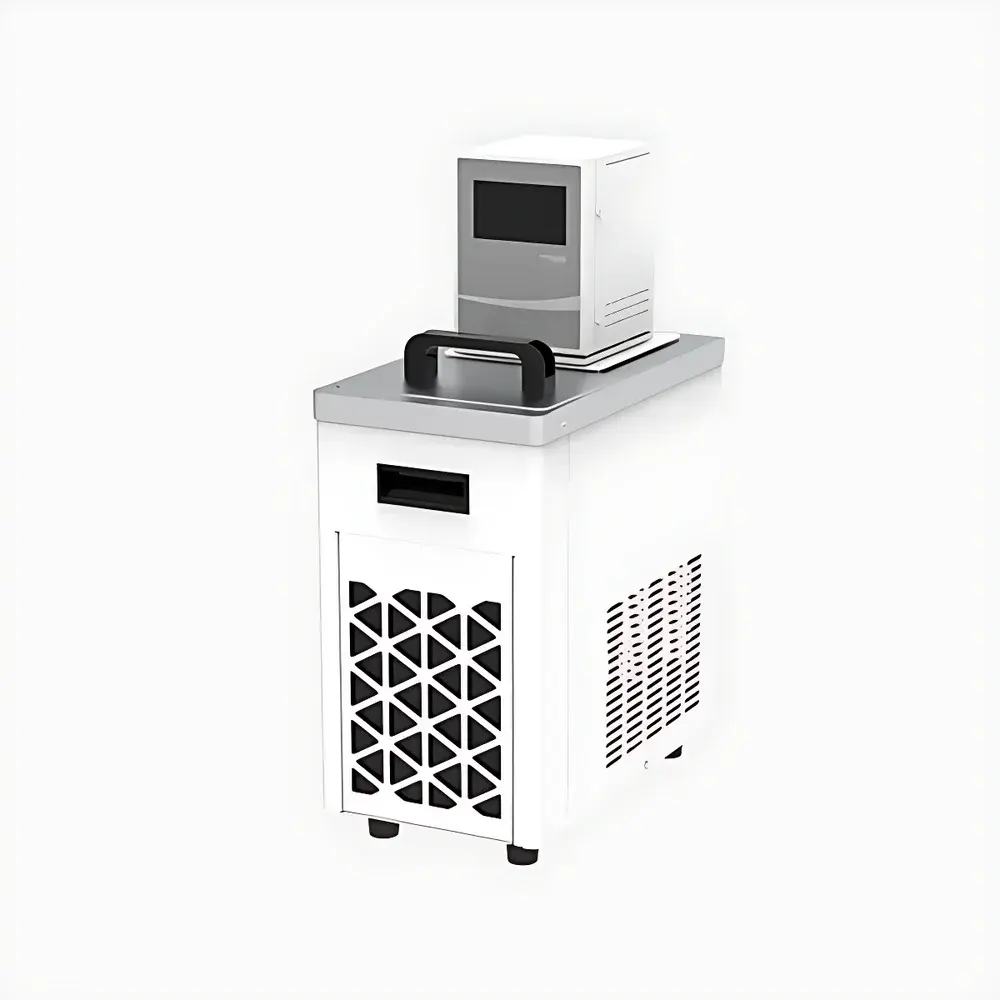
Titan HLC-0820S High-Low Temperature Circulating Bath
| Brand | Titan |
|---|---|
| Origin | Shanghai, China |
| Manufacturer Type | Direct Manufacturer |
| Product Category | Domestic |
| Model | HLC-0820S |
| Instrument Type | Integrated Unit |
| Cooling Method | Water-Cooled |
| Temperature Range | −20 °C to +200 °C |
| Cooling Capacity | 400 W (Heating Capacity: 2000 W) |
| Temperature Stability | ±0.03 °C |
| Circulation Pump Pressure | 0.3 bar (discharge) / 0.2 bar (suction) |
| Flow Rate | 22 L/min |
| Reservoir Volume | 8 L |
| Operation Mode | Continuous |
Overview
The Titan HLC-0820S is an integrated high-low temperature circulating bath engineered for precision thermal control in demanding laboratory and industrial applications. It operates on a closed-loop thermoregulation principle, combining Peltier-assisted or compressor-based refrigeration with high-power resistive heating to achieve seamless, bidirectional temperature control across a broad operational span—from cryogenic cooling at −20 °C to high-temperature stabilization at +200 °C. Unlike modular chiller–heater systems, the HLC-0820S integrates all thermal management subsystems—including refrigeration circuit, heating elements, circulation pump, PID-controlled thermostat, and insulated reservoir—into a single compact footprint. This architecture minimizes thermal lag, enhances system responsiveness, and ensures consistent fluid delivery to external devices such as spectrophotometer jackets, reaction calorimeters, material testing chambers, or vacuum oven manifolds. Its design prioritizes long-term stability over transient performance, making it suitable for applications requiring sustained thermal uniformity under variable load conditions.
Key Features
- Wide operational temperature range (−20 °C to +200 °C) enabled by dual-mode thermal regulation—refrigeration for sub-ambient control and high-wattage resistive heating for rapid ramp-up and precise high-temperature maintenance.
- High-precision temperature stability of ±0.03 °C (at setpoint, under static load), achieved via multi-stage PID tuning, platinum RTD sensing (Class A tolerance), and active compensation for ambient drift and heat exchange losses.
- Integrated water-cooled refrigeration system optimized for continuous-duty operation; eliminates reliance on ambient air cooling and improves thermal efficiency in confined or climate-controlled lab spaces.
- Robust circulation system delivering up to 22 L/min at 0.3 bar discharge pressure and 0.2 bar suction head—compatible with standard 1/2″–3/4″ tubing and capable of driving coolant through moderate-pressure external loops (e.g., jacketed reactors or inline viscometers).
- 8-liter stainless-steel reservoir with level sensor, overflow protection, and corrosion-resistant internal coating—designed for compatibility with water, water–glycol mixtures (up to 50% v/v), and low-conductivity heat transfer fluids.
- Continuous-duty rated electronics and thermal components, validated for unattended 24/7 operation in GLP-compliant environments when paired with appropriate monitoring protocols.
Sample Compatibility & Compliance
The HLC-0820S supports indirect thermal conditioning of diverse sample interfaces—including immersion probes, jacketed vessels, cold fingers, and external heat exchangers—without direct contact between the circulating fluid and the sample. Fluid compatibility extends to aqueous solutions, ethylene glycol/water blends, and synthetic silicone oils (viscosity ≤ 50 cSt), subject to user verification of chemical resistance. The unit complies with IEC 61010-1:2010 for electrical safety in laboratory equipment and meets CE marking requirements for electromagnetic compatibility (EMC Directive 2014/30/EU). While not intrinsically rated for hazardous locations, its sealed reservoir and grounded chassis support safe integration into ISO 17025-accredited testing laboratories. Optional data logging modules enable audit-ready temperature traceability aligned with FDA 21 CFR Part 11 principles when deployed in regulated QC workflows.
Software & Data Management
The HLC-0820S features an embedded microcontroller with local LCD interface for real-time setpoint adjustment, status monitoring (temperature, flow, fault codes), and manual override. For advanced integration, optional RS485 (Modbus RTU) or Ethernet (TCP/IP) communication enables remote parameter control and telemetry streaming to LIMS or SCADA platforms. Third-party software drivers are available for LabVIEW, MATLAB, and Python (via PySerial or pymodbus), supporting automated temperature ramping, hold sequences, and synchronized data acquisition with analytical instruments. All logged temperature profiles include timestamped metadata and can be exported in CSV or XML format for post-processing and regulatory documentation.
Applications
- Calibration of temperature-sensitive sensors (e.g., thermocouples, RTDs, infrared pyrometers) across extended ranges per ASTM E230/E230M.
- Thermal conditioning of optical components during spectroscopic measurements to mitigate thermal lensing and wavelength drift.
- Controlled-rate heating/cooling in polymer rheology studies, where bath stability directly influences melt viscosity reproducibility (ISO 11443, ISO 6721).
- Stabilization of laser diodes, CCD detectors, and interferometric stages requiring sub-0.1 °C thermal uniformity.
- Support of accelerated aging tests (e.g., IPC-TM-650 2.6.25) and thermal cycling protocols in materials reliability labs.
FAQ
What fluids are compatible with the HLC-0820S reservoir?
Deionized water, 20–50% ethylene glycol/water mixtures, and low-viscosity silicone oils (≤50 cSt) are verified for use. Avoid halogenated solvents, strong acids/bases, or fluids with vapor pressure >10 kPa at 200 °C.
Can the unit maintain ±0.03 °C stability while supplying external flow?
Yes—stability specification is validated under dynamic load conditions with 15–22 L/min flow through a 3-meter, 1/2″ ID external loop at ambient lab temperature (22 ±2 °C).
Is remote monitoring supported out of the box?
Standard configuration includes local display only; RS485 or Ethernet connectivity requires optional communication module installation and firmware update.
Does the system meet GMP/GLP documentation requirements?
The base unit provides real-time digital readouts and alarm logging. Full 21 CFR Part 11 compliance requires integration with validated third-party data acquisition software and procedural controls for electronic signatures and audit trails.
What maintenance intervals are recommended for continuous operation?
Reservoir fluid replacement every 6 months (or per fluid manufacturer guidelines), annual inspection of pump seals and refrigerant charge, and biannual calibration of the primary RTD sensor using NIST-traceable reference standards.



