
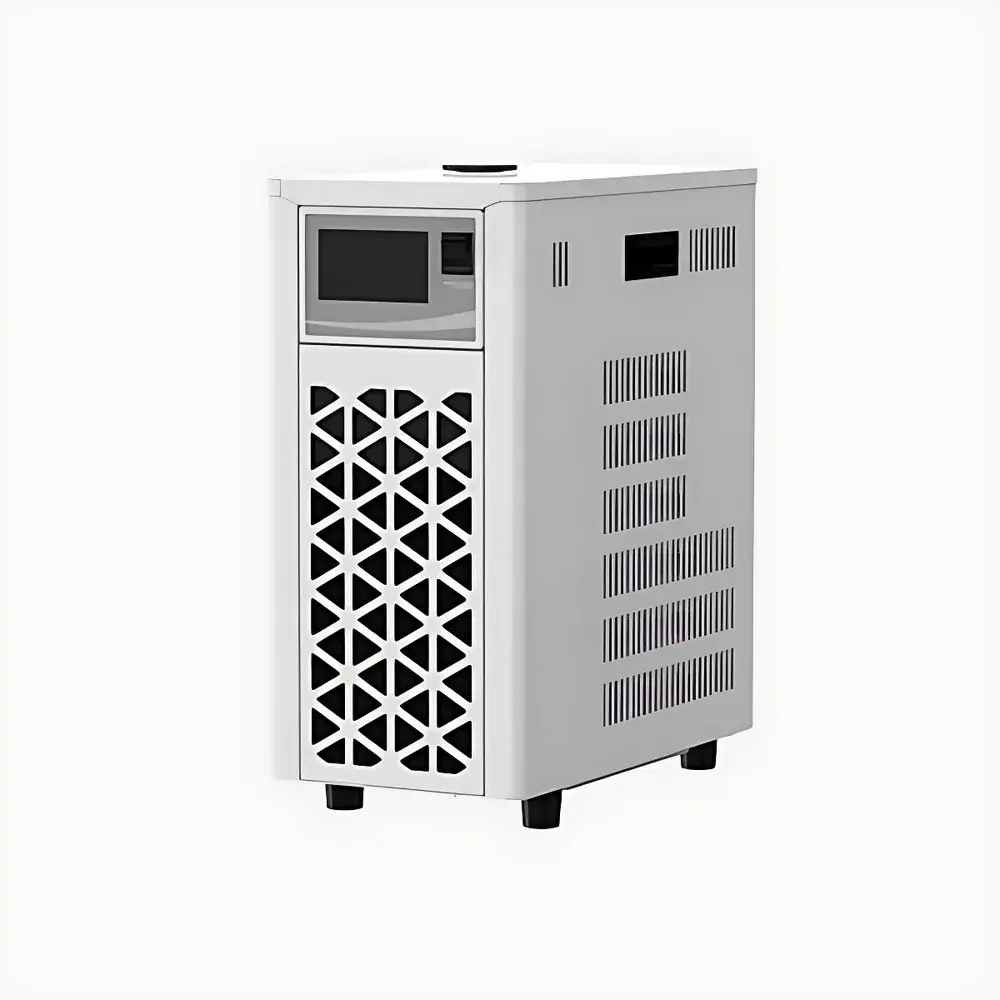
Titan HLT-0520 Integrated High-Low Temperature Circulating Chiller
| Brand | Titan |
|---|---|
| Origin | Shanghai, China |
| Manufacturer Type | Direct Manufacturer |
| Product Category | Domestic |
| Model | HLT-0520 |
| Instrument Type | Integrated Unit |
| Cooling Method | Water-Cooled |
| Temperature Range | −20 °C to +100 °C |
| Cooling Capacity | 700 W (Heating Capacity: 1500 W) |
| Temperature Stability | ±0.05 °C |
| Circulation Pump Pressure | 0.3 bar (discharge) / 0.2 bar (suction) |
| Flow Rate | 22 L/min |
| Reservoir Volume | 4.5 L |
| Operation Mode | Continuous Duty |
Overview
The Titan HLT-0520 is an integrated high-low temperature circulating chiller engineered for precision thermal control in demanding laboratory and analytical applications. Utilizing a dual-mode refrigeration-heating system based on vapor-compression thermodynamics with PID-controlled electric heating elements, it maintains stable bath temperatures across a wide operational range—from cryogenic −20 °C to elevated +100 °C—without requiring external heat exchangers or auxiliary chillers. Its compact, self-contained architecture eliminates the need for separate coolant reservoirs or external condenser water lines beyond standard facility tap water supply for the water-cooled condenser. Designed for continuous-duty operation under load, the unit delivers consistent thermal output with minimal drift, making it suitable for coupling with rotary evaporators, spectrophotometers, calorimeters, laser systems, and other temperature-sensitive instrumentation where thermal inertia and setpoint fidelity are critical.
Key Features
- Integrated dual-function design: simultaneous cooling and heating within a single chassis, eliminating the need for separate heating baths or external chillers.
- High-precision temperature regulation with ±0.05 °C stability over the full −20 °C to +100 °C range, achieved via multi-stage PID feedback control and platinum RTD (Pt100) sensing at both reservoir and outlet points.
- Water-cooled condenser system optimized for ambient environments up to 35 °C, reducing dependency on ambient air quality and enabling stable performance in enclosed or HVAC-limited lab spaces.
- Robust circulation pump delivering 22 L/min flow at 0.3 bar discharge pressure and 0.2 bar suction capability—sufficient to overcome typical backpressure from jacketed reactors, condenser coils, and inline heat exchangers.
- 4.5-liter stainless steel reservoir with level sensor, overflow protection, and corrosion-resistant internal wetted surfaces compatible with aqueous and glycol-water mixtures (up to 30% ethylene glycol).
- Continuous-duty rated compressor and heating elements, validated for 24/7 operation under nominal thermal load without duty cycling or thermal shutdown.
Sample Compatibility & Compliance
The HLT-0520 is designed for closed-loop circulation of heat-transfer fluids—not direct sample contact—and therefore interfaces exclusively with externally jacketed equipment. It supports standard laboratory coolants including deionized water, 20–30% aqueous ethylene glycol solutions, and low-conductivity silicone oils (viscosity < 50 cSt). All fluid pathways comply with ISO 8573-1:2010 Class 4 for particulate cleanliness and meet UL 61010-1 safety requirements for laboratory electrical equipment. The unit’s temperature control firmware adheres to GLP principles: all setpoints, actual temperatures, and operational timestamps are internally logged with audit-trail capability (optional USB data export). While not FDA 21 CFR Part 11 certified out-of-the-box, its deterministic control logic and non-volatile event logging support validation protocols required under GMP and ISO/IEC 17025 environments.
Software & Data Management
The HLT-0520 operates via an embedded microcontroller with a high-contrast LCD interface supporting real-time display of setpoint, actual bath temperature, outlet temperature, pump status, and error codes. Optional RS485 Modbus RTU communication enables integration into centralized lab monitoring systems (e.g., LabVantage, Siemens Desigo, or custom SCADA). Logged temperature history (1-second resolution, 30-day buffer) is exportable via USB flash drive in CSV format. No proprietary software installation is required; raw data files are natively readable in Excel, Python (pandas), or MATLAB. Firmware updates are performed offline via USB—no cloud connectivity or internet dependency is involved, ensuring data sovereignty and network security compliance.
Applications
- Temperature stabilization of rotary evaporator condensers and receiving flasks during solvent removal under reduced pressure.
- Thermal conditioning of UV-Vis, FTIR, and fluorescence spectrophotometer optical benches and detector housings.
- Cooling of high-power LED light sources and diode lasers in imaging and spectroscopy setups.
- Controlled-temperature jacketing for benchtop bioreactors, calorimetry cells, and rheometer temperature blocks.
- Pre-conditioning of samples and standards prior to chromatographic injection or mechanical testing per ASTM E145 or ISO 291.
FAQ
What is the maximum allowable coolant viscosity for reliable pump operation?
The integrated centrifugal pump is rated for fluids with kinematic viscosity up to 50 cSt at operating temperature. For glycol-water mixtures, concentrations exceeding 30% by volume are not recommended due to increased viscosity and reduced heat transfer efficiency.
Can the unit maintain −20 °C while delivering 22 L/min flow?
Yes—full flow rate is sustained across the entire temperature range. However, cooling capacity decreases gradually below 0 °C; at −20 °C, usable cooling power is approximately 450 W (derated per ISO 5149 test conditions).
Is remote monitoring supported via Ethernet or Wi-Fi?
No. Communication is limited to RS485 Modbus RTU (wired only) and USB host mode for data export. Network interfaces are intentionally omitted to meet electromagnetic compatibility (EMC) requirements in sensitive instrumentation labs.
Does the reservoir include level and dry-run protection?
Yes. A capacitive level sensor triggers automatic pump shutoff and visual/audible alarm if fluid falls below 20% capacity. Dry-run protection is hardware-locked and independent of controller firmware.
What maintenance intervals are recommended for long-term reliability?
Condenser cleaning every 6 months (depending on water hardness), annual inspection of refrigerant charge integrity, and biannual verification of RTD calibration traceability to NIST standards using external reference thermometers.



