
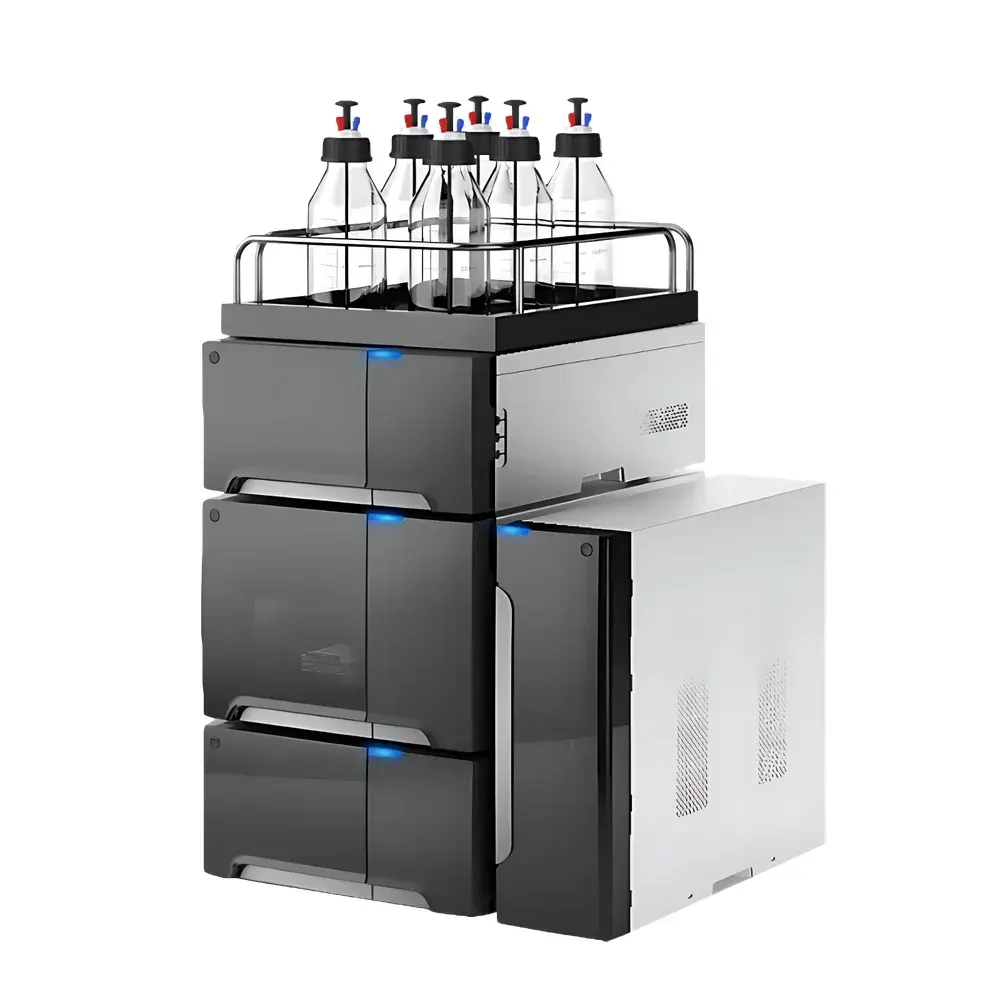
Titan Instruments LC-8000 Ultra-High Performance Liquid Chromatograph (UHPLC)
| Brand | Titan Instruments |
|---|---|
| Origin | Beijing, China |
| Manufacturer Type | Direct Manufacturer |
| Instrument Type | Ultra-High Performance Liquid Chromatograph (UHPLC) |
| Model | LC-8000 |
| Flow Rate Range | 0.01–10.000 mL/min (0.001 mL/min increment) |
| Maximum Operating Pressure | 10,500 PSI (72 MPa) at 0–2 mL/min |
| Flow Accuracy | ≤0.06% RSD |
| Autosampler Capacity | ≥108 positions (1.5 mL vials) |
| Injection Volume Range | 20–100 µL |
| Column Oven Temperature Range | Ambient +5 °C to 85 °C |
| UV-Vis Detector Wavelength Range | 190–900 nm |
| Data Acquisition Rate | 100 Hz |
Overview
The Titan Instruments LC-8000 Ultra-High Performance Liquid Chromatograph (UHPLC) is a fully integrated, modular chromatographic platform engineered for precision, robustness, and regulatory compliance in demanding analytical laboratories. Based on high-pressure liquid chromatography (HPLC) principles—specifically optimized for sub-2-µm particle-packed columns—the LC-8000 delivers enhanced resolution, reduced analysis time, and improved sensitivity compared to conventional HPLC systems. Its hydraulic architecture supports sustained operation up to 72 MPa (10,500 PSI), enabling rapid gradient elution, narrow peak widths, and superior peak capacity across complex matrices. Designed for routine and method-development workflows, the system meets the technical and operational requirements of modern QC/QA labs, contract research organizations (CROs), and pharmaceutical development facilities operating under GLP, GMP, and FDA 21 CFR Part 11 frameworks.
Key Features
- High-pressure binary solvent delivery system with pressure capability up to 72 MPa (10,500 PSI), compatible with 1.7–2.0 µm particle size columns for maximum efficiency and speed.
- Low-pressure pulsation design (<10 psi) achieved via advanced pulse-dampening technology (PPRC-equivalent architecture), ensuring baseline stability and reproducible retention times over extended runs.
- Large-capacity column oven accommodating up to six 250 mm columns simultaneously, supporting multi-method scheduling and automated column switching without manual intervention.
- Forced-air circulation with dual-sensor PID temperature control maintains thermal uniformity ±0.1 °C across the entire column compartment (ambient +5 °C to 85 °C).
- Autosampler featuring dual-needle wash architecture—separate inner- and outer-needle rinsing stations with programmable solvent selection—to minimize carryover and cross-contamination below 0.005% (measured with caffeine standard).
- UV-Vis photodiode array detector with full spectral acquisition from 190 nm to 900 nm and real-time data sampling at 100 Hz, enabling high-fidelity peak tracking and spectral deconvolution in fast-eluting peaks.
- Integrated system controller with embedded Linux-based firmware, supporting remote diagnostics, event logging, and audit-trail-enabled method execution.
Sample Compatibility & Compliance
The LC-8000 is validated for use with aqueous, organic, and mixed mobile phases—including acetonitrile, methanol, water, ammonium acetate, and formic acid buffers—across pH 1.5–11.0. It accommodates standard 4.6 × 150 mm, 3.0 × 100 mm, and microbore column formats, as well as UHPLC-specific 2.1 × 50 mm and 1.0 × 100 mm configurations. The system conforms to key international regulatory expectations: data integrity controls align with FDA 21 CFR Part 11 (electronic signatures, audit trails, user access levels); hardware and software validation documentation supports IQ/OQ/PQ protocols; and operational parameters meet ISO/IEC 17025 traceability requirements when paired with NIST-traceable reference standards. Method transfer compatibility has been verified against USP , EP 2.2.46, and ICH Q2(R2) guidelines.
Software & Data Management
Titan ChromoLink™ 3.2 software provides unified control of all LC-8000 modules—including pump, autosampler, column oven, and detector—via a role-based GUI compliant with ALCOA+ principles. Raw data files are stored in vendor-neutral .cdf format (netCDF 4.0), readable by third-party processing tools (e.g., OpenChrom, Chromeleon). Built-in features include sequence scheduling with conditional logic, real-time chromatogram overlay, peak purity assessment using spectral correlation, and automated calibration curve generation with weighting options (1/x, 1/x²). All electronic records retain immutable timestamps, operator IDs, instrument state logs, and version-controlled method parameters—fully auditable during internal or regulatory inspections.
Applications
The LC-8000 serves as a primary analytical tool across regulated and research-driven domains. In food safety testing, it quantifies synthetic sweeteners (acesulfame-K, sucralose), preservatives (sorbic acid, benzoic acid), mycotoxins (aflatoxin B1, ochratoxin A), and pesticide residues per GB 5009 and GB 23200 series standards. For environmental analysis, it resolves PAHs, organochlorine pesticides, and neonicotinoids in soil and water extracts per GB 5750 and EPA Method 8330B equivalents. In pharmaceutical QC, it performs assay and related substances testing for antibiotics (ciprofloxacin, amoxicillin), CNS agents (diazepam, lorazepam), and biologics-derived small molecules in accordance with ChP monographs. Additional applications span clinical metabolomics (amino acid profiling), polymer additive screening, and fragrance component identification in cosmetic formulations.
FAQ
Does the LC-8000 support method transfer from legacy HPLC systems?
Yes—gradient dwell volume compensation, adjustable dwell delay settings, and column dimension normalization tools facilitate seamless translation of methods from 5 µm or 3 µm column-based platforms.
Is the autosampler compatible with 2 mL vials and 96-well plates?
The standard configuration supports 1.5 mL screw-thread vials; optional adapters enable 2 mL vials and ANSI/SLAS-compliant 96-well microplates.
Can the system be integrated into a LIMS environment?
Yes—via ASTM E1578-compliant API and configurable HL7/SOAP interfaces for bidirectional sample queue synchronization and result reporting.
What validation documentation is provided with the instrument?
Factory-issued IQ/OQ protocols, electronic signature validation report, and 21 CFR Part 11 configuration checklist are included in the delivery package.
Is preventive maintenance covered under warranty?
The standard 24-month parts-and-labor warranty includes one scheduled PM visit; extended service plans with quarterly calibration and performance verification are available.





