
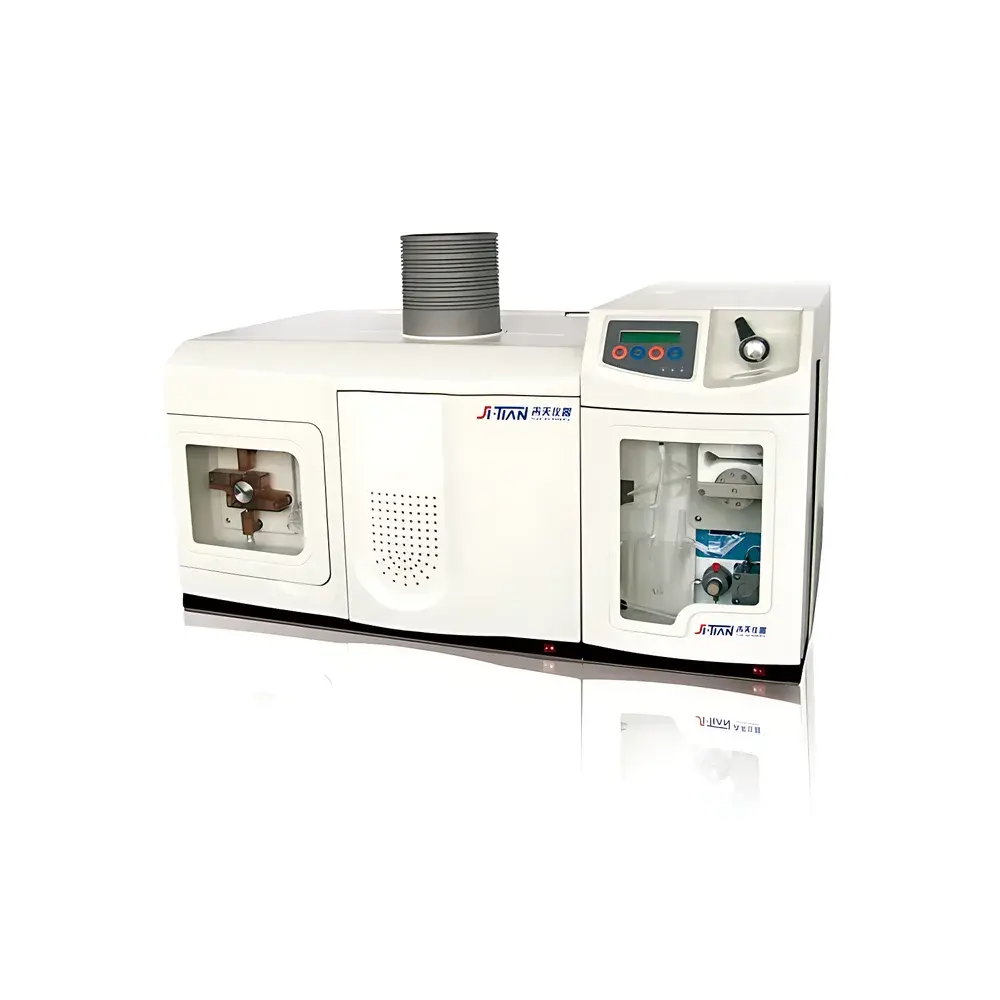
Titan Instruments SA-20 Liquid Chromatography–Atomic Fluorescence Spectrometry (LC-AFS) System
| Brand | Titan Instruments |
|---|---|
| Origin | Beijing, China |
| Manufacturer Type | Direct Manufacturer |
| Instrument Type | Hyphenated LC-AFS System for Elemental Speciation |
| Sample Introduction | Dual Sequential Injection Pumps |
| Waste Disposal | Peristaltic Pump Extraction |
| Hydride Generation Mode | Vapor Generation / Hydride Generation |
| Gas Flow Control | Mass Flow Controller (MFC) |
| Speciated Elements | As(III), As(V), MMA(V), DMA(V), AsB, AsC, p-ASA, Roxarsone |
| RSD | <5% |
| Linear Dynamic Range | >3 orders of magnitude |
| Detection Limits | As(III) ≤0.04 µg/L, DMA ≤0.08 µg/L, MMA ≤0.08 µg/L, As(V) ≤0.2 µg/L, SeCys ≤0.3 µg/L, SeMeCys ≤1 µg/L, Se(IV) ≤0.3 µg/L, SeMet ≤2 µg/L |
| PMT Wavelength Range | 160–320 nm |
| Atomizer Temperature Control Range | Ambient to 1000 °C (programmable) |
Overview
The Titan Instruments SA-20 Liquid Chromatography–Atomic Fluorescence Spectrometry (LC-AFS) System is a purpose-built hyphenated analytical platform engineered for high-sensitivity, quantitative speciation analysis of hydride-forming elements in complex biological, environmental, and food matrices. Unlike conventional total-element atomic fluorescence spectrometers, the SA-20 integrates reversed-phase or ion-exchange liquid chromatography with post-column hydride generation and atomic fluorescence detection—enabling separation, identification, and quantification of individual chemical species based on their molecular structure and redox state. This architecture leverages the exceptional selectivity of chromatographic retention and the sub-ppt sensitivity of atomic fluorescence detection, delivering robust performance for regulatory-compliant speciation workflows. The system operates on the principle of species-specific hydride generation under controlled acidic/reducing conditions, followed by atomization in a quartz tube furnace and measurement of element-specific atomic fluorescence at characteristic wavelengths (160–320 nm). Its design prioritizes reproducibility, low carryover, and minimal post-column band broadening—critical for resolving co-eluting species such as As(III)/DMA or MeHg/PhHg.
Key Features
- In-tube UV photolysis module: Integrated post-column UV digestion eliminates the need for chemical oxidants (e.g., KBrO3 or KMnO4), reducing reagent blank interference and enabling direct analysis of thermally labile or oxidation-sensitive species—including AsB, AsC, SeCys, and SeMeCys—without degradation.
- Dual sequential injection pumping: Provides precise, pulse-free delivery of mobile phase, derivatization reagents, and standards—ensuring stable baseline, high retention time reproducibility (<0.2% RSD), and compatibility with gradient elution protocols.
- Optimized gas–liquid separation (GLS): A proprietary membrane-based GLS unit achieves >95% water vapor removal prior to atomization, significantly lowering background noise and improving signal-to-noise ratio—performance comparable to Nafion™ tubing but with enhanced mechanical durability and reduced maintenance frequency.
- Programmable quartz tube atomizer: Temperature-controlled atomization (ambient to 1000 °C) allows optimization of atomization efficiency across diverse species (e.g., lower temperatures for volatile organometallics like MeHg; higher for refractory forms like SeMet).
- Mass flow controller (MFC)-regulated gas delivery: Ensures stoichiometric and repeatable hydrogen/argon mixing for hydride formation, critical for method transferability and inter-laboratory comparability.
Sample Compatibility & Compliance
The SA-20 is validated for use with aqueous extracts from foodstuffs (e.g., rice, seafood, feed), biological fluids (urine, serum), soil leachates, and wastewater. It supports both anion- and cation-exchange chromatography for simultaneous separation of As, Se, Hg, and Sb species under ISO/IEC 17025-aligned operating conditions. The system meets key regulatory requirements including GB 5009.11–2014 (inorganic arsenic in food), GB 5009.17–2014 (organic mercury in food), and is compatible with method development for EPA Method 1638 (mercury speciation) and ASTM D7624 (arsenic speciation in coal ash). Data integrity features—including electronic audit trails, user-access controls, and secure raw-data archiving—support compliance with FDA 21 CFR Part 11 and GLP/GMP documentation standards when deployed with optional compliant software modules.
Software & Data Management
The SA-20 is operated via TitanSpec™ Speciation Workstation—a dedicated, Windows-based application designed for multi-dimensional LC-AFS data acquisition and processing. It supports real-time chromatogram acquisition synchronized with pump actuation and detector triggering, automatic peak integration using second-derivative algorithms, species identification via retention time matching against certified reference materials (CRMs), and calibration curve generation using weighted linear regression (1/x or 1/x²). Reports are exportable in PDF, CSV, and XML formats, with customizable templates aligned to ISO/IEC 17025 reporting clauses. The software architecture permits seamless integration with LIMS environments via ODBC and supports instrument qualification documentation (IQ/OQ/PQ) packages for regulated laboratories.
Applications
The SA-20 delivers actionable speciation data across multiple domains: monitoring inorganic vs. organic arsenic in rice and infant cereals per EU Commission Regulation (EU) No 2023/915; quantifying methylmercury bioaccumulation in fish tissue for FDA/EPA risk assessment; profiling selenium species (SeCys, SeMet, Se(IV)) in dietary supplements to verify label claims; evaluating stability of organoarsenicals (p-ASA, Roxarsone) during feed processing; and assessing redox transformations of antimony species in contaminated groundwater remediation studies. Its ability to resolve structurally similar species with high resolution and low detection limits makes it indispensable for toxicological research, regulatory enforcement, and quality control in nutraceutical and agrochemical manufacturing.
FAQ
What sample preparation methods are recommended prior to LC-AFS analysis on the SA-20?
Solid samples should undergo enzymatic (e.g., protease XIV) or mild acid extraction (0.1–1.0 M HNO₃, 60 °C, 30 min), followed by centrifugation, filtration (0.22 µm nylon), and pH adjustment to match the mobile phase. Extracts must be analyzed within 24 h or stored at –80 °C.
Can the SA-20 quantify thiol-bound metal species such as As(GS)₃ or Hg–cysteine complexes?
No—the SA-20 is optimized for stable, extractable hydride-forming species. Thiol-bound or protein-conjugated forms require prior selective cleavage (e.g., UV/H₂O₂ digestion) or orthogonal techniques like HPLC-ICP-MS.
Is method validation support available for regulatory submissions?
Yes—Titan Instruments provides application notes, CRM correlation data, and validation templates aligned with ICH Q2(R2) and AOAC guidelines for linearity, accuracy, precision, LOD/LOQ, and robustness testing.
What maintenance intervals are recommended for the UV digestion lamp and quartz atomizer?
UV lamp output should be verified monthly; replacement is advised every 1,000 h of operation. Quartz atomizers require cleaning with 10% HNO₃ after every 50 injections and visual inspection for carbon deposition every 200 runs.
Does the system support automated standard addition for complex matrices?
Yes—the dual injection pump architecture enables programmable standard addition loops, allowing matrix-matched calibration directly in sample extracts without dilution or pre-spiking.






