
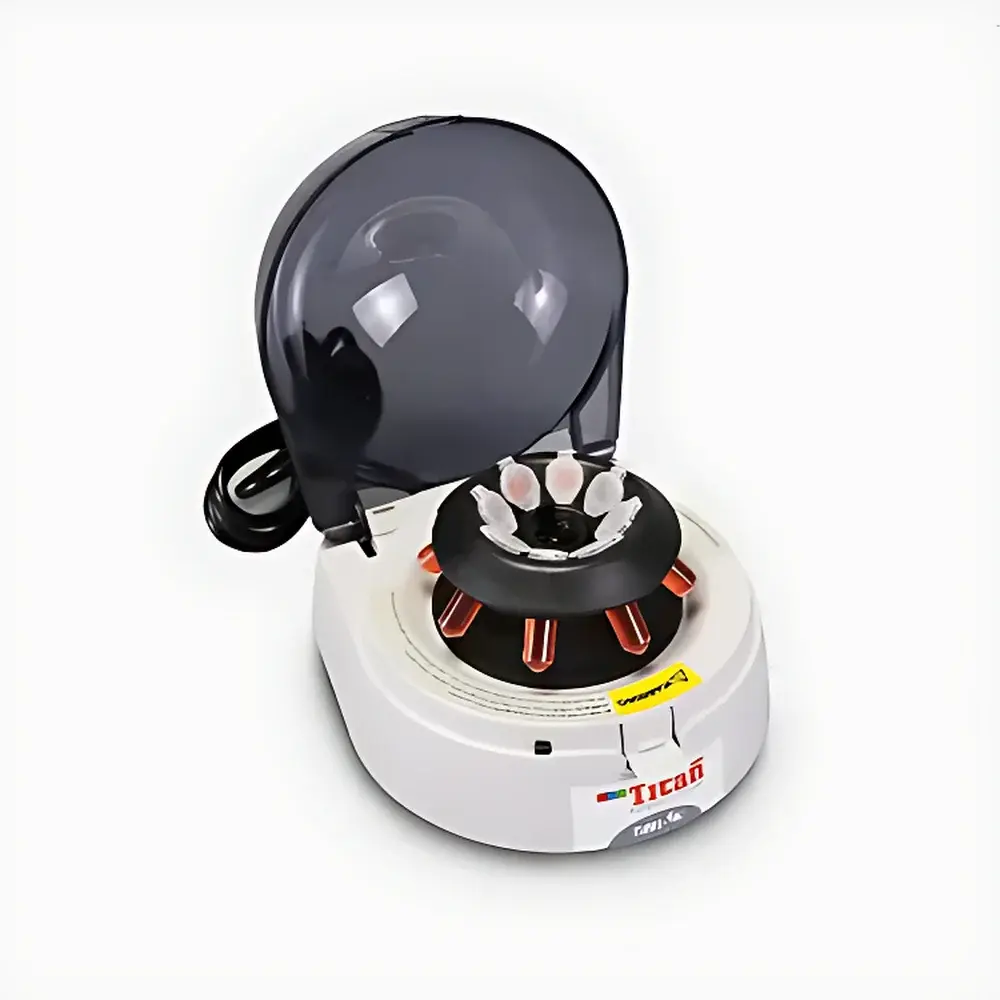
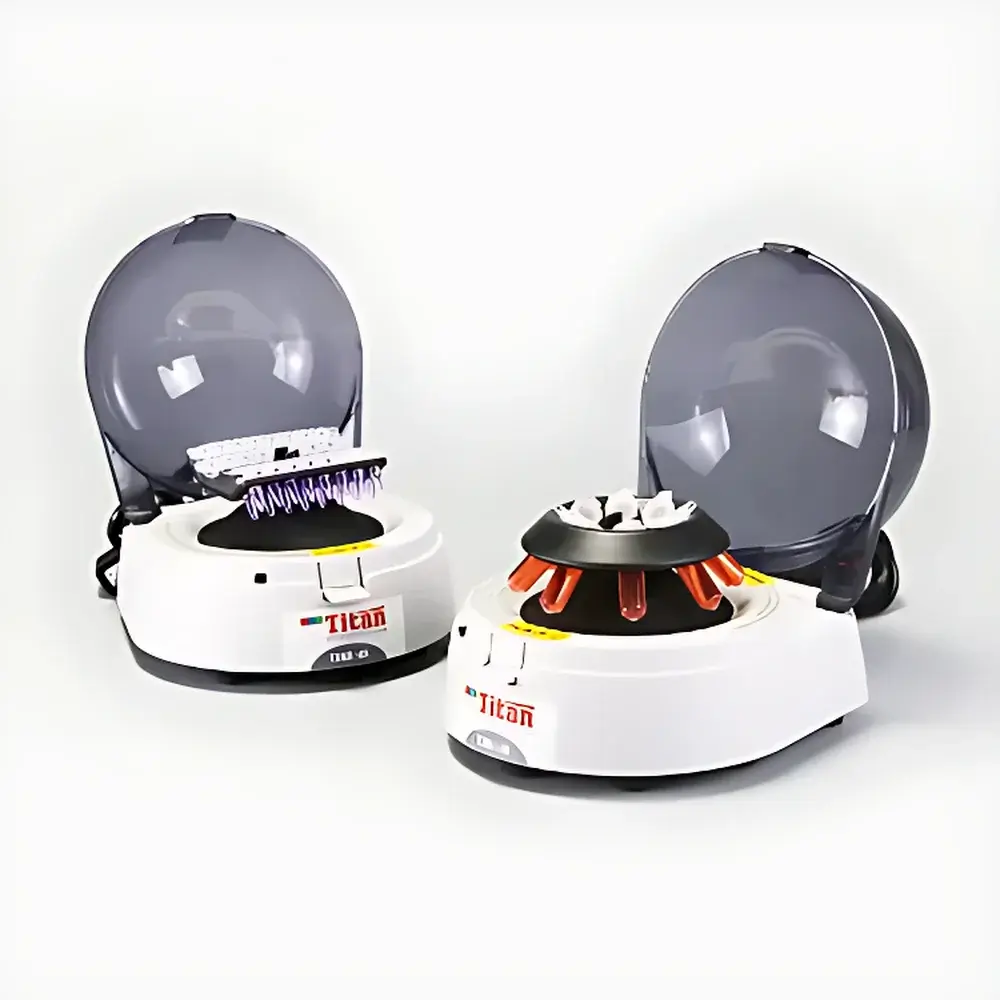
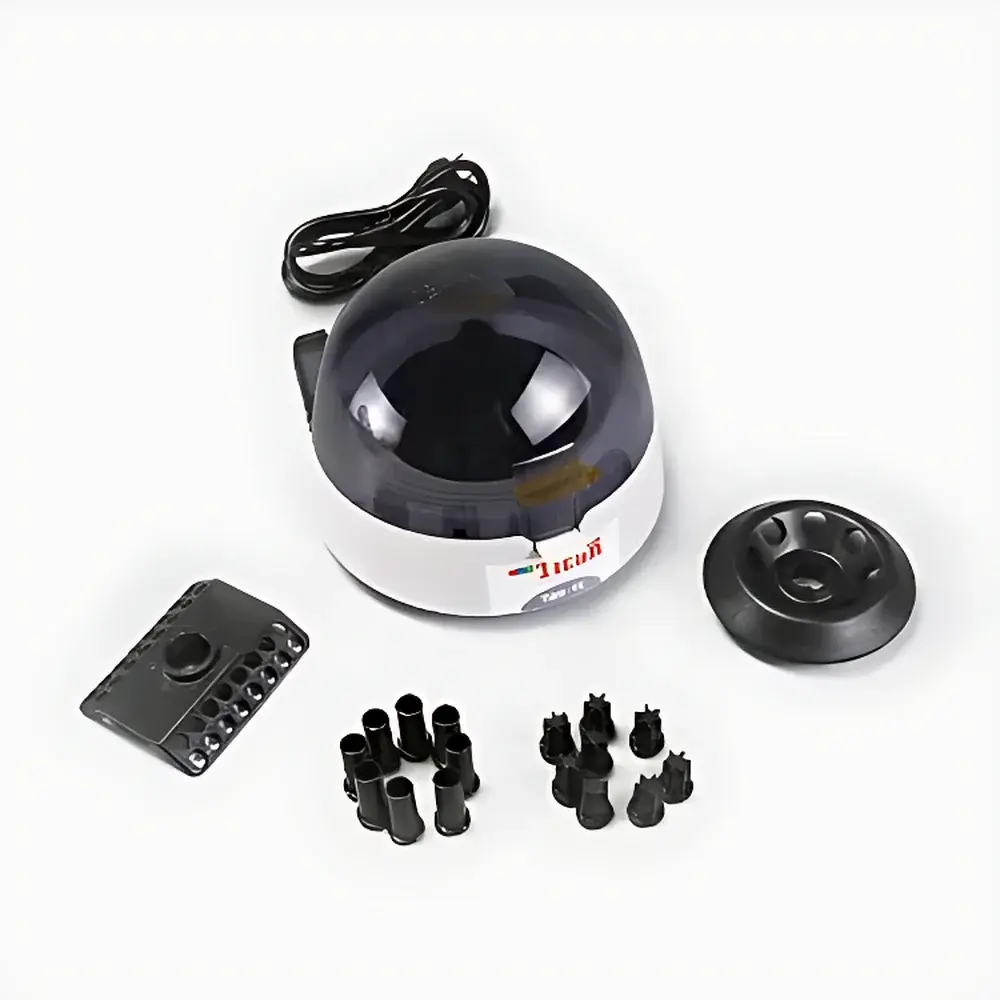
Titan TIMI-4K Mini Benchtop Centrifuge
| Brand | Titan |
|---|---|
| Origin | Shanghai, China |
| Manufacturer Type | Direct Manufacturer |
| Product Category | Domestic |
| Model | TIMI-4K |
| Instrument Type | Palm-Sized Centrifuge |
| Speed Range | Up to 4,000 rpm |
| Maximum RCF | 990 × g |
| Maximum Capacity | 16 mL (4 × 4 mL tubes or 8 × 1.5/2.0 mL tubes) |
| Dimensions | 155 × 168 × 118 mm (W × D × H) |
| Rotor Configuration | Fixed-angle rotor (standard) |
| Speed Control | Single-speed (fixed at 4,000 rpm) |
| Power Supply | AC 100–240 V, 50/60 Hz |
| Safety Certification | CE-compliant design, lid interlock mechanism |
Overview
The Titan TIMI-4K Mini Benchtop Centrifuge is an engineered solution for rapid, low-force sample sedimentation in space-constrained laboratory environments. Designed around a brushless DC motor and fixed-angle rotor architecture, it operates on the principle of radial acceleration to separate suspended particles—such as cells, precipitates, or aggregated biomolecules—from liquid phases via differential sedimentation velocity. Unlike high-speed or refrigerated centrifuges, the TIMI-4K is optimized for routine micro-volume processing where moderate g-force (≤990 × g) and operational simplicity are prioritized over ultracentrifugal resolution. Its compact footprint and palm-sized form factor make it suitable for biosafety cabinets, laminar flow hoods, QC benches, and field-deployable diagnostic stations. The device complies with IEC 61010-1 safety standards for laboratory electrical equipment and integrates mechanical lid interlock to prevent operation when open.
Key Features
- Compact footprint (155 × 168 × 118 mm) enables placement in tight workspaces without compromising accessibility.
- Brushless DC motor ensures consistent rotational stability, minimal heat generation, and extended service life under repeated daily use.
- Fixed-angle rotor accommodates up to eight 1.5 mL or 2.0 mL microcentrifuge tubes—or four 4 mL tubes—supporting common microvolume workflows in molecular biology and clinical chemistry.
- Single-speed operation at 4,000 rpm delivers reproducible 990 × g force, eliminating speed-selection complexity while maintaining alignment with CLSI EP05-A3 and ISO 15197 pre-analytical requirements for specimen preparation.
- Integrated lid interlock prevents rotor rotation unless fully latched, satisfying basic mechanical safety provisions per EN 61010-2-020.
- Low-noise operation (<55 dB(A) at 1 m) supports shared lab environments without acoustic disruption.
- AC universal input (100–240 V, 50/60 Hz) eliminates need for voltage converters during international deployment.
Sample Compatibility & Compliance
The TIMI-4K accepts standard polypropylene and polycarbonate microcentrifuge tubes (1.5 mL and 2.0 mL) as well as conical 4 mL tubes conforming to ISO 8536-5 specifications. It is not rated for use with hazardous, volatile, or corrosive solvents; tube compatibility must be verified against manufacturer-recommended chemical resistance charts. While not certified for GLP/GMP production environments, its construction and performance meet baseline requirements for non-regulated research, teaching labs, and point-of-care sample prep. No refrigeration or vacuum sealing is provided; users requiring temperature-sensitive separations must implement external thermal management strategies. Device documentation includes CE Declaration of Conformity and RoHS 2 compliance statements.
Software & Data Management
The TIMI-4K operates as a standalone instrument with no embedded microprocessor, display interface, or digital control logic. Consequently, it does not generate electronic audit trails, store run logs, or support connectivity protocols (e.g., USB, RS-232, or Ethernet). All operational parameters—including runtime—are manually controlled via mechanical switch activation. This analog architecture aligns with laboratories seeking FDS (Fail-Dead-Safe) operation, avoiding firmware vulnerabilities and eliminating validation overhead associated with 21 CFR Part 11 compliance. For regulated settings requiring traceability, external timers with calibration certificates (e.g., NIST-traceable stopwatches) are recommended for documenting centrifugation duration.
Applications
- Routine pelleting of PCR products, plasmid preps, and column-eluted nucleic acids prior to downstream quantification or storage.
- Clarification of bacterial lysates, cell culture supernatants, and serum samples before ELISA, spectrophotometry, or HPLC injection.
- Microcentrifuge-based phase separation in solvent extraction workflows (e.g., phenol-chloroform isolation).
- Quick spin-down of adhesive reagents (e.g., enzyme mixes, master blends) to eliminate air bubbles prior to pipetting.
- Field-ready sample concentration in mobile diagnostics units operating under ISO 15189 Annex A.4 preanalytical guidelines.
- Undergraduate teaching labs where mechanical reliability and intuitive operation supersede programmable functionality.
FAQ
Is the TIMI-4K suitable for blood sample processing?
Yes, for initial plasma or serum separation from whole blood collected in EDTA or heparin tubes—provided centrifugation time is empirically validated per local SOPs and total g-force exposure remains within 990 × g.
Can I use this centrifuge with 0.5 mL tubes?
No—the rotor geometry is designed exclusively for 1.5 mL, 2.0 mL, and 4 mL tubes. Smaller formats require adapter inserts not supplied with the base configuration.
Does the device include a rotor locking mechanism?
Yes—a positive-action latch secures the rotor cover; operation is physically inhibited until full engagement is confirmed.
What maintenance is required?
Routine cleaning of the rotor chamber with 70% ethanol and visual inspection of rotor threads and lid seal integrity every 100 operating hours.
Is rotor balancing necessary?
Yes—symmetrical tube loading (e.g., paired tubes of equal volume and density) is mandatory to prevent vibration-induced misalignment or bearing wear.



